







Question: In this problem set, you will explore the consequences of including fiscal shocks to an RBC model. The setting is similar to the one you
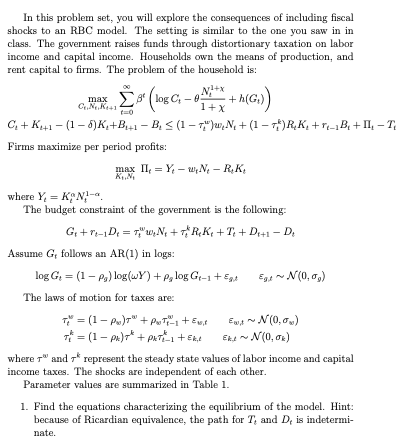
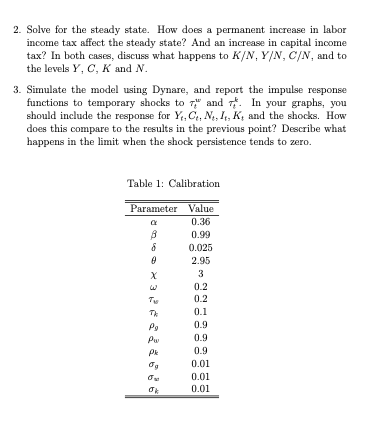
In this problem set, you will explore the consequences of including fiscal shocks to an RBC model. The setting is similar to the one you saw in in class. The government raises funds through distortionary taxation on labor income and capital income. Households own the means of production, and rent capital to firms. The problem of the household is: max " (log C, - + (G) CN,K+1 1 + x C + K+1-(1 )K,+B.+1-B, 3 (1 - 7"). Ni + (1 - TARK+F_B+ II.-T, Firms maximize per period profits: max II, = Y,- N - RK KIN, where Y = KN, The budget constraint of the government is the following: G: +1-1D = 7;">N, +7 RK + T. +De+1-D, Assume G, follows an AR(1) in logs: log G= (1 Ps) log(WY) +p, log G-1 + E! EgeN(0,0) The laws of motion for taxes are: T= (1 - Pup" + PT-1 + Emil EWN(0,0) T = (1 - Purl + PATA+Ekt ERAN(0,0) where " and represent the steady state values of labor income and capital income taxes. The shocks are independent of each other. Parameter values are summarized in Table 1. 1. Find the equations characterizing the equilibrium of the model. Hint: because of Ricardian equivalence, the path for T, and D is indetermi- nate. 2. Solve for the steady state. How does a permanent increase in labor income tax affect the steady state? And an increase in capital income tax? In both cases, discuss what happens to K/N, Y/N, C/N, and to the levels Y, C, K and N. 3. Simulate the model using Dynare, and report the impulse response functions to temporary shocks to 7 and 7 In your graphs, you should include the response for Y, C, N, 1, K, and the shocks. How does this compare to the results in the previous point? Describe what happens in the limit when the shock persistence tends to zero. Table 1: Calibration Parameter Value 0.36 B 0.99 8 0.025 @ 2.95 X 3 0.2 0.2 TA 0.1 Po 0.9 Pw 0.9 pe 0.9 0.01 0.01 0.01 In this problem set, you will explore the consequences of including fiscal shocks to an RBC model. The setting is similar to the one you saw in in class. The government raises funds through distortionary taxation on labor income and capital income. Households own the means of production, and rent capital to firms. The problem of the household is: max " (log C, - + (G) CN,K+1 1 + x C + K+1-(1 )K,+B.+1-B, 3 (1 - 7"). Ni + (1 - TARK+F_B+ II.-T, Firms maximize per period profits: max II, = Y,- N - RK KIN, where Y = KN, The budget constraint of the government is the following: G: +1-1D = 7;">N, +7 RK + T. +De+1-D, Assume G, follows an AR(1) in logs: log G= (1 Ps) log(WY) +p, log G-1 + E! EgeN(0,0) The laws of motion for taxes are: T= (1 - Pup" + PT-1 + Emil EWN(0,0) T = (1 - Purl + PATA+Ekt ERAN(0,0) where " and represent the steady state values of labor income and capital income taxes. The shocks are independent of each other. Parameter values are summarized in Table 1. 1. Find the equations characterizing the equilibrium of the model. Hint: because of Ricardian equivalence, the path for T, and D is indetermi- nate. 2. Solve for the steady state. How does a permanent increase in labor income tax affect the steady state? And an increase in capital income tax? In both cases, discuss what happens to K/N, Y/N, C/N, and to the levels Y, C, K and N. 3. Simulate the model using Dynare, and report the impulse response functions to temporary shocks to 7 and 7 In your graphs, you should include the response for Y, C, N, 1, K, and the shocks. How does this compare to the results in the previous point? Describe what happens in the limit when the shock persistence tends to zero. Table 1: Calibration Parameter Value 0.36 B 0.99 8 0.025 @ 2.95 X 3 0.2 0.2 TA 0.1 Po 0.9 Pw 0.9 pe 0.9 0.01 0.01 0.01
Step by Step Solution
There are 3 Steps involved in it

Get step-by-step solutions from verified subject matter experts
 Study Help