







Question: In this problem, the complex reactions described below will first be carried out in the liquid phase (parts (a) through (d)) and then in the
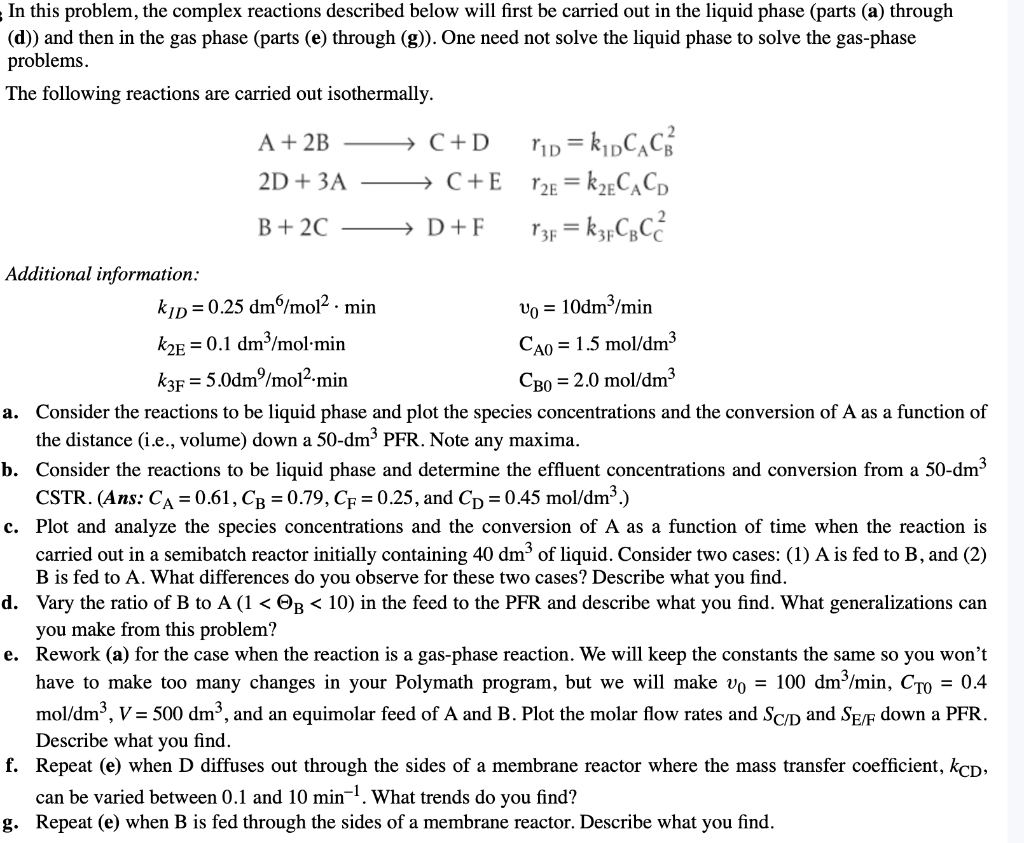
In this problem, the complex reactions described below will first be carried out in the liquid phase (parts (a) through (d)) and then in the gas phase (parts (e) through (g)). One need not solve the liquid phase to solve the gas-phase problems. The following reactions are carried out isothermally. A + 2B + C +D rip = kipCacz 2D+3A C+E rze = k2ECACD B + 2C - D + F 133 = k3fCoC? Additional information: kip = 0.25 dm/mol2 . min Vo = 10dm3/min k2E = 0.1 dm3/mol-min CA0 = 1.5 mol/dm3 k3F = 5.0dm/mola-min CBO = 2.0 mol/dm3 a. Consider the reactions to be liquid phase and plot the species concentrations and the conversion of A as a function of the distance (i.e., volume) down a 50-dm PFR. Note any maxima. b. Consider the reactions to be liquid phase and determine the effluent concentrations and conversion from a 50-dm3 CSTR. (Ans: CA = 0.61, CB = 0.79, Cp = 0.25, and Cp =0.45 mol/dm3.) c. Plot and analyze the species concentrations and the conversion of A as a function of time when the reaction is carried out in a semibatch reactor initially containing 40 dm3 of liquid. Consider two cases: (1) A is fed to B, and (2) B is fed to A. What differences do you observe for these two cases? Describe what you find. d. Vary the ratio of B to A (1
Step by Step Solution
There are 3 Steps involved in it

Get step-by-step solutions from verified subject matter experts
 Study Help