







Question: In this problem we are going to explore the evidence for the expansion of the universe that was first discovered by Edwin Hubble. In the
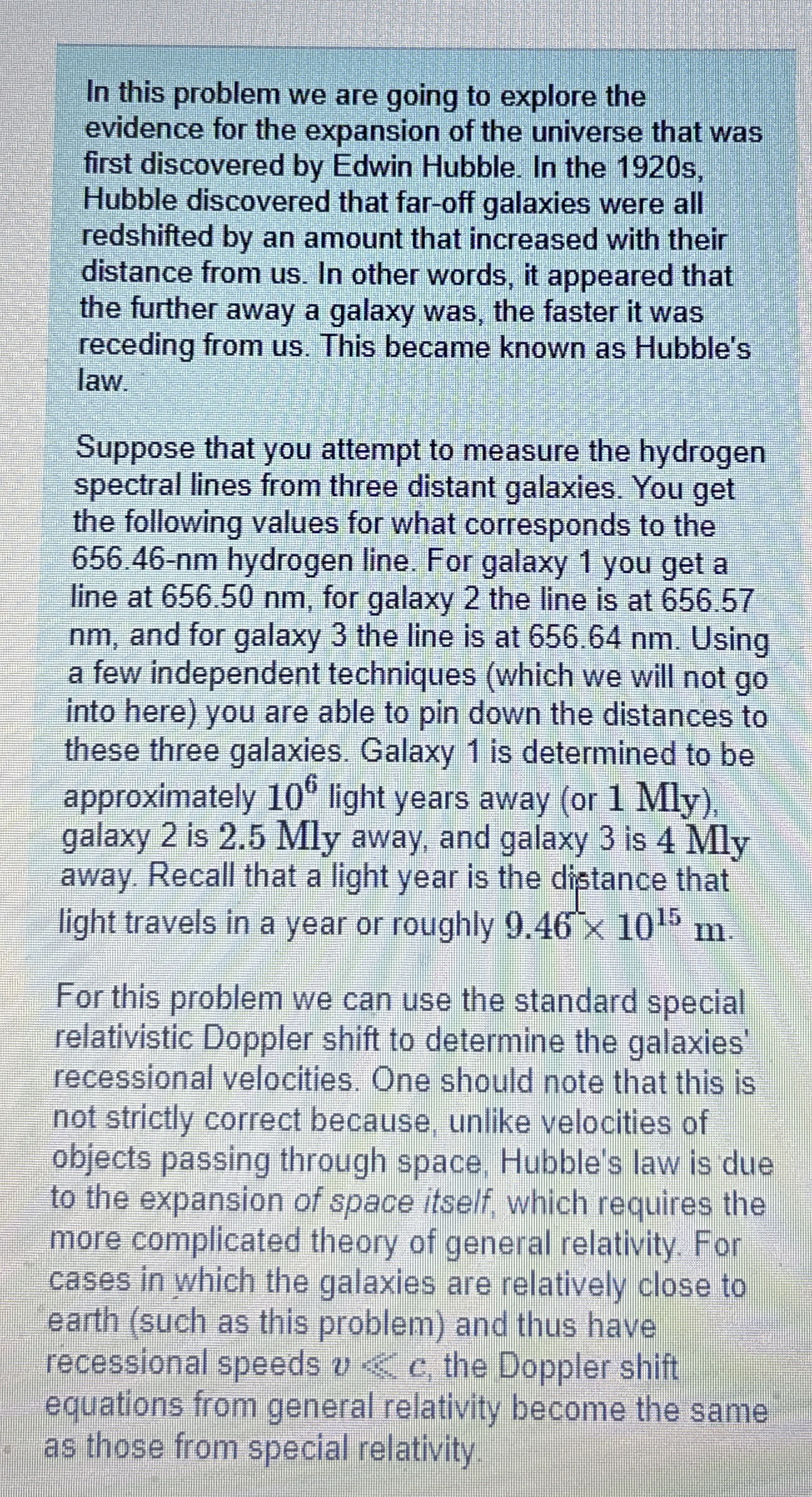
In this problem we are going to explore the evidence for the expansion of the universe that was first discovered by Edwin Hubble. In the s Hubble discovered that faroff galaxies were all redshifted by an amount that increased with their distance from us In other words, it appeared that the further away a galaxy was, the faster it was receding from us This became known as Hubble's law.
Suppose that you attempt to measure the hydrogen spectral lines from three distant galaxies. You get the following values for what corresponds to the nm hydrogen line. For galaxy you get a line at nm for galaxy the line is at nm and for galaxy the line is at nm Using a few independent techniques which we will not go into here you are able to pin down the distances to these three galaxies. Galaxy is determined to be approximately light years away or Mly galaxy is Mly away, and galaxy is Mly away. Recall that a light year is the distance that light travels in a year or roughly
For this problem we can use the standard special relativistic Doppler shift to determine the galaxies' recessional velocities. One should note that this is not strictly correct because, unlike velocities of objects passing through space, Hubble's law is due to the expansion of space itself, which requires the more complicated theory of general relativity. For cases in which the galaxies are relatively close to earth such as this problem and thus have recessional speeds the Doppler shift equations from general relativity become the same those from special relativity.
Step by Step Solution
There are 3 Steps involved in it
1 Expert Approved Answer
Step: 1 Unlock

Question Has Been Solved by an Expert!
Get step-by-step solutions from verified subject matter experts
Step: 2 Unlock
Step: 3 Unlock
 Study Help