







Question: In this problem, we will consider the ( Q , R ) model. Specifically, we will be looking at the version of the model with
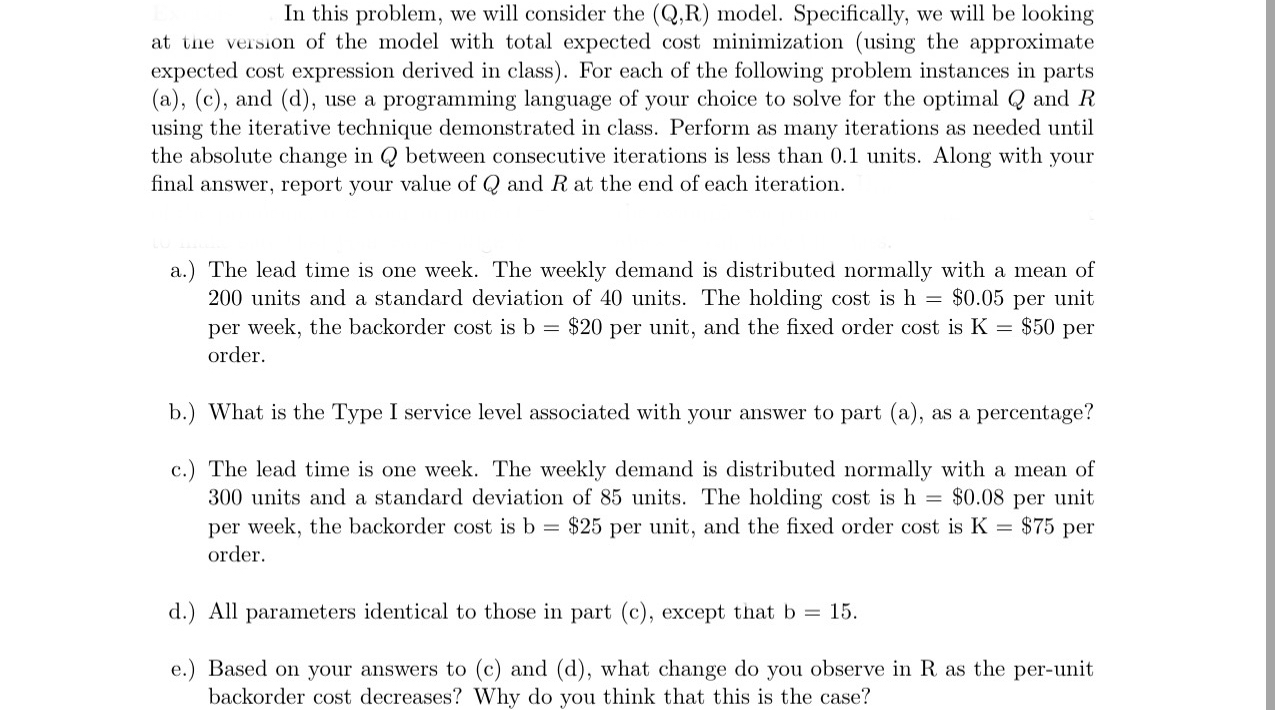
In this problem, we will consider the model. Specifically, we will be looking at the version of the model with total expected cost minimization using the approximate expected cost expression derived in class For each of the following problem instances in parts ac and d use a programming language of your choice to solve for the optimal and using the iterative technique demonstrated in class. Perform as many iterations as needed until the absolute change in between consecutive iterations is less than units. Along with your final answer, report your value of and at the end of each iteration.
a The lead time is one week. The weekly demand is distributed normally with a mean of units and a standard deviation of units. The holding cost is $ per unit per week, the backorder cost is $ per unit, and the fixed order cost is $ per order.
b What is the Type I service level associated with your answer to part a as a percentage?
c The lead time is one week. The weekly demand is distributed normally with a mean of units and a standard deviation of units. The holding cost is $ per unit per week, the backorder cost is $ per unit, and the fixed order cost is $ per order.
d All parameters identical to those in part c except that
e Based on your answers to c and d what change do you observe in as the perunit backorder cost decreases? Why do you think that this is the case?
Step by Step Solution
There are 3 Steps involved in it
1 Expert Approved Answer
Step: 1 Unlock

Question Has Been Solved by an Expert!
Get step-by-step solutions from verified subject matter experts
Step: 2 Unlock
Step: 3 Unlock
 Study Help