







Question: In this problem we will work with a simplified model for a drug delivery device. We can think about the device as having two wide
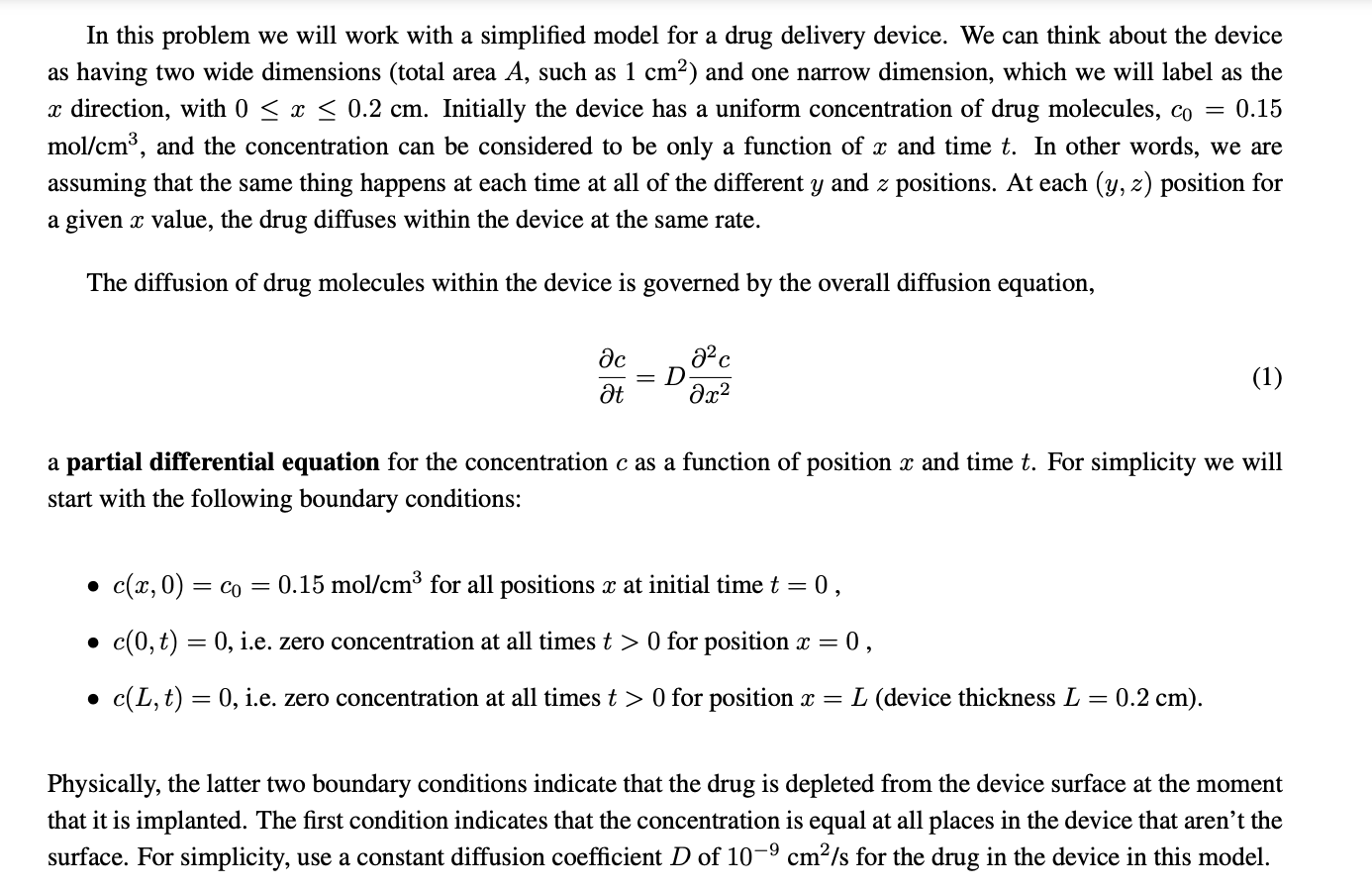
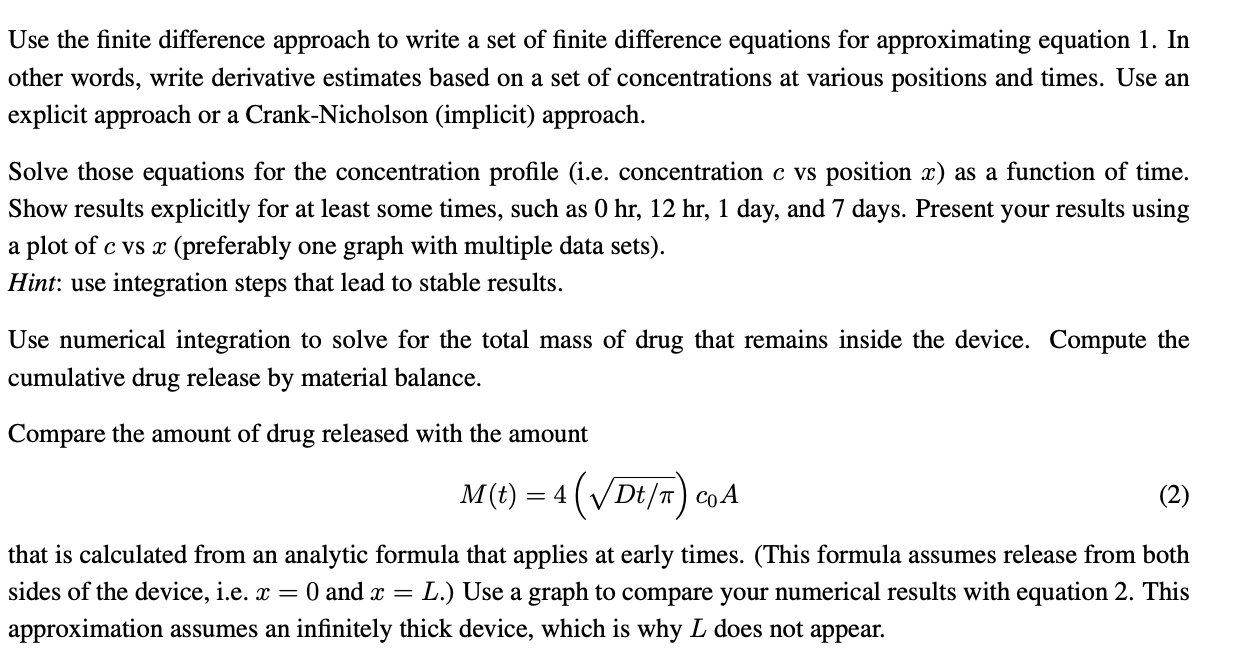
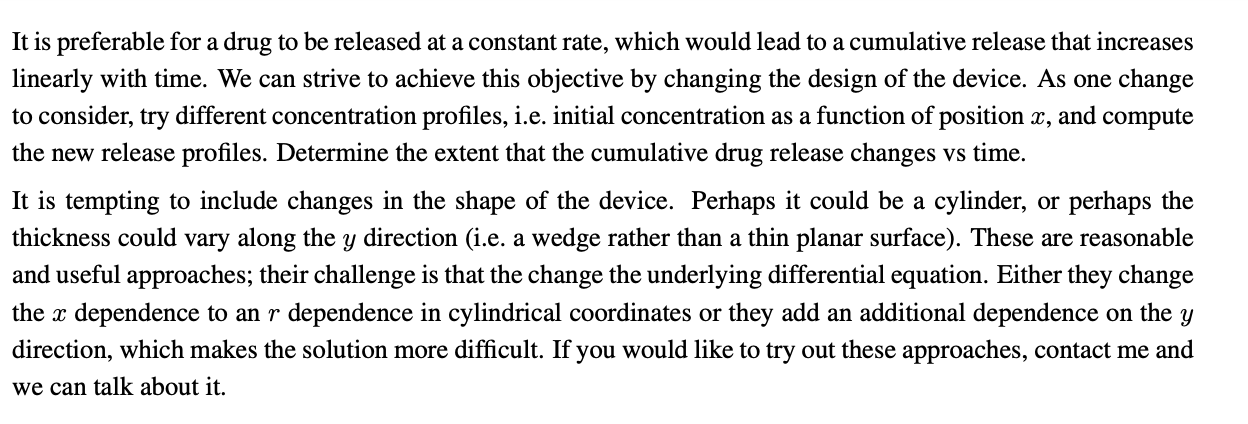
In this problem we will work with a simplified model for a drug delivery device. We can think about the device as having two wide dimensions (total area A, such as 1cm2 ) and one narrow dimension, which we will label as the x direction, with 0x0.2cm. Initially the device has a uniform concentration of drug molecules, c0=0.15 mol/cm3, and the concentration can be considered to be only a function of x and time t. In other words, we are assuming that the same thing happens at each time at all of the different y and z positions. At each (y,z) position for a given x value, the drug diffuses within the device at the same rate. The diffusion of drug molecules within the device is governed by the overall diffusion equation, tc=Dx22c a partial differential equation for the concentration c as a function of position x and time t. For simplicity we will start with the following boundary conditions: - c(x,0)=c0=0.15mol/cm3 for all positions x at initial time t=0, - c(0,t)=0, i.e. zero concentration at all times t>0 for position x=0, - c(L,t)=0, i.e. zero concentration at all times t>0 for position x=L (device thickness L=0.2cm ). Physically, the latter two boundary conditions indicate that the drug is depleted from the device surface at the moment that it is implanted. The first condition indicates that the concentration is equal at all places in the device that aren't the surface. For simplicity, use a constant diffusion coefficient D of 109cm2/s for the drug in the device in this model. Use the finite difference approach to write a set of finite difference equations for approximating equation 1 . In other words, write derivative estimates based on a set of concentrations at various positions and times. Use an explicit approach or a Crank-Nicholson (implicit) approach. Solve those equations for the concentration profile (i.e. concentration c vs position x ) as a function of time. Show results explicitly for at least some times, such as 0hr,12hr,1 day, and 7 days. Present your results using a plot of c vs x (preferably one graph with multiple data sets). Hint: use integration steps that lead to stable results. Use numerical integration to solve for the total mass of drug that remains inside the device. Compute the cumulative drug release by material balance. Compare the amount of drug released with the amount M(t)=4(Dt/)c0A that is calculated from an analytic formula that applies at early times. (This formula assumes release from both sides of the device, i.e. x=0 and x=L.) Use a graph to compare your numerical results with equation 2 . This approximation assumes an infinitely thick device, which is why L does not appear. It is preferable for a drug to be released at a constant rate, which would lead to a cumulative release that increases linearly with time. We can strive to achieve this objective by changing the design of the device. As one change to consider, try different concentration profiles, i.e. initial concentration as a function of position x, and compute the new release profiles. Determine the extent that the cumulative drug release changes vs time. It is tempting to include changes in the shape of the device. Perhaps it could be a cylinder, or perhaps the thickness could vary along the y direction (i.e. a wedge rather than a thin planar surface). These are reasonable and useful approaches; their challenge is that the change the underlying differential equation. Either they change the x dependence to an r dependence in cylindrical coordinates or they add an additional dependence on the y direction, which makes the solution more difficult. If you would like to try out these approaches, contact me and we can talk about it
Step by Step Solution
There are 3 Steps involved in it

Get step-by-step solutions from verified subject matter experts
 Study Help