







Question: In this problem, we'll study what happens in the basic principal-agent model if the principal is restricted in terms of the fixed payment / participation
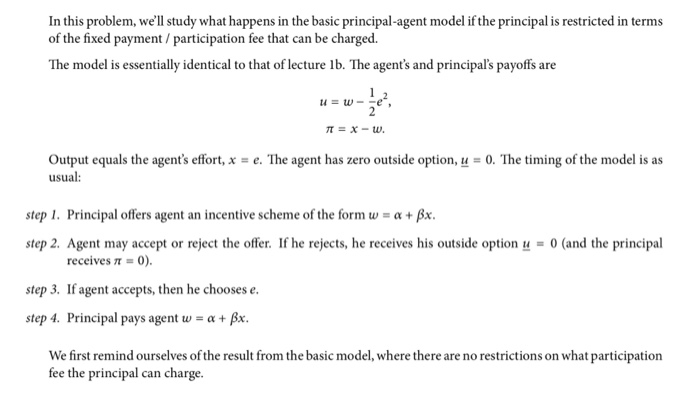
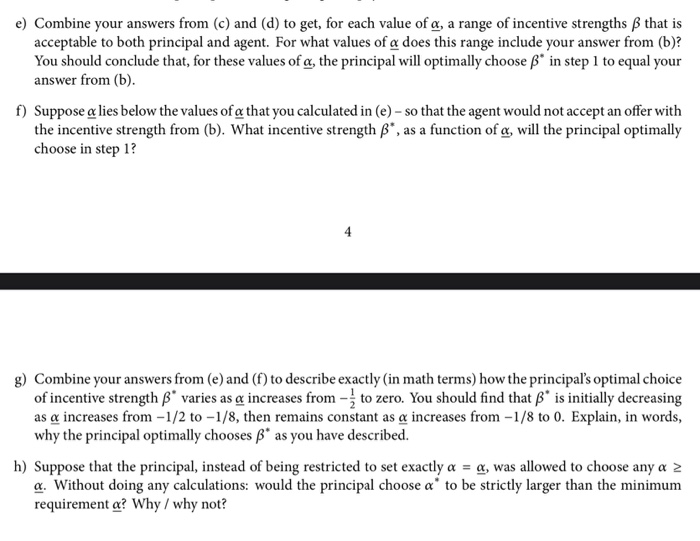
In this problem, we'll study what happens in the basic principal-agent model if the principal is restricted in terms of the fixed payment / participation fee that can be charged. The model is essentially identical to that of lecture lb. The agents and principal's payoffs are u=w- TI = x-w. Output equals the agent's effort, x = e. The agent has zero outside option, u = 0. The timing of the model is as usual: 2 step 1. Principal offers agent an incentive scheme of the form w = a + Bx. step 2. Agent may accept or reject the offer. If he rejects, he receives his outside option u = 0 (and the principal receives r = 0). step 3. If agent accepts, then he chooses e. step 4. Principal pays agent w = a + Bx. We first remind ourselves of the result from the basic model, where there are no restrictions on what participation fee the principal can charge. e) Combine your answers from (c) and (d) to get, for each value of a, a range of incentive strengths that is acceptable to both principal and agent. For what values of a does this range include your answer from (b)? You should conclude that, for these values of a, the principal will optimally choose * in step 1 to equal your answer from (b). f) Suppose a lies below the values of a that you calculated in (e) - so that the agent would not accept an offer with the incentive strength from (b). What incentive strength 3*, as a function of a, will the principal optimally choose in step 1? g) Combine your answers from (e) and (f) to describe exactly (in math terms) how the principal's optimal choice of incentive strength * varies as a increases from to zero. You should find that B* is initially decreasing as a increases from -1/2 to -1/8, then remains constant as a increases from -1/8 to 0. Explain, in words, why the principal optimally chooses * as you have described. h) Suppose that the principal, instead of being restricted to set exactly a = a, was allowed to choose any a 2 a. Without doing any calculations: would the principal choose a' to be strictly larger than the minimum requirement a? Why / why not? In this problem, we'll study what happens in the basic principal-agent model if the principal is restricted in terms of the fixed payment / participation fee that can be charged. The model is essentially identical to that of lecture lb. The agents and principal's payoffs are u=w- TI = x-w. Output equals the agent's effort, x = e. The agent has zero outside option, u = 0. The timing of the model is as usual: 2 step 1. Principal offers agent an incentive scheme of the form w = a + Bx. step 2. Agent may accept or reject the offer. If he rejects, he receives his outside option u = 0 (and the principal receives r = 0). step 3. If agent accepts, then he chooses e. step 4. Principal pays agent w = a + Bx. We first remind ourselves of the result from the basic model, where there are no restrictions on what participation fee the principal can charge. e) Combine your answers from (c) and (d) to get, for each value of a, a range of incentive strengths that is acceptable to both principal and agent. For what values of a does this range include your answer from (b)? You should conclude that, for these values of a, the principal will optimally choose * in step 1 to equal your answer from (b). f) Suppose a lies below the values of a that you calculated in (e) - so that the agent would not accept an offer with the incentive strength from (b). What incentive strength 3*, as a function of a, will the principal optimally choose in step 1? g) Combine your answers from (e) and (f) to describe exactly (in math terms) how the principal's optimal choice of incentive strength * varies as a increases from to zero. You should find that B* is initially decreasing as a increases from -1/2 to -1/8, then remains constant as a increases from -1/8 to 0. Explain, in words, why the principal optimally chooses * as you have described. h) Suppose that the principal, instead of being restricted to set exactly a = a, was allowed to choose any a 2 a. Without doing any calculations: would the principal choose a' to be strictly larger than the minimum requirement a? Why / why not
Step by Step Solution
There are 3 Steps involved in it

Get step-by-step solutions from verified subject matter experts
 Study Help