







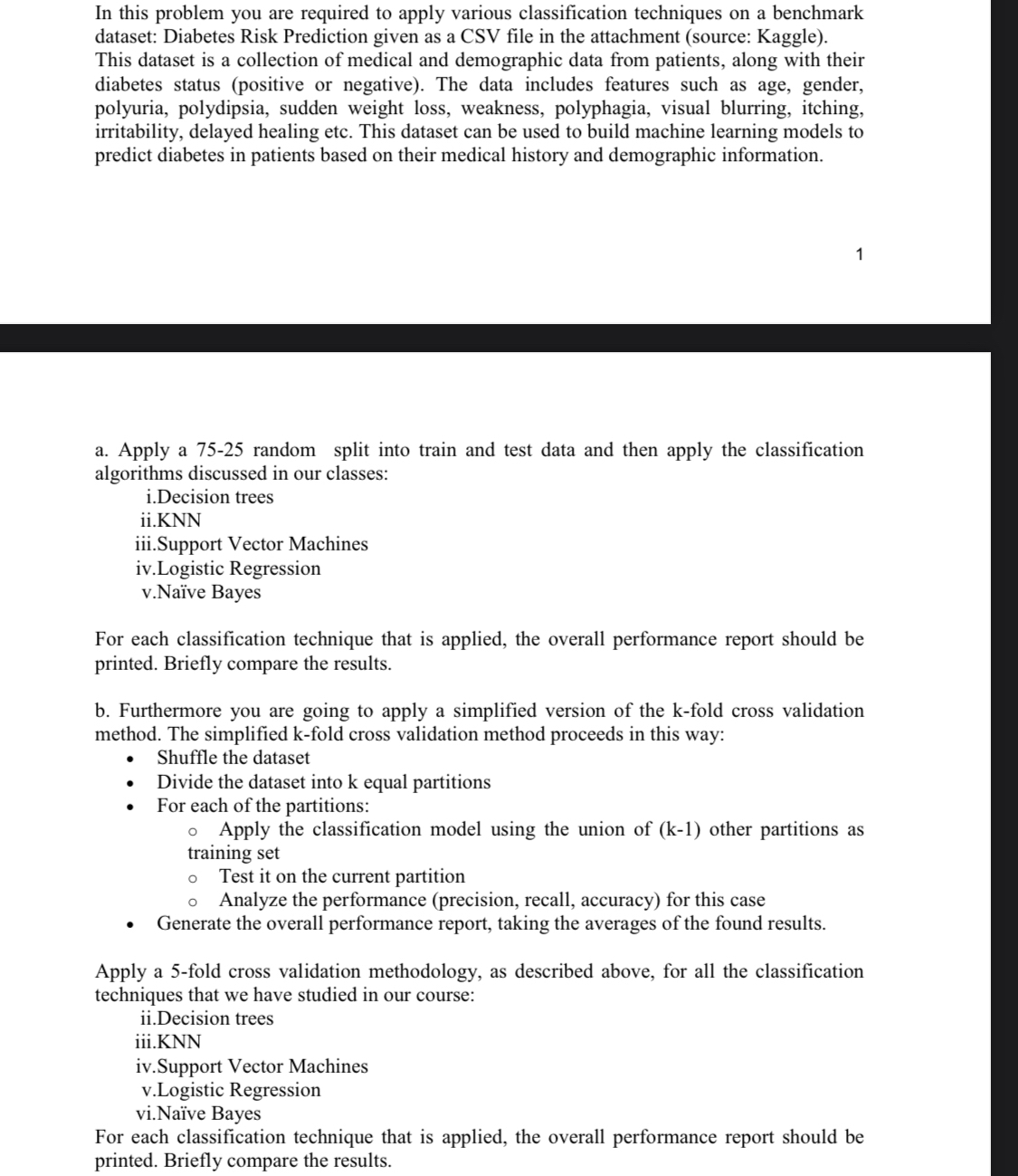
Question: In this problem you are required to apply various classification techniques on a benchmark dataset: Diabetes Risk Prediction given as a CSV file in the
In this problem you are required to apply various classification techniques on a benchmark dataset: Diabetes Risk Prediction given as a CSV file in the attachment source: Kaggle
This dataset is a collection of medical and demographic data from patients, along with their diabetes status positive or negative The data includes features such as age, gender, polyuria, polydipsia, sudden weight loss, weakness, polyphagia, visual blurring, itching, irritability, delayed healing etc. This dataset can be used to build machine learning models to predict diabetes in patients based on their medical history and demographic information.
a Apply a random split into train and test data and then apply the classification algorithms discussed in our classes:
iDecision trees
iiKNN
iii.Support Vector Machines
ivLogistic Regression
vNave Bayes
For each classification technique that is applied, the overall performance report should be printed. Briefly compare the results.
b Furthermore you are going to apply a simplified version of the kfold cross validation method. The simplified fold cross validation method proceeds in this way:
Shuffle the dataset
Divide the dataset into equal partitions
For each of the partitions:
Apply the classification model using the union of k other partitions as training set
Test it on the current partition
Analyze the performance precision recall, accuracy for this case
Generate the overall performance report, taking the averages of the found results.
Apply a fold cross validation methodology, as described above, for all the classification techniques that we have studied in our course:
iiDecision trees
iii.KNN
ivSupport Vector Machines
vLogistic Regression
viNave Bayes
For each classification technique that is applied, the overall performance report should be printed. Briefly compare the results.
Step by Step Solution
There are 3 Steps involved in it
1 Expert Approved Answer
Step: 1 Unlock

Question Has Been Solved by an Expert!
Get step-by-step solutions from verified subject matter experts
Step: 2 Unlock
Step: 3 Unlock
 Study Help