





Question: In this problem you will be answering question from the reading Finance Reading: Risk and Re- turn 1: Stock Returns and Diversification by Timothy A.
In this problem you will be answering question
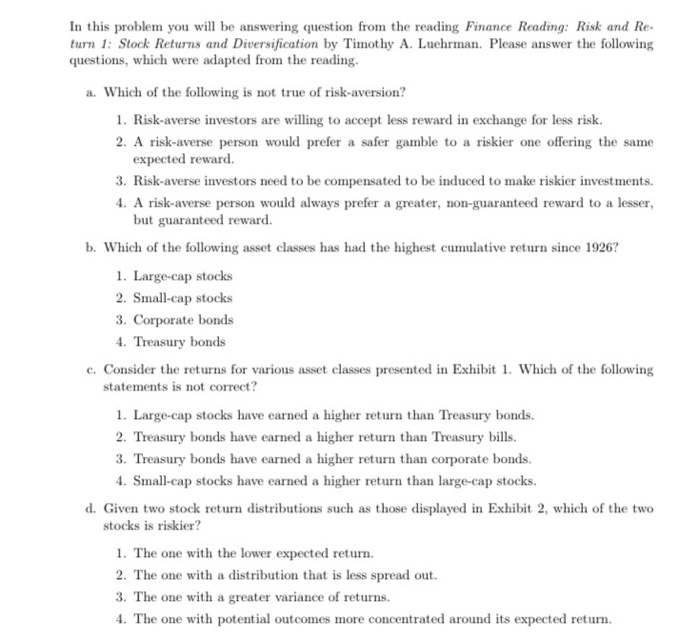
In this problem you will be answering question from the reading Finance Reading: Risk and Re- turn 1: Stock Returns and Diversification by Timothy A. Luehrman. Please answer the following questions, which were adapted from the reading. a. Which of the following is not true of risk-aversion? 1. Risk-averse investors are willing to accept less reward in exchange for less risk. 2. A risk-averse person would prefer a safer gamble to a riskier one offering the same expected reward. 3. Risk-averse investors need to be compensated to be induced to make riskier investments. 4. A risk-averse person would always prefer a greater, non-guaranteed reward to a lesser, but guaranteed reward. b. Which of the following asset classes has had the highest cumulative return since 1926? 1. Large-cap stocks 2. Small-cap stocks 3. Corporate bonds 4. Treasury bonds c. Consider the returns for various asset classes presented in Exhibit 1. Which of the following statements is not correct? 1. Large-cap stocks have earned a higher return than Treasury bonds. 2. Treasury bonds have earned a higher return than Treasury bills. 3. Treasury bonds have earned a higher return than corporate bonds. 4. Small-cap stocks have earned a higher return than large-cap stocks. d. Given two stock return distributions such as those displayed in Exhibit 2, which of the two stocks is riskier? 1. The one with the lower expected return. 2. The one with a distribution that is less spread out. 3. The one with a greater variance of returns. 4. The one with potential outcomes more concentrated around its expected return. In this problem you will be answering question from the reading Finance Reading: Risk and Re- turn 1: Stock Returns and Diversification by Timothy A. Luehrman. Please answer the following questions, which were adapted from the reading. a. Which of the following is not true of risk-aversion? 1. Risk-averse investors are willing to accept less reward in exchange for less risk. 2. A risk-averse person would prefer a safer gamble to a riskier one offering the same expected reward. 3. Risk-averse investors need to be compensated to be induced to make riskier investments. 4. A risk-averse person would always prefer a greater, non-guaranteed reward to a lesser, but guaranteed reward. b. Which of the following asset classes has had the highest cumulative return since 1926? 1. Large-cap stocks 2. Small-cap stocks 3. Corporate bonds 4. Treasury bonds c. Consider the returns for various asset classes presented in Exhibit 1. Which of the following statements is not correct? 1. Large-cap stocks have earned a higher return than Treasury bonds. 2. Treasury bonds have earned a higher return than Treasury bills. 3. Treasury bonds have earned a higher return than corporate bonds. 4. Small-cap stocks have earned a higher return than large-cap stocks. d. Given two stock return distributions such as those displayed in Exhibit 2, which of the two stocks is riskier? 1. The one with the lower expected return. 2. The one with a distribution that is less spread out. 3. The one with a greater variance of returns. 4. The one with potential outcomes more concentrated around its expected return

Step by Step Solution

There are 3 Steps involved in it

1 Expert Approved Answer
Step: 1 Unlock blur-text-image

Question Has Been Solved by an Expert!

Get step-by-step solutions from verified subject matter experts

Step: 2 Unlock
Step: 3 Unlock

Students Have Also Explored These Related General Management Questions!