







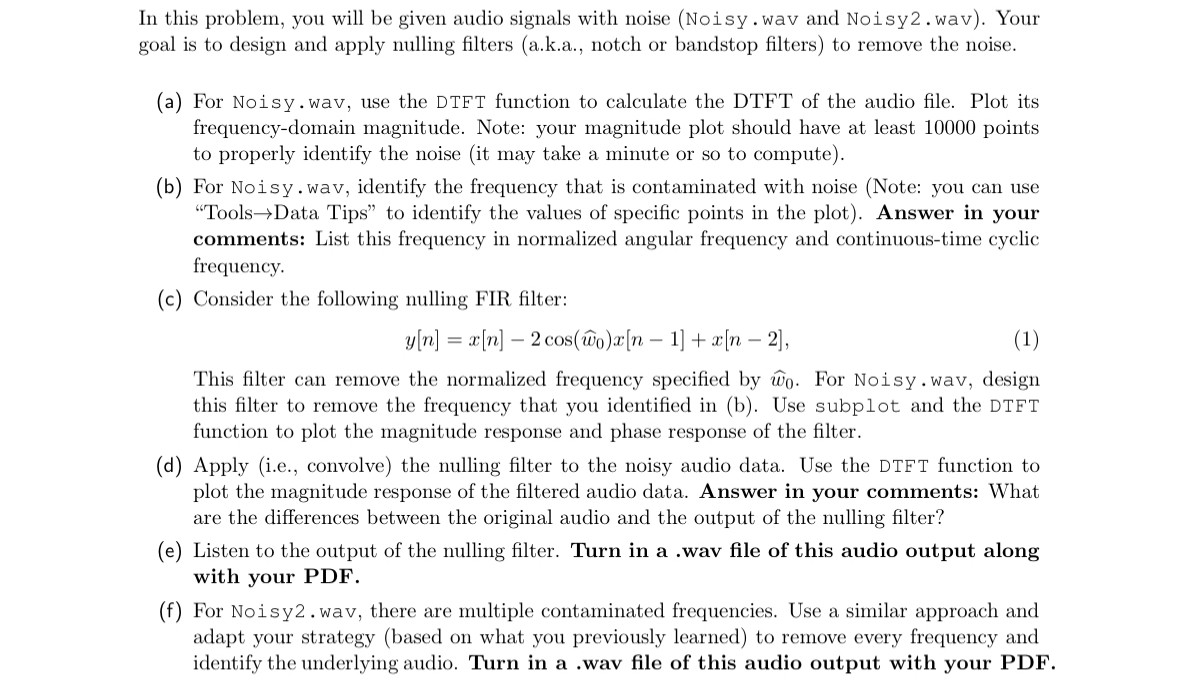
Question: In this problem, you will be given audio signals with noise ( Noisy . wav and Noisy 2 . wav ) . Your goal is
In this problem, you will be given audio signals with noise Noisywav and Noisywav Your goal is to design and apply nulling filters aka notch or bandstop filters to remove the noise.
a For Noisy.wav, use the DTFT function to calculate the DTFT of the audio file. Plot its frequencydomain magnitude. Note: your magnitude plot should have at least points to properly identify the noise it may take a minute or so to compute
b For Noisy.wav, identify the frequency that is contaminated with noise Note: you can use "Tools Data Tips" to identify the values of specific points in the plot Answer in your comments: List this frequency in normalized angular frequency and continuoustime cyclic frequency.
c Consider the following nulling FIR filter:
This filter can remove the normalized frequency specified by widehat For Noisy.wav, design this filter to remove the frequency that you identified in b Use subplot and the DTFT function to plot the magnitude response and phase response of the filter.
d Apply ie convolve the nulling filter to the noisy audio data. Use the DTFT function to plot the magnitude response of the filtered audio data. Answer in your comments: What are the differences between the original audio and the output of the nulling filter?
e Listen to the output of the nulling filter. Turn in a wav file of this audio output along with your PDF
f For Noisywav, there are multiple contaminated frequencies. Use a similar approach and adapt your strategy based on what you previously learned to remove every frequency and identify the underlying audio. Turn in a wav file of this audio output with your PDF
Need help with writing the code
Step by Step Solution
There are 3 Steps involved in it
1 Expert Approved Answer
Step: 1 Unlock

Question Has Been Solved by an Expert!
Get step-by-step solutions from verified subject matter experts
Step: 2 Unlock
Step: 3 Unlock
 Study Help