Question: In this problem, you will implement and compare wall clock times for several different sorting algorithms. You may use any pseudocode and code from your
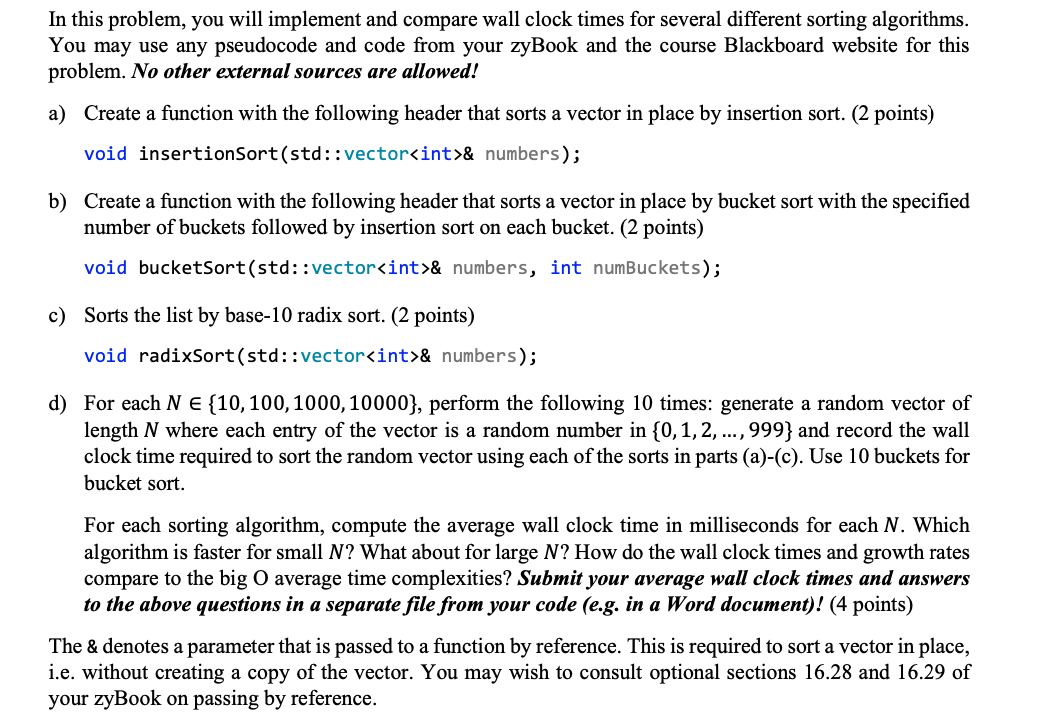
In this problem, you will implement and compare wall clock times for several different sorting algorithms. You may use any pseudocode and code from your zyBook and the course Blackboard website for this problem. No other external sources are allowed! a) Create a function with the following header that sorts a vector in place by insertion sort. (2 points) void insertionSort(std::vector int>& numbers); b) Create a function with the following header that sorts a vector in place by bucket sort with the specified number of buckets followed by insertion sort on each bucket. (2 points) void bucketSort(std::vector& numbers, int numBuckets); c) Sorts the list by base-10 radix sort. (2 points) void radixSort(std::vector& numbers); d) For each N E{10, 100, 1000, 10000}, perform the following 10 times: generate a random vector of length N where each entry of the vector is a random number in {0, 1, 2, ...,999} and record the wall clock time required to sort the random vector using each of the sorts in parts (a)-c). Use 10 buckets for bucket sort. For each sorting algorithm, compute the average wall clock time in milliseconds for each N. Which algorithm is faster for small N? What about for large N? How do the wall clock times and growth rates compare to the big O average time complexities? Submit your average wall clock times and answers to the above questions in a separate file from your code (e.g. in a Word document)! (4 points) The & denotes a parameter that is passed to a function by reference. This is required to sort a vector in place, i.e. without creating a copy of the vector. You may wish to consult optional sections 16.28 and 16.29 of your zyBook on passing by reference. In this problem, you will implement and compare wall clock times for several different sorting algorithms. You may use any pseudocode and code from your zyBook and the course Blackboard website for this problem. No other external sources are allowed! a) Create a function with the following header that sorts a vector in place by insertion sort. (2 points) void insertionSort(std::vector int>& numbers); b) Create a function with the following header that sorts a vector in place by bucket sort with the specified number of buckets followed by insertion sort on each bucket. (2 points) void bucketSort(std::vector& numbers, int numBuckets); c) Sorts the list by base-10 radix sort. (2 points) void radixSort(std::vector& numbers); d) For each N E{10, 100, 1000, 10000}, perform the following 10 times: generate a random vector of length N where each entry of the vector is a random number in {0, 1, 2, ...,999} and record the wall clock time required to sort the random vector using each of the sorts in parts (a)-c). Use 10 buckets for bucket sort. For each sorting algorithm, compute the average wall clock time in milliseconds for each N. Which algorithm is faster for small N? What about for large N? How do the wall clock times and growth rates compare to the big O average time complexities? Submit your average wall clock times and answers to the above questions in a separate file from your code (e.g. in a Word document)! (4 points) The & denotes a parameter that is passed to a function by reference. This is required to sort a vector in place, i.e. without creating a copy of the vector. You may wish to consult optional sections 16.28 and 16.29 of your zyBook on passing by reference









 Study Help