



Question: In this problem, you'll model the amount of morphine present in a patient over time using a continuous intravenous dosage and the half-life of morphine.
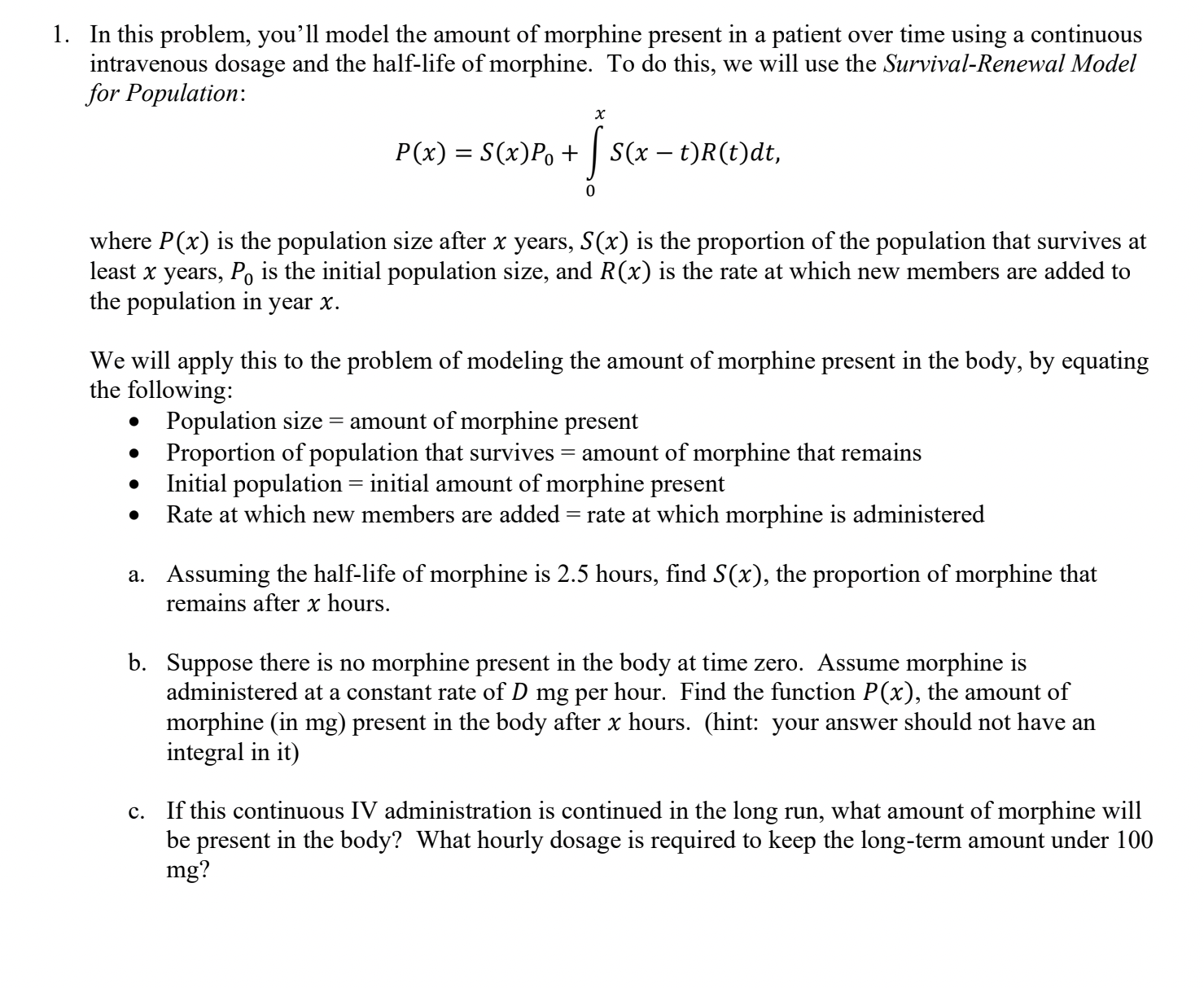
In this problem, you'll model the amount of morphine present in a patient over time using a continuous intravenous dosage and the half-life of morphine. To do this, we will use the Survival-Renewal Model for Population: P(x)=S(x)P0+0xS(xt)R(t)dt, where P(x) is the population size after x years, S(x) is the proportion of the population that survives at least x years, P0 is the initial population size, and R(x) is the rate at which new members are added to the population in year x. We will apply this to the problem of modeling the amount of morphine present in the body, by equating the following: - Population size = amount of morphine present - Proportion of population that survives = amount of morphine that remains - Initial population = initial amount of morphine present - Rate at which new members are added = rate at which morphine is administered a. Assuming the half-life of morphine is 2.5 hours, find S(x), the proportion of morphine that remains after x hours. b. Suppose there is no morphine present in the body at time zero. Assume morphine is administered at a constant rate of Dmg per hour. Find the function P(x), the amount of morphine (in mg ) present in the body after x hours. (hint: your answer should not have an integral in it) c. If this continuous IV administration is continued in the long run, what amount of morphine will be present in the body? What hourly dosage is required to keep the long-term amount under 100 mg
Step by Step Solution
There are 3 Steps involved in it

Get step-by-step solutions from verified subject matter experts