







Question: In this project, you will create a Simple Restaurant Order Management System. This project is designed to implement two fundamental data structures: Stacks and Queues
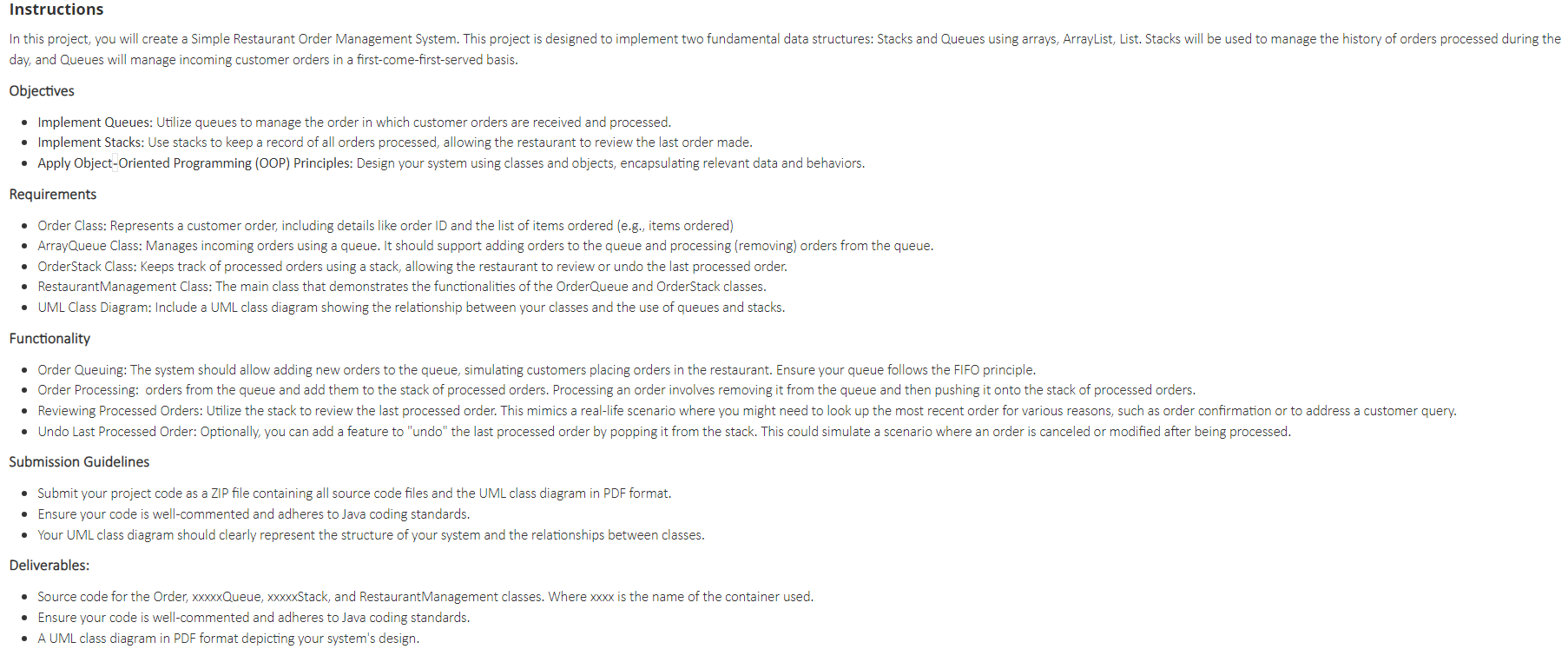
In this project, you will create a Simple Restaurant Order Management System. This project is designed to implement two fundamental data structures: Stacks and Queues using arrays, ArrayList, List. Stacks will be used to manage the history of orders processed during the day, and Queues will manage incoming customer orders in a firstcomefirstserved basis. JAVA ONLY
Objectives
Implement Queues: Utilize queues to manage the order in which customer orders are received and processed.
Implement Stacks: Use stacks to keep a record of all orders processed, allowing the restaurant to review the last order made.
Apply ObjectOriented Programming OOP Principles: Design your system using classes and objects, encapsulating relevant data and behaviors.
Requirements
Order Class: Represents a customer order, including details like order ID and the list of items ordered eg items ordered
ArrayQueue Class: Manages incoming orders using a queue. It should support adding orders to the queue and processing removing orders from the queue.
OrderStack Class: Keeps track of processed orders using a stack, allowing the restaurant to review or undo the last processed order.
RestaurantManagement Class: The main class that demonstrates the functionalities of the OrderQueue and OrderStack classes.
UML Class Diagram: Include a UML class diagram showing the relationship between your classes and the use of queues and stacks.
Functionality
Order Queuing: The system should allow adding new orders to the queue, simulating customers placing orders in the restaurant. Ensure your queue follows the FIFO principle.
Order Processing: orders from the queue and add them to the stack of processed orders. Processing an order involves removing it from the queue and then pushing it onto the stack of processed orders.
Reviewing Processed Orders: Utilize the stack to review the last processed order. This mimics a reallife scenario where you might need to look up the most recent order for various reasons, such as order confirmation or to address a customer query.
Undo Last Processed Order: Optionally, you can add a feature to "undo" the last processed order by popping it from the stack. This could simulate a scenario where an order is canceled or modified after being processed.
Submission Guidelines
Submit your project code as a ZIP file containing all source code files and the UML class diagram in PDF format.
Ensure your code is wellcommented and adheres to Java coding standards.
Your UML class diagram should clearly represent the structure of your system and the relationships between classes.
Deliverables:
Source code for the Order, xxxxxQueue, xxxxxStack, and RestaurantManagement classes. Where xxxx is the name of the container used.
Ensure your code is wellcommented and adheres to Java coding standards.
A UML class diagram in PDF format depicting your system's design.Instructions
day, and Queues will manage incoming customer orders in a firstcomefirstserved basis.
Objectives
Implement Queues: Utilize queues to manage the order in which customer orders are received and processed.
Implement Stacks: Use stacks to keep a record of all orders processed, allowing the restaurant to review the last order made.
Apply ObjectOriented Programming OOP Principles: Design your system using classes and objects, encapsulating relevant data and behaviors.
Requirements
Order Class: Represents a customer order, including details like order ID and the list of items ordered eg items ordered
ArrayQueue Class: Manages incoming orders using a queue. It should support adding orders to the queue and processing removing orders from the queue.
OrderStack Class: Keeps track of processed orders using a stack, allowing the restaurant to review or undo the last processed order.
RestaurantManagement Class: The main class that demonstrates the functionalities of the OrderQueue and OrderStack classes.
UML Class Diagram: Include a UML class diagram showing the relationship between your classes and the use of queues and stacks.
Functionality
Order Queuing: The system should allow adding new orders to the queue, simulating customers placing orders in the restaurant. Ensure your queue follows the FIFO principle.
Order Processing: orders from the queue and add them to the stack of processed orders. Processing an order involves removing it from the queue and then pushing it onto the stack of processed orders.
Undo Last Processed Order: Optionally, you can add a feature to "undo" the last processed order by popping it from the stack. This could simulate a scenario where an order is canceled or modified after being processed.
Submission Guidelines
Submit your project code as a ZIP file containing all source code files and the UML class diagram in PDF format.
Ensure your code is wellcommented and adheres to Java coding standards.
Your UML class diagram should clearly represent the structure of your system and the relationships between classes.
Deliverables:
Source code for
Step by Step Solution
There are 3 Steps involved in it
1 Expert Approved Answer
Step: 1 Unlock

Question Has Been Solved by an Expert!
Get step-by-step solutions from verified subject matter experts
Step: 2 Unlock
Step: 3 Unlock
 Study Help