







Question: In this Python exercise we generate independent, 1000 standard Cauchy random variables with the density function f (z) := from independent 1000 uniform random variables
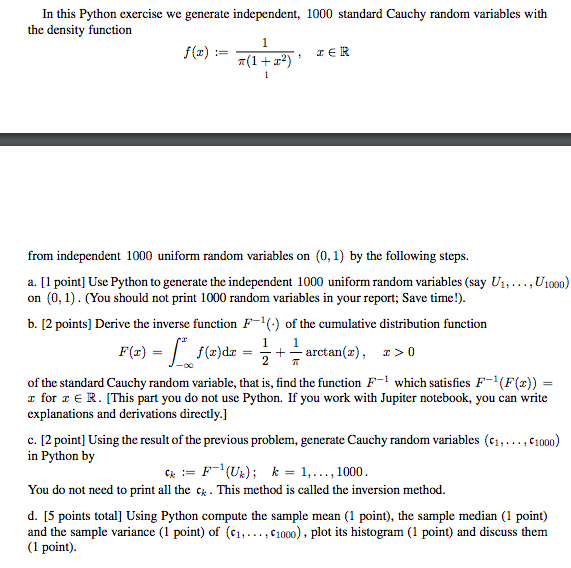
In this Python exercise we generate independent, 1000 standard Cauchy random variables with the density function f (z) := from independent 1000 uniform random variables on (0,1) by the following steps. a. [I point] Use Python to generate the independent 1000 uniform random variables (say U1, U1000) on (0, 1). (You should not print 1000 random variables in your report; Save time!). b. 12 points] Derive the inverse function F-1of the cumulative distribution function F(z) f(z)dz =-+-arctan(z), z > 0 of the standard Cauchy random variable, that is, find the function F-1 which satisfies F-1 (F(z)) = z for x E R. [This part you do not use Python. If you work with Jupiter notebook, you can write explanations and derivations directly.] ) c. 12 point1 Using the result of the previous problem, generate Cauchy random variables (a, in Python by Ge :-F-1(UL) ; k= 1, . . . , 1000 You do not need to print all the ck. This method is called the inversion method. d. [5 points total] Using Python compute the sample mean (1 point), the sample median (1 point) and the sample variance (I point) of (ci,... ,c1000), plot its histogram (1 point) and discuss them (1 point)
Step by Step Solution
There are 3 Steps involved in it

Get step-by-step solutions from verified subject matter experts
 Study Help