







Question: In this question all variables represent strings over the alphabet fa, bj. Let SA(u) mean u starts with a, EB(u) mean u ends with b,
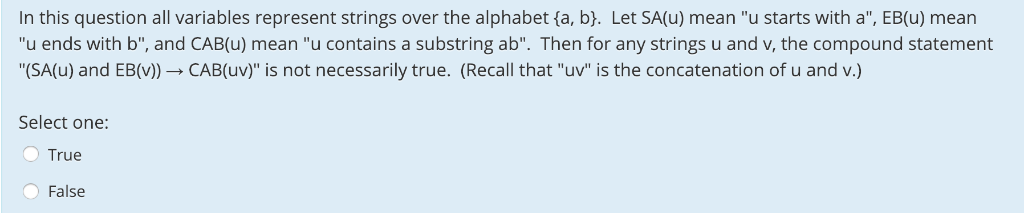
In this question all variables represent strings over the alphabet fa, bj. Let SA(u) mean "u starts with a", EB(u) mean "u ends with b", and CAB(u) mean "u contains a substring ab". Then for any strings u and v, the compound statement "(SA(u) and EB(v)) CAB(uv)" is not necessarily true. (Recall that "uv" is the concatenation of u and v.) Select one: True False
Step by Step Solution
There are 3 Steps involved in it
1 Expert Approved Answer
Step: 1 Unlock

Question Has Been Solved by an Expert!
Get step-by-step solutions from verified subject matter experts
Step: 2 Unlock
Step: 3 Unlock
 Study Help