







Question: in this question, i wanna know about real details using flow rate, flow time, inventory, etc using operation management technique im newbie so im working
in this question, i wanna know about real details using flow rate, flow time, inventory, etc
using operation management technique
im newbie so im working on it hard to study
thank you
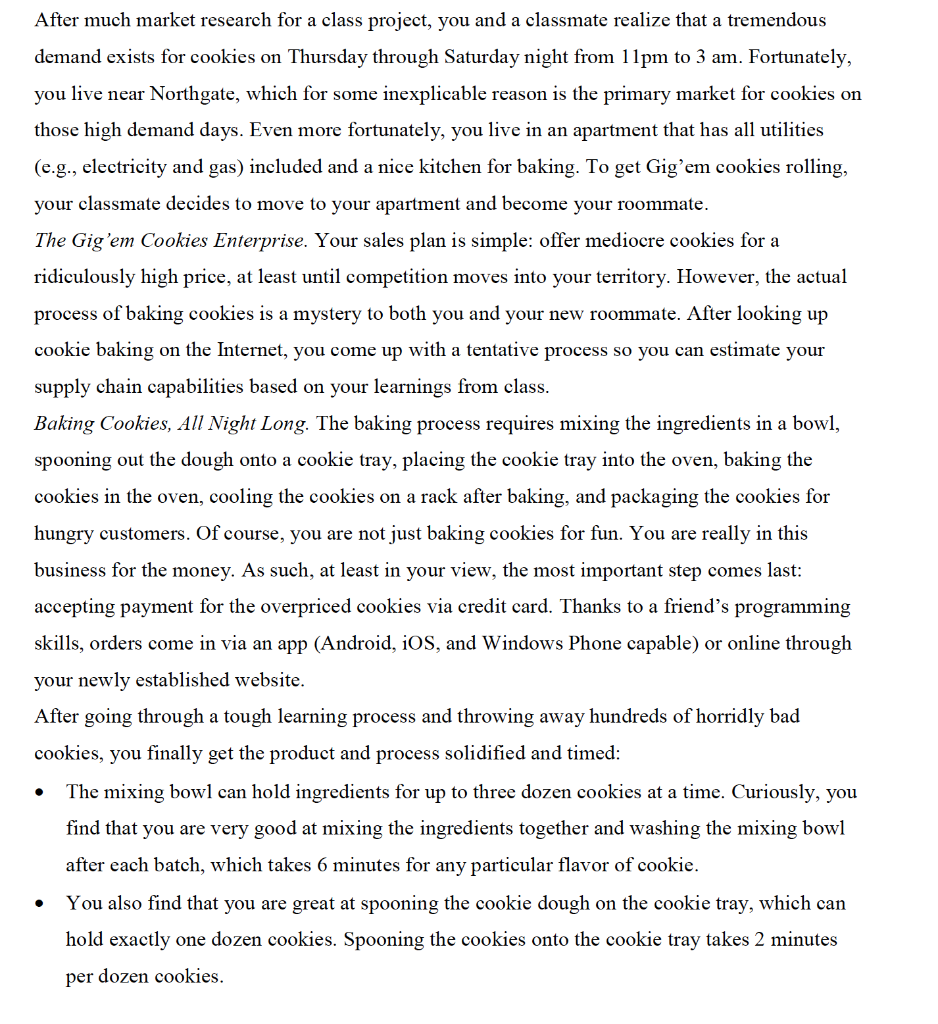
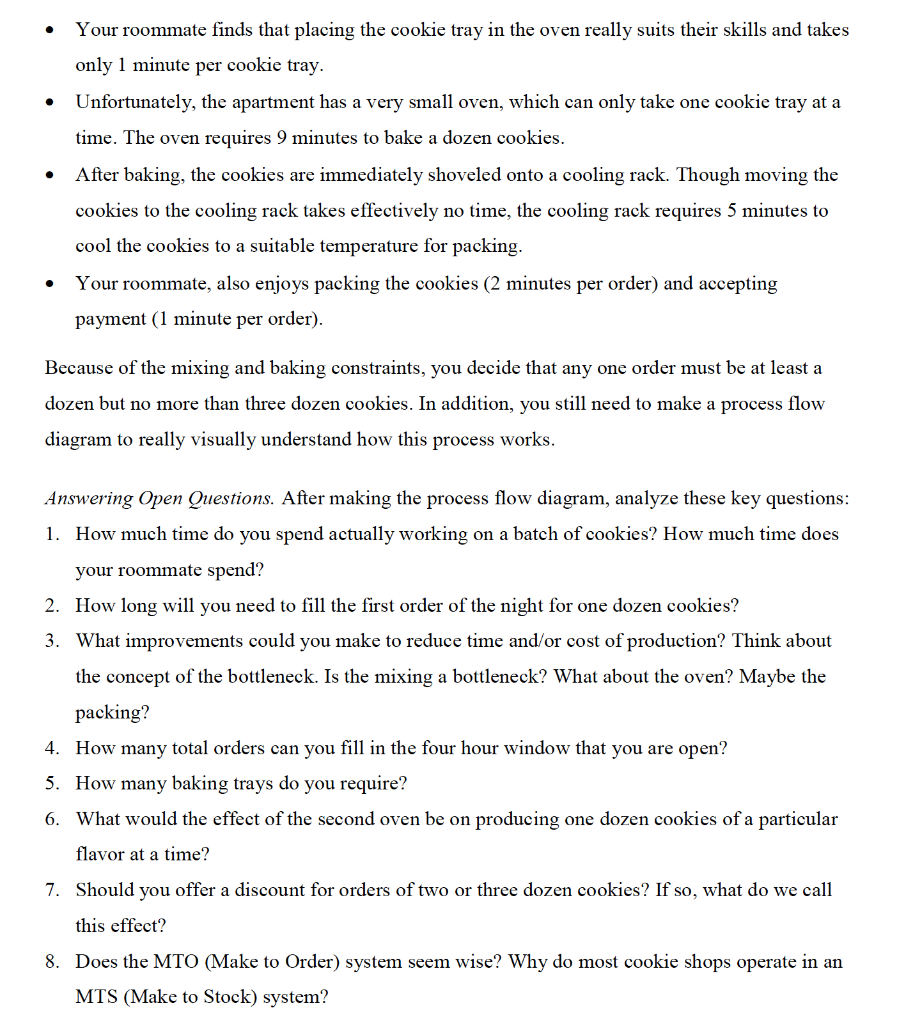
After much market research for a class project, you and a classmate realize that a tremendous demand exists for cookies on Thursday through Saturday night from 11pm to 3 am. Fortunately, you live near Northgate, which for some inexplicable reason is the primary market for cookies on those high demand days. Even more fortunately, you live in an apartment that has all utilities (e.g., electricity and gas) included and a nice kitchen for baking. To get Gigem cookies rolling, your classmate decides to move to your apartment and become your roommate. The Gig'em Cookies Enterprise. Your sales plan is simple: offer mediocre cookies for a ridiculously high price, at least until competition moves into your territory. However, the actual process of baking cookies is a mystery to both you and your new roommate. After looking up cookie baking on the Internet, you come up with a tentative process so you can estimate your supply chain capabilities based on your learnings from class. Baking Cookies, All Night Long. The baking process requires mixing the ingredients in a bowl, spooning out the dough onto a cookie tray, placing the cookie tray into the oven, baking the cookies in the oven, cooling the cookies on a rack after baking, and packaging the cookies for hungry customers. Of course, you are not just baking cookies for fun. You are really in this business for the money. As such, at least in your view, the most important step comes last: accepting payment for the overpriced cookies via credit card. Thanks to a friend's programming skills, orders come in via an app (Android, iOS, and Windows Phone capable) or online through your newly established website. After going through a tough learning process and throwing away hundreds of horridly bad cookies, you finally get the product and process solidified and timed: The mixing bowl can hold ingredients for up to three dozen cookies at a time. Curiously, you find that you are very good at mixing the ingredients together and washing the mixing bowl after each batch, which takes 6 minutes for any particular flavor of cookie. You also find that you are great at spooning the cookie dough on the cookie tray, which can hold exactly one dozen cookies. Spooning the cookies onto the cookie tray takes 2 minutes per dozen cookies. . . . Your roommate finds that placing the cookie tray in the oven really suits their skills and takes only 1 minute per cookie tray. Unfortunately, the apartment has a very small oven, which can only take one cookie tray at a time. The oven requires 9 minutes to bake a dozen cookies. After baking, the cookies are immediately shoveled onto a cooling rack. Though moving the cookies to the cooling rack takes effectively no time, the cooling rack requires 5 minutes to cool the cookies to a suitable temperature for packing. Your roommate, also enjoys packing the cookies (2 minutes per order) and accepting payment (1 minute per order). Because of the mixing and baking constraints, you decide that any one order must be at least a dozen but no more than three dozen cookies. In addition, you still need to make a process flow diagram to really visually understand how this process works. Answering Open Questions. After making the process flow diagram, analyze these key questions: 1. How much time do you spend actually working on a batch of cookies? How much time does your roommate spend? 2. How long will you need to fill the first order of the night for one dozen cookies? 3. What improvements could you make to reduce time and/or cost of production? Think about the concept of the bottleneck. Is the mixing a bottleneck? What about the oven? Maybe the packing? 4. How many total orders can you fill in the four hour window that you are open? 5. How many baking trays do you require? 6. What would the effect of the second oven be on producing one dozen cookies of a particular flavor at a time? 7. Should you offer a discount for orders of two or three dozen cookies? If so, what do we call this effect? 8. Does the MTO (Make to Order) system seem wise? Why do most cookie shops operate in an MTS (Make to Stock) systemStep by Step Solution
There are 3 Steps involved in it
1 Expert Approved Answer
Step: 1 Unlock

Question Has Been Solved by an Expert!
Get step-by-step solutions from verified subject matter experts
Step: 2 Unlock
Step: 3 Unlock
 Study Help