







Question: In this question, numerical approaches for the first - order and second - order derivatives will be considered. Please refer to the codes provided in
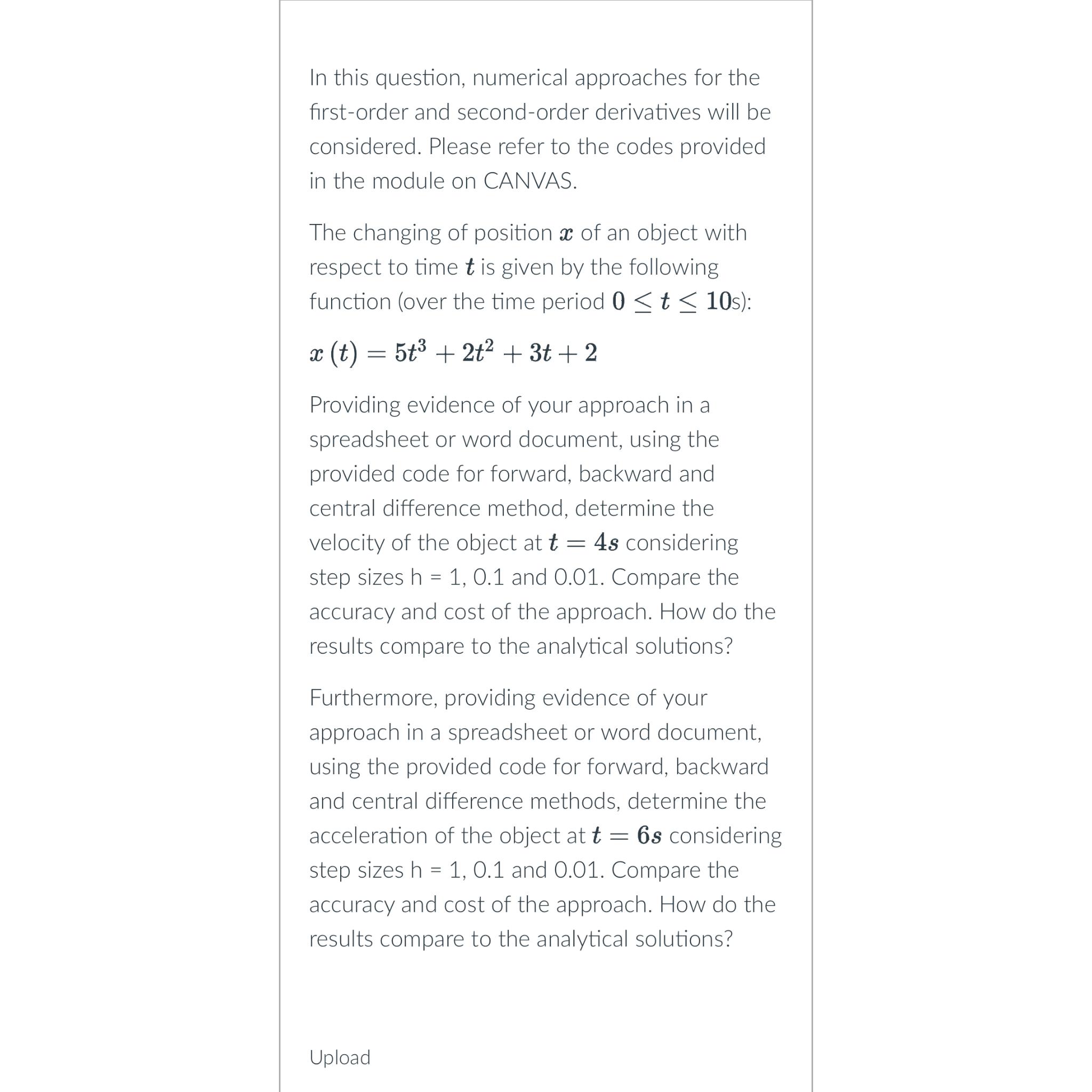
In this question, numerical approaches for the firstorder and secondorder derivatives will be considered. Please refer to the codes provided in the module on CANVAS.
The changing of position of an object with respect to time is given by the following function over the time period :
Providing evidence of your approach in a spreadsheet or word document, using the provided code for forward, backward and central difference method, determine the velocity of the object at considering step sizes and Compare the accuracy and cost of the approach. How do the results compare to the analytical solutions?
Furthermore, providing evidence of your approach in a spreadsheet or word document, using the provided code for forward, backward and central difference methods, determine the acceleration of the object at considering step sizes and Compare the accuracy and cost of the approach. How do the results compare to the analytical solutions?
Upload
Step by Step Solution
There are 3 Steps involved in it
1 Expert Approved Answer
Step: 1 Unlock

Question Has Been Solved by an Expert!
Get step-by-step solutions from verified subject matter experts
Step: 2 Unlock
Step: 3 Unlock
 Study Help