







Question: In this question, we will consider the numerical approaches for Partial Differential Equations (PDEs) by considering the solution of the 2D Poisson Equation. Please refer
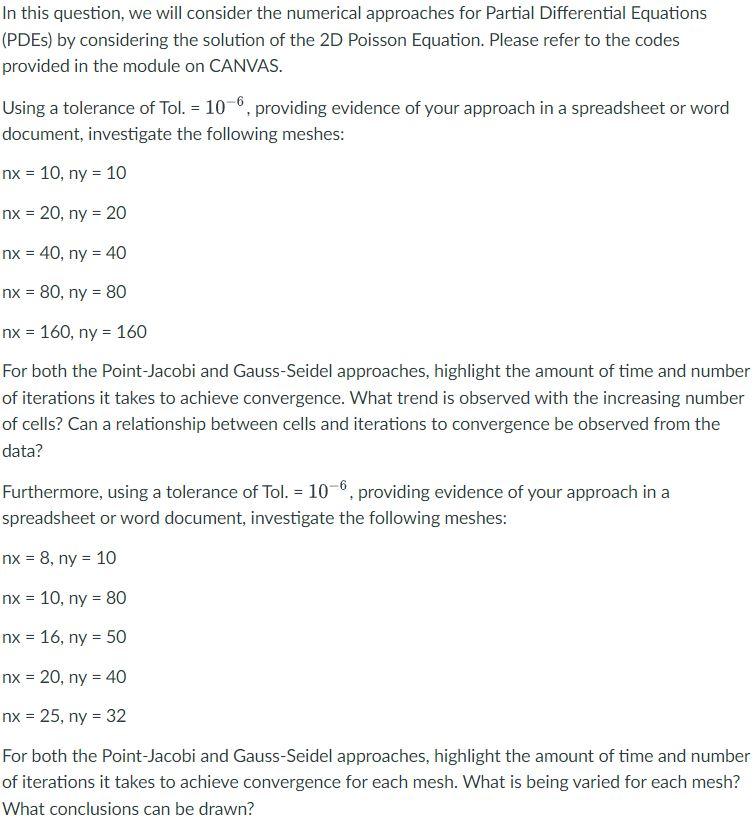
In this question, we will consider the numerical approaches for Partial Differential Equations (PDEs) by considering the solution of the 2D Poisson Equation. Please refer to the codes provided in the module on CANVAS. Using a tolerance of Tol. =106, providing evidence of your approach in a spreadsheet or word document, investigate the following meshes: nx=10,ny=10nx=20,ny=20nx=40,ny=40nx=80,ny=80nx=160,ny=160 For both the Point-Jacobi and Gauss-Seidel approaches, highlight the amount of time and number of iterations it takes to achieve convergence. What trend is observed with the increasing number of cells? Can a relationship between cells and iterations to convergence be observed from the data? Furthermore, using a tolerance of Tol. =106, providing evidence of your approach in a spreadsheet or word document, investigate the following meshes: nx=8,ny=10nx=10,ny=80nx=16,ny=50nx=20,ny=40nx=25,ny=32 For both the Point-Jacobi and Gauss-Seidel approaches, highlight the amount of time and number of iterations it takes to achieve convergence for each mesh. What is being varied for each mesh? What conclusions can be drawn
Step by Step Solution
There are 3 Steps involved in it

Get step-by-step solutions from verified subject matter experts
 Study Help