







Question: In this question we'll look at the Bears data set, using observation I's only (data set is posted on our course website). (@) Verify that
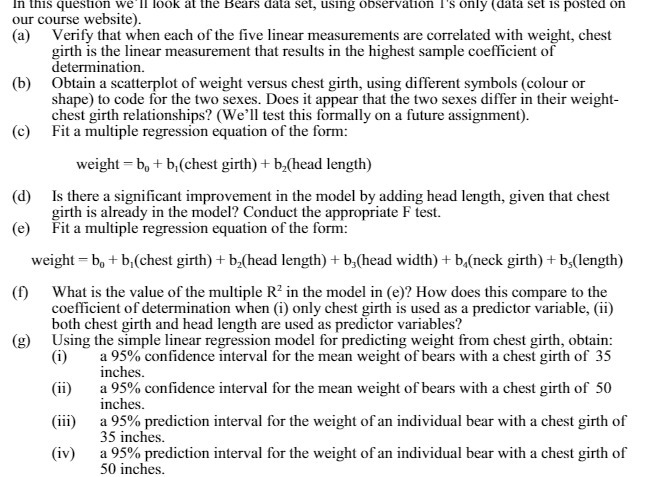
In this question we'll look at the Bears data set, using observation I's only (data set is posted on our course website). (@) Verify that when each of the five linear measurements are correlated with weight, chest girth is the linear measurement that results in the highest sample coefficient of determination. (b) Obtain a scatterplot of weight versus chest girth, using different symbols (colour or shape) to code for the two sexes. Does it appear that the two sexes differ in their weight- chest girth relationships? (We'll test this formally on a future assignment). (c) Fit a multiple regression equation of the form: weight = b, + b, (chest girth) + bz(head length) (d) Is there a significant improvement in the model by adding head length, given that chest girth is already in the model? Conduct the appropriate F test. (e) Fit a multiple regression equation of the form: weight = b, + b,(chest girth) + b,(head length) + b,(head width) + b,(neck girth) + b,(length) (f ) What is the value of the multiple R' in the model in (e)? How does this compare to the coefficient of determination when (i) only chest girth is used as a predictor variable, (ii) both chest girth and head length are used as predictor variables? (g Using the simple linear regression model for predicting weight from chest girth, obtain: (i) a 95% confidence interval for the mean weight of bears with a chest girth of 35 inches. (11) a 95% confidence interval for the mean weight of bears with a chest girth of 50 inches. (iii) a 95% prediction interval for the weight of an individual bear with a chest girth of 35 inches. (iv) a 95% prediction interval for the weight of an individual bear with a chest girth of 50 inches
Step by Step Solution
There are 3 Steps involved in it

Get step-by-step solutions from verified subject matter experts
 Study Help