







Question: In this section, we will refresh your memories and help you further understand some key concepts/methods. In the process, you will answer some questions to
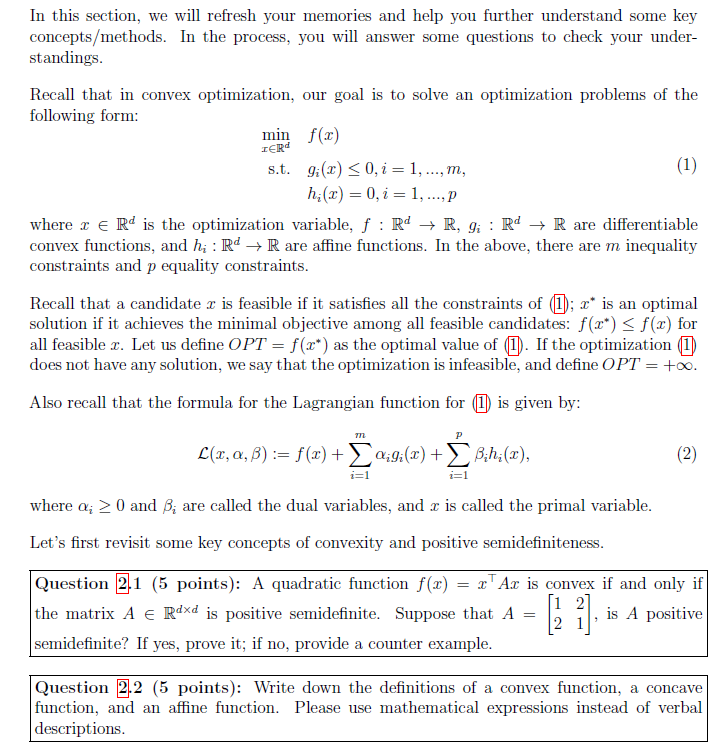
In this section, we will refresh your memories and help you further understand some key concepts/methods. In the process, you will answer some questions to check your understandings. Recall that in convex optimization, our goal is to solve an optimization problems of the following form: minxRds.t.f(x)gi(x)0,i=1,,m,hi(x)=0,i=1,,p where xRd is the optimization variable, f:RdR,gi:RdR are differentiable convex functions, and hi:RdR are affine functions. In the above, there are m inequality constraints and p equality constraints. Recall that a candidate x is feasible if it satisfies all the constraints of (1); x is an optimal solution if it achieves the minimal objective among all feasible candidates: f(x)f(x) for all feasible x. Let us define OPT=f(x) as the optimal value of (1). If the optimization (1) does not have any solution, we say that the optimization is infeasible, and define OPT=+. Also recall that the formula for the Lagrangian function for (1) is given by: L(x,,):=f(x)+i=1migi(x)+i=1pihi(x), where i0 and i are called the dual variables, and x is called the primal variable. Let's first revisit some key concepts of convexity and positive semidefiniteness. Question 2.1 (5 points): A quadratic function f(x)=xAx is convex if and only if the matrix ARdd is positive semidefinite. Suppose that A=[1221], is A positive semidefinite? If yes, prove it; if no, provide a counter example. Question 2.2 (5 points): Write down the definitions of a convex function, a concave function, and an affine function. Please use mathematical expressions instead of verbal descriptions
Step by Step Solution
There are 3 Steps involved in it

Get step-by-step solutions from verified subject matter experts
 Study Help