


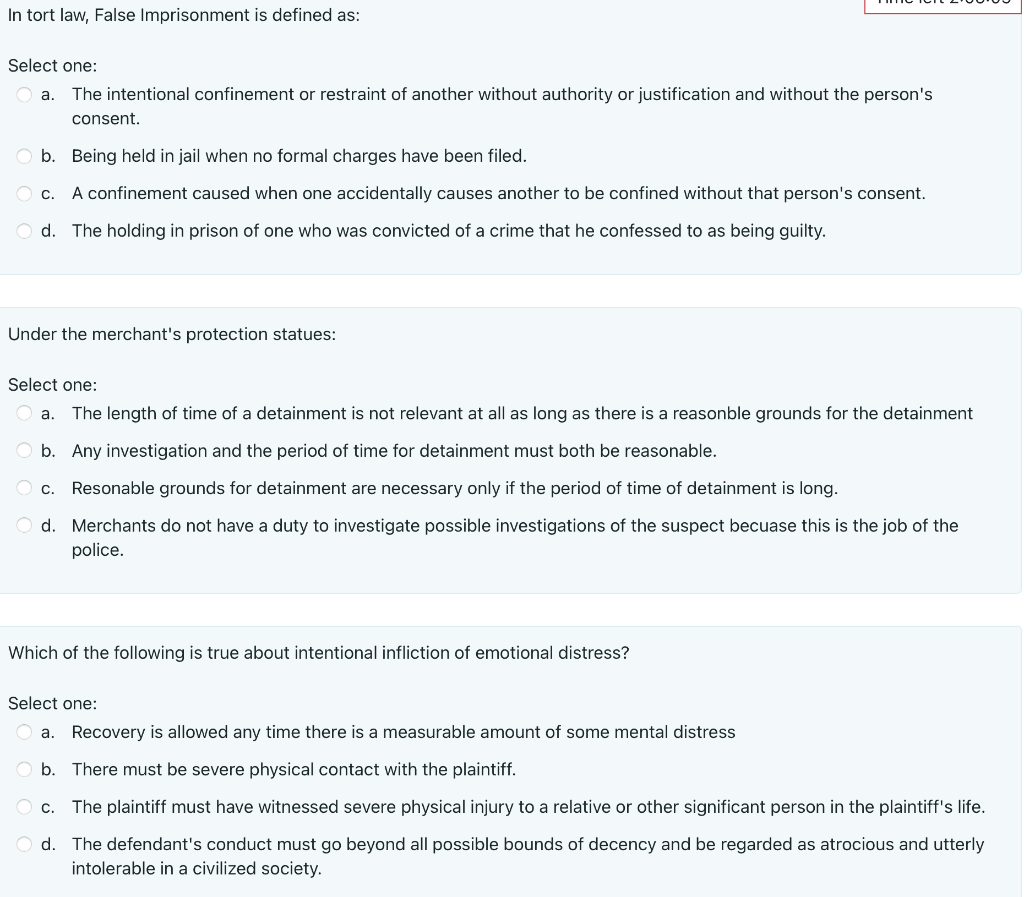
Question: In tort law, False Imprisonment is defined as: Select one: The intentional confinement or restraint of another without authority or justification and without the person's
In tort law, False Imprisonment is defined as:

In tort law, False Imprisonment is defined as: Select one: The intentional confinement or restraint of another without authority or justification and without the person's consent. a. b. Being held in jail when no formal charges have been filed. c. A confinement caused when one accidentally causes another to be confined without that person's consent. d. The holding in prison of one who was convicted of a crime that he confessed to as being guilty. Under the merchant's protection statues: Select one: The length of time of a detainment is not relevant at all as long as there is a reasonble grounds for the detainment a. b. Any investigation and the period of time for detainment must both be reasonable. c. Resonable grounds for detainment are necessary only if the period of time of detainment is long. d. Merchants do not have a duty to investigate possible investigations of the suspect becuase this is the job of the police. Which of the following is true about intentional infliction of emotional distress? Select one: a. Recovery is allowed any time there is a measurable amount of some mental distress b. There must be severe physical contact with the plaintiff. C. The plaintiff must have witnessed severe physical injury to a relative or other significant person in the plaintiff's life. d. The defendant's conduct must go beyond all possible bounds of decency and be regarded as atrocious and utterly intolerable in a civilized society

Step by Step Solution

There are 3 Steps involved in it

1 Expert Approved Answer
Step: 1 Unlock blur-text-image

Question Has Been Solved by an Expert!

Get step-by-step solutions from verified subject matter experts

Step: 2 Unlock
Step: 3 Unlock

Students Have Also Explored These Related General Management Questions!