







Question: In X86 Assembly code 1. Assume that you are dealing with 8 bit data, and you wish to be able to detect any 2 bit
In X86 Assembly code
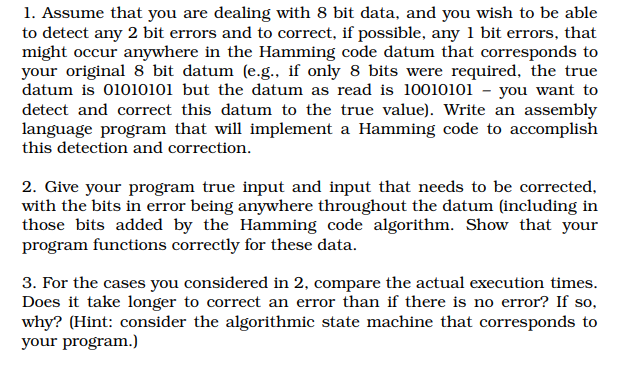
1. Assume that you are dealing with 8 bit data, and you wish to be able to detect any 2 bit errors and to correct, if possible, any 1 bit errors, that might occur anywhere in the Hamming code datum that corresponds to your original 8 bit datum (e.g., if only 8 bits were required, the true datum is 01010101 but the datum as read is 1001010 detect and correct this datum to the true value). Write an assembly language program that will implement a Hamming code to accomplish this detection and correction 1 - you want to 2. Give your program true input and input that needs to be corrected with the bits in error being anywhere throughout the datum (including in those bits added by the Hamming code algorithm. Show that your program functions correctly for these data. 3. For the cases you considered in 2, compare the actual execution times Does it take longer to correct an error than if there is no error? If so, why? (Hint: consider the algorithmic state machine that corresponds to your program.) 1. Assume that you are dealing with 8 bit data, and you wish to be able to detect any 2 bit errors and to correct, if possible, any 1 bit errors, that might occur anywhere in the Hamming code datum that corresponds to your original 8 bit datum (e.g., if only 8 bits were required, the true datum is 01010101 but the datum as read is 1001010 detect and correct this datum to the true value). Write an assembly language program that will implement a Hamming code to accomplish this detection and correction 1 - you want to 2. Give your program true input and input that needs to be corrected with the bits in error being anywhere throughout the datum (including in those bits added by the Hamming code algorithm. Show that your program functions correctly for these data. 3. For the cases you considered in 2, compare the actual execution times Does it take longer to correct an error than if there is no error? If so, why? (Hint: consider the algorithmic state machine that corresponds to your program.)
Step by Step Solution
There are 3 Steps involved in it

Get step-by-step solutions from verified subject matter experts
 Study Help