Question: In your analysis discuss and present your perspective on these: Start with the basic premise of the case. Briefly present the interpersonal dynamics of the
In your analysis discuss and present your perspective on these:
Start with the basic premise of the case.
Briefly present the interpersonal dynamics of the interviewing committee - what is your perspective on the situation apart from the selection process?
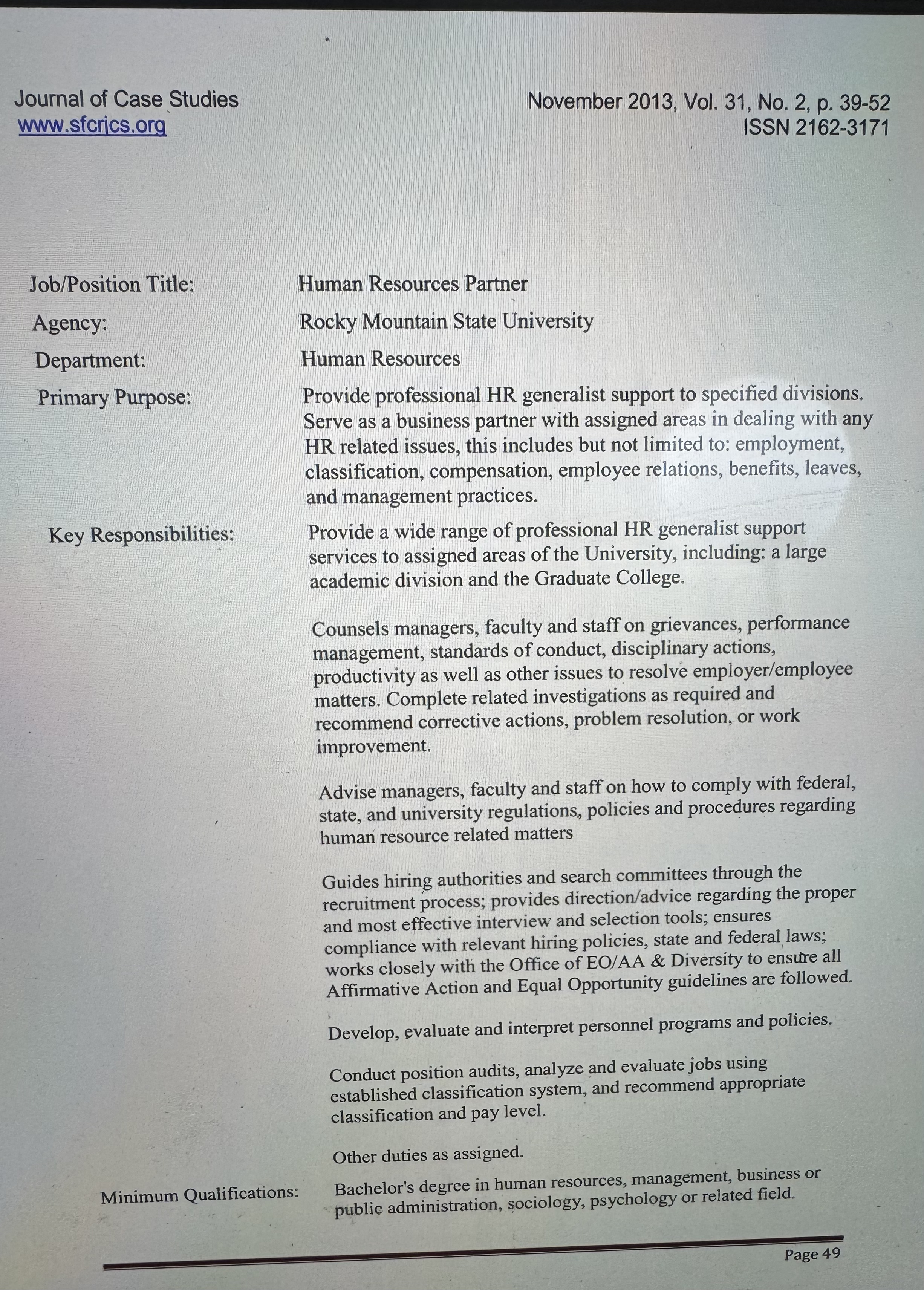
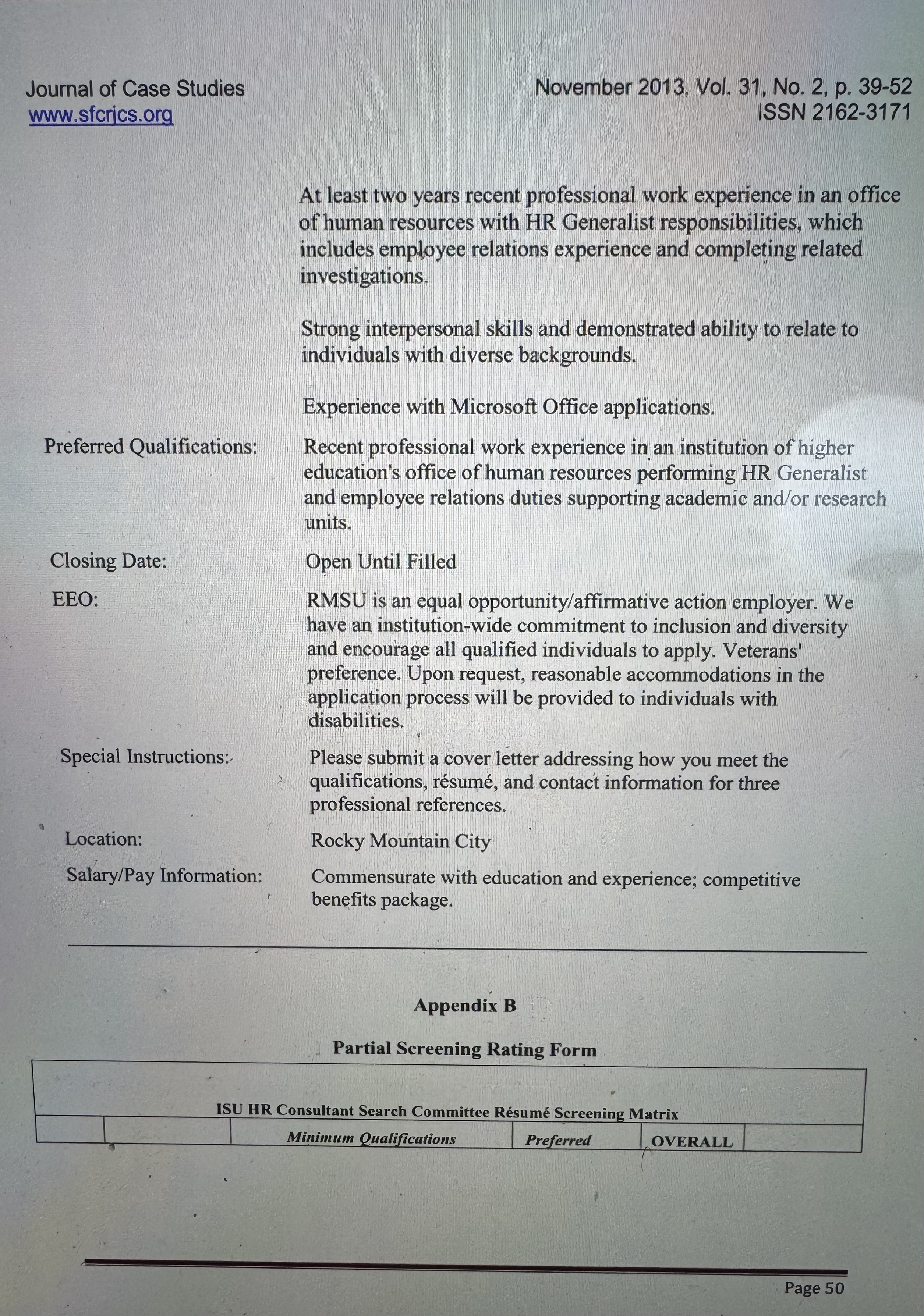
Read the job description and the requirements for the job - quite standard for the position
From externa assessment:
Discuss key dimensions of fit - for this position
Present which of the BIG 5 factors are relevant for the position and why?
Your recommendations of possible assessment methods that should be used to select the right candidate
You are free to add other concepts if these add value to the analysis.
You don't need to follow the sequence - write what you believe is a logical analysis, using topics areas that you seem relevant.
In your analysis discuss and present your perspective Consider the Following Questions in the Analysis as Apa formatfor it all to flow
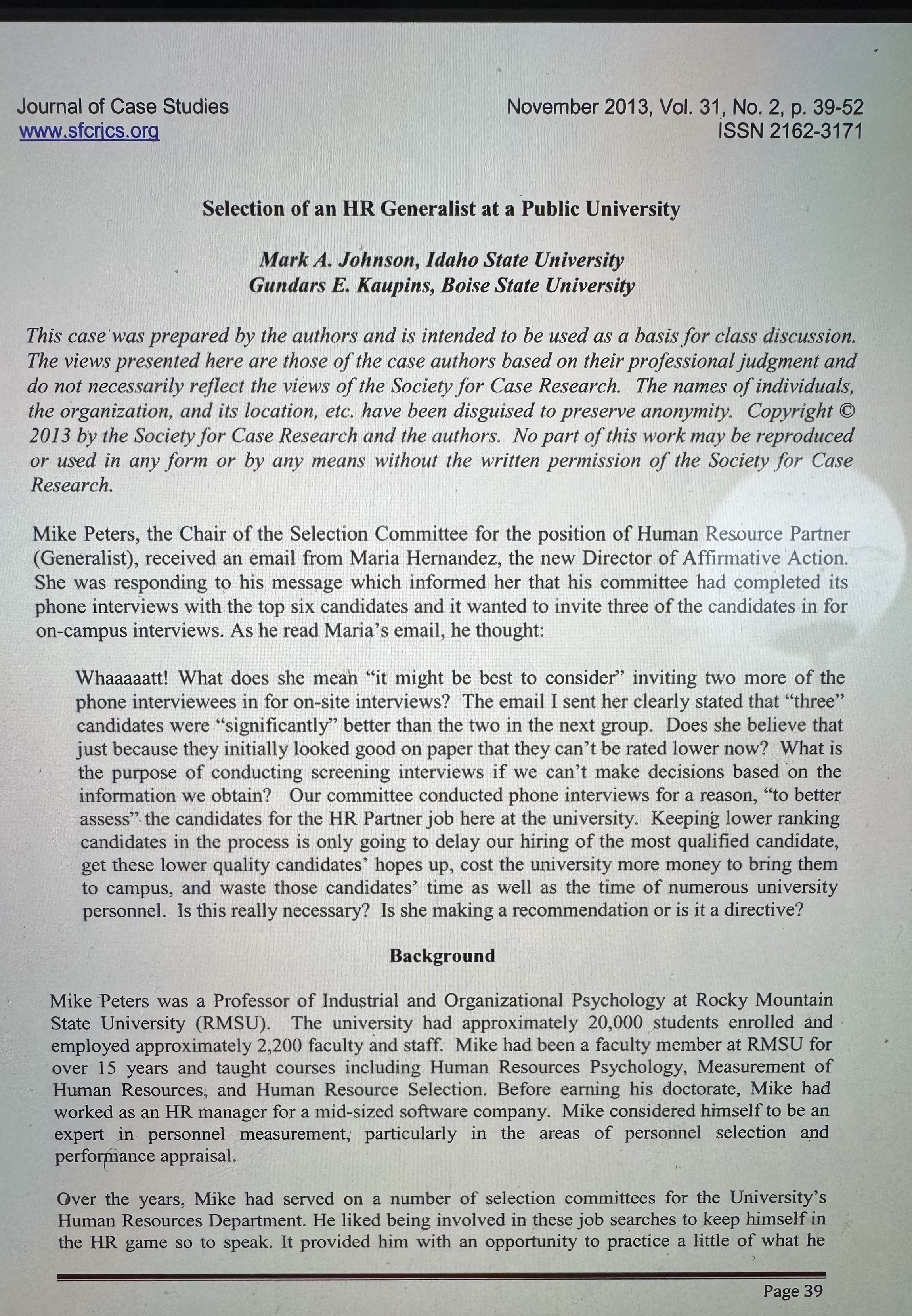
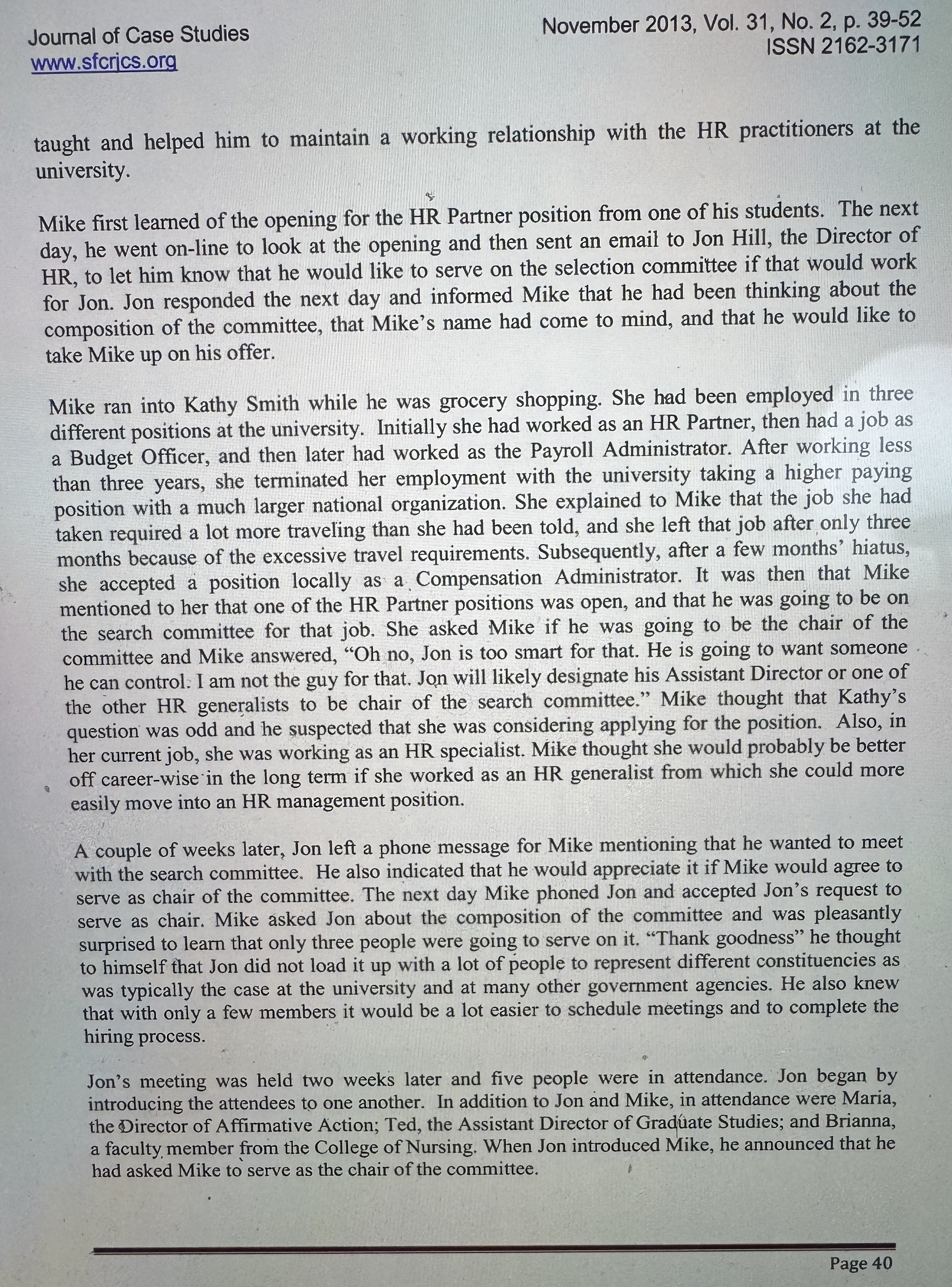
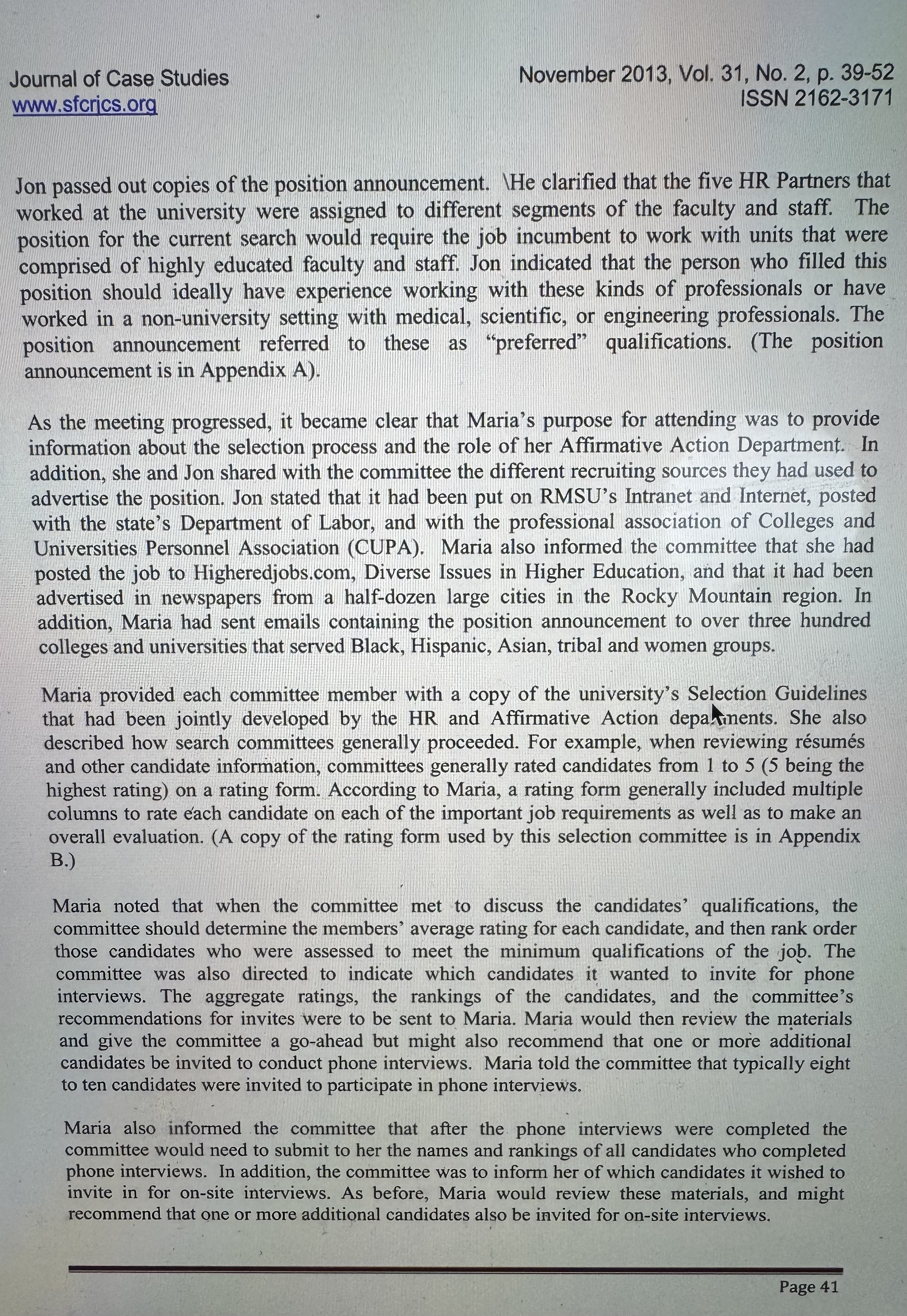
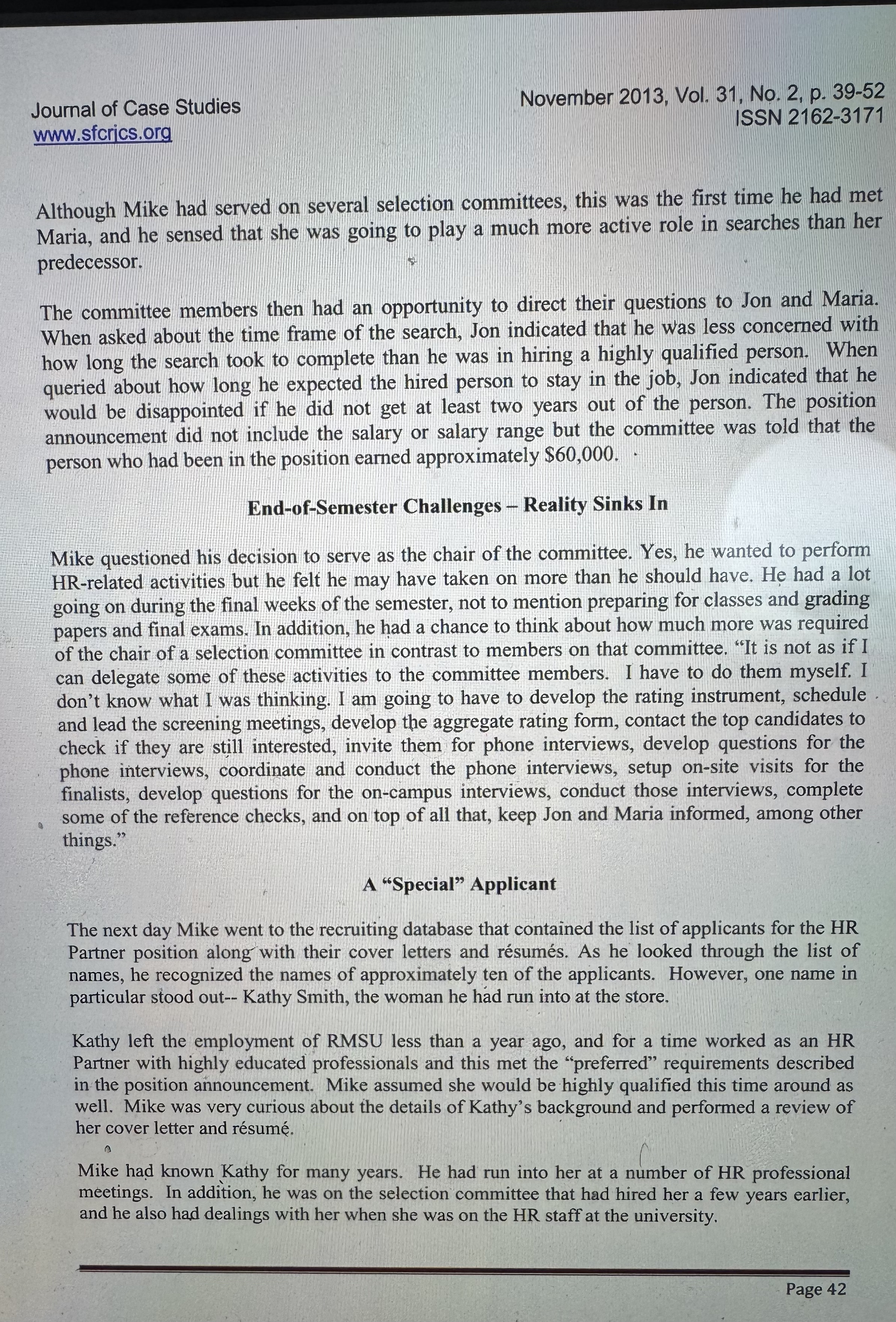
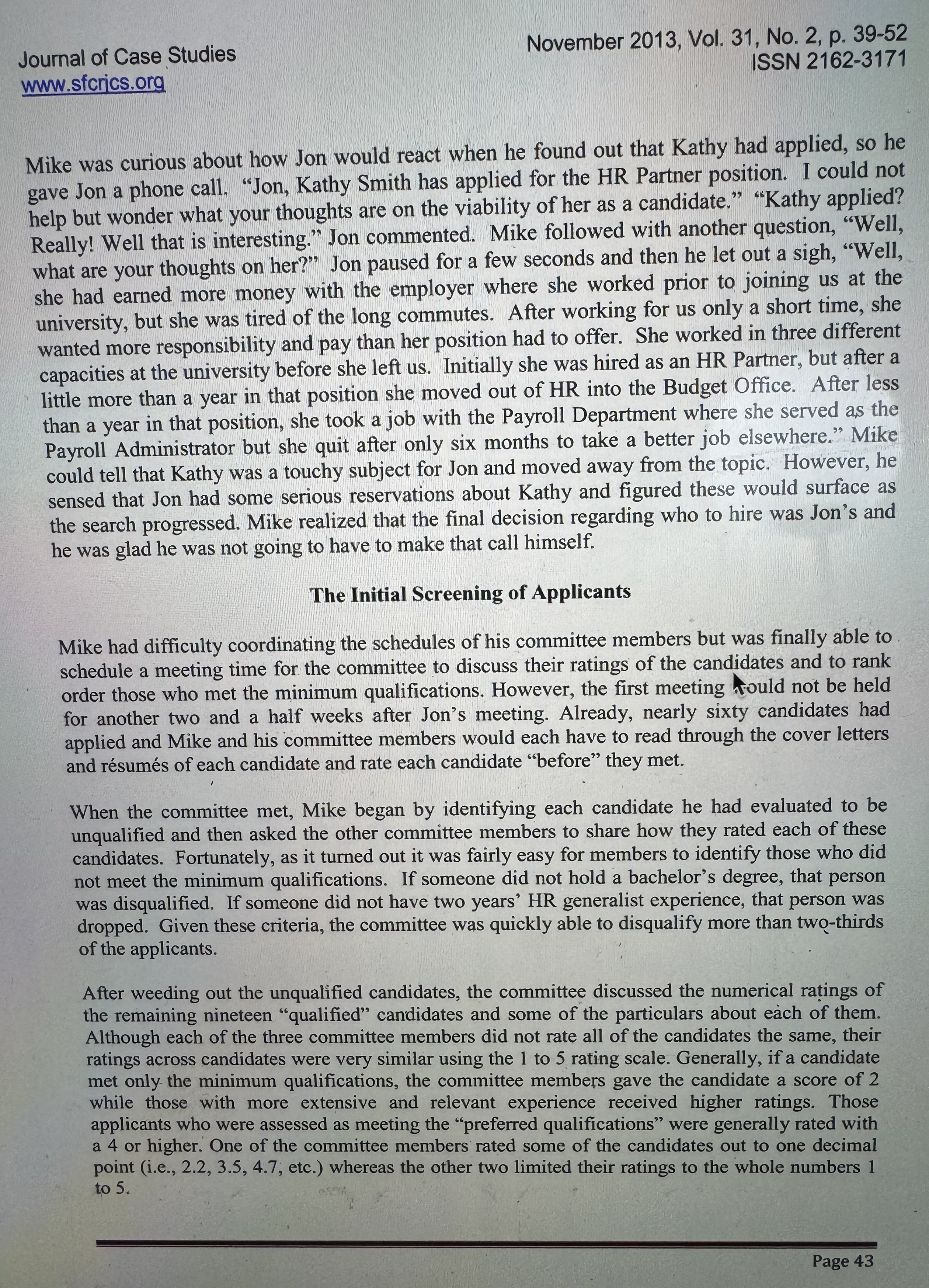
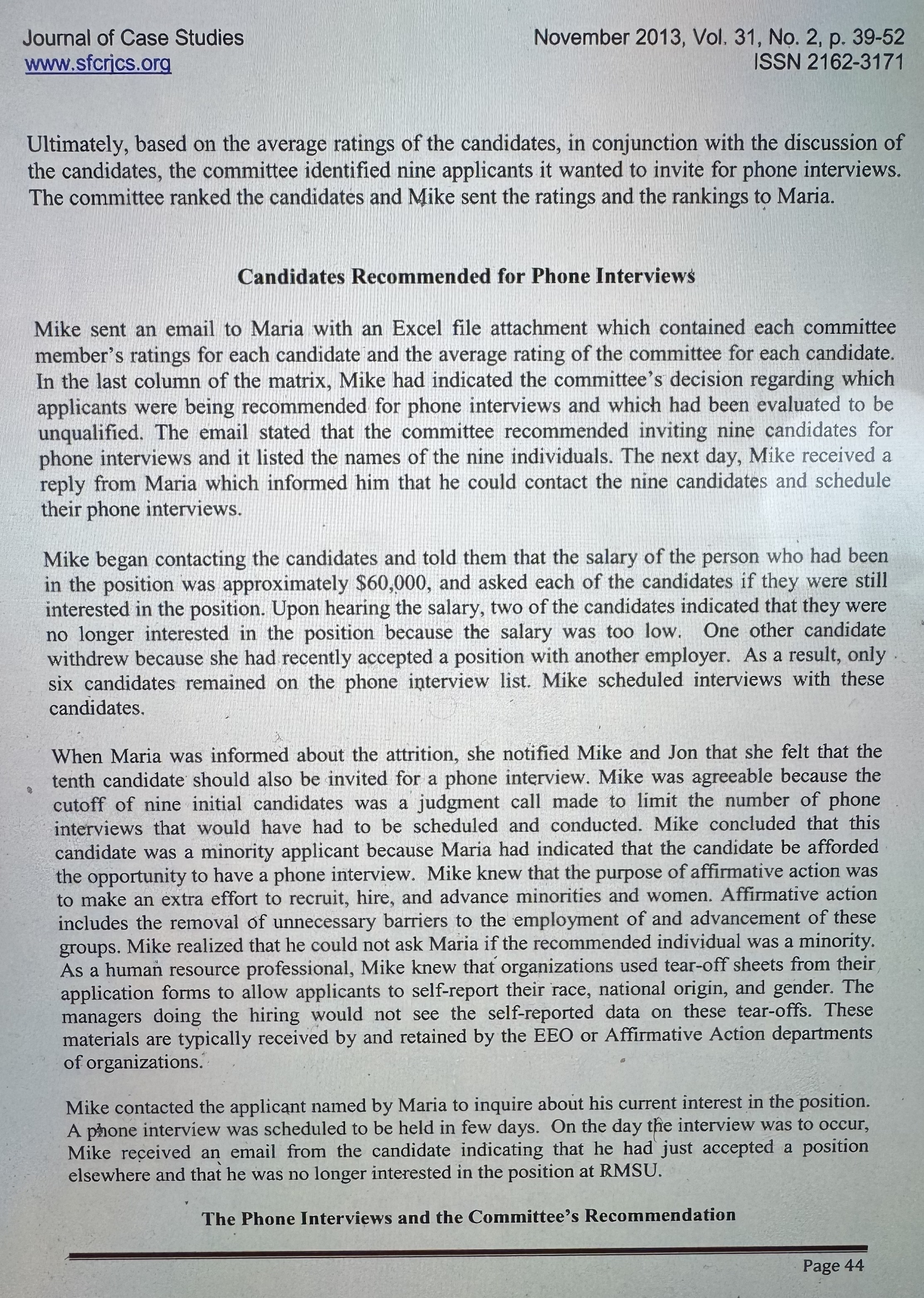
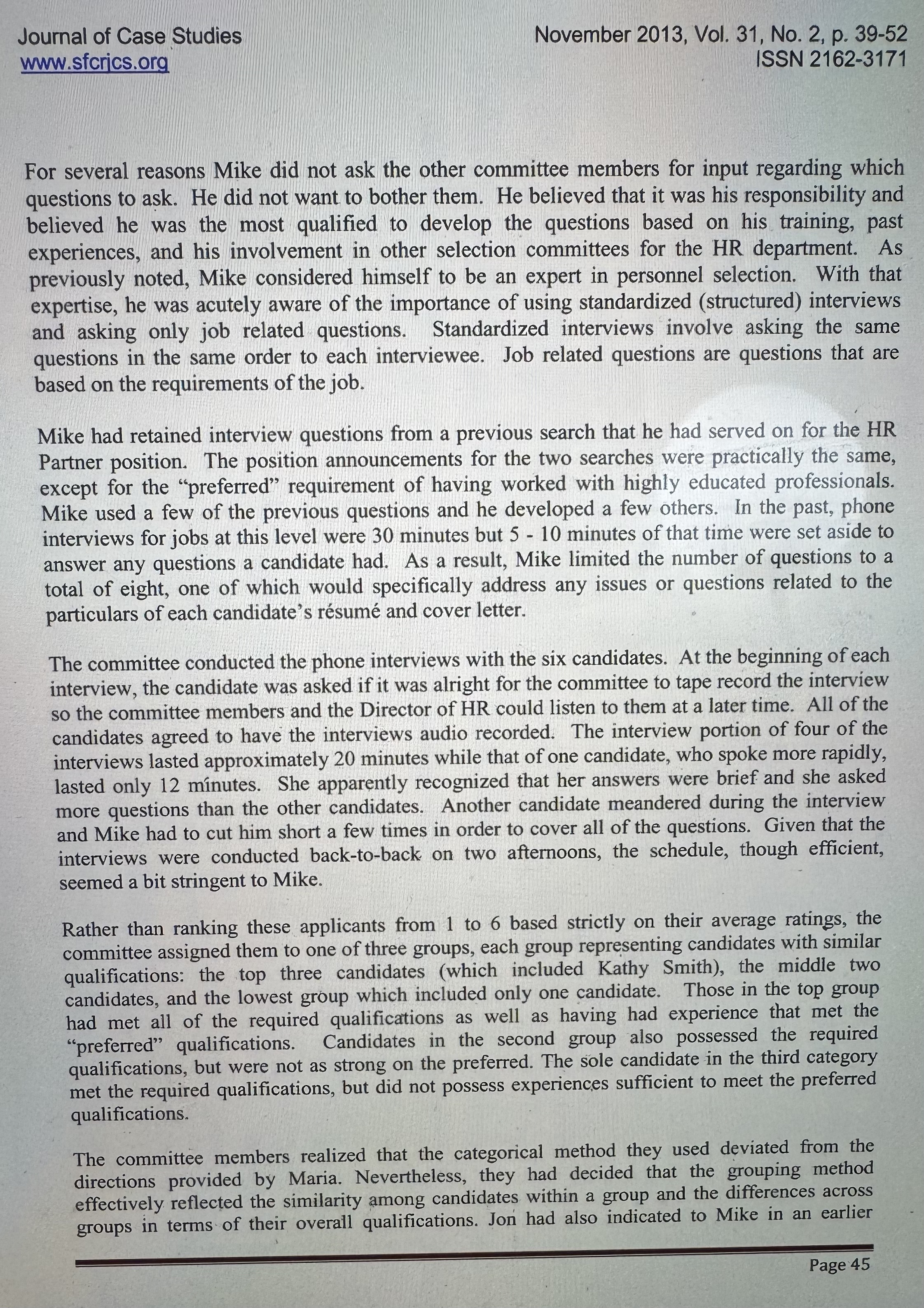
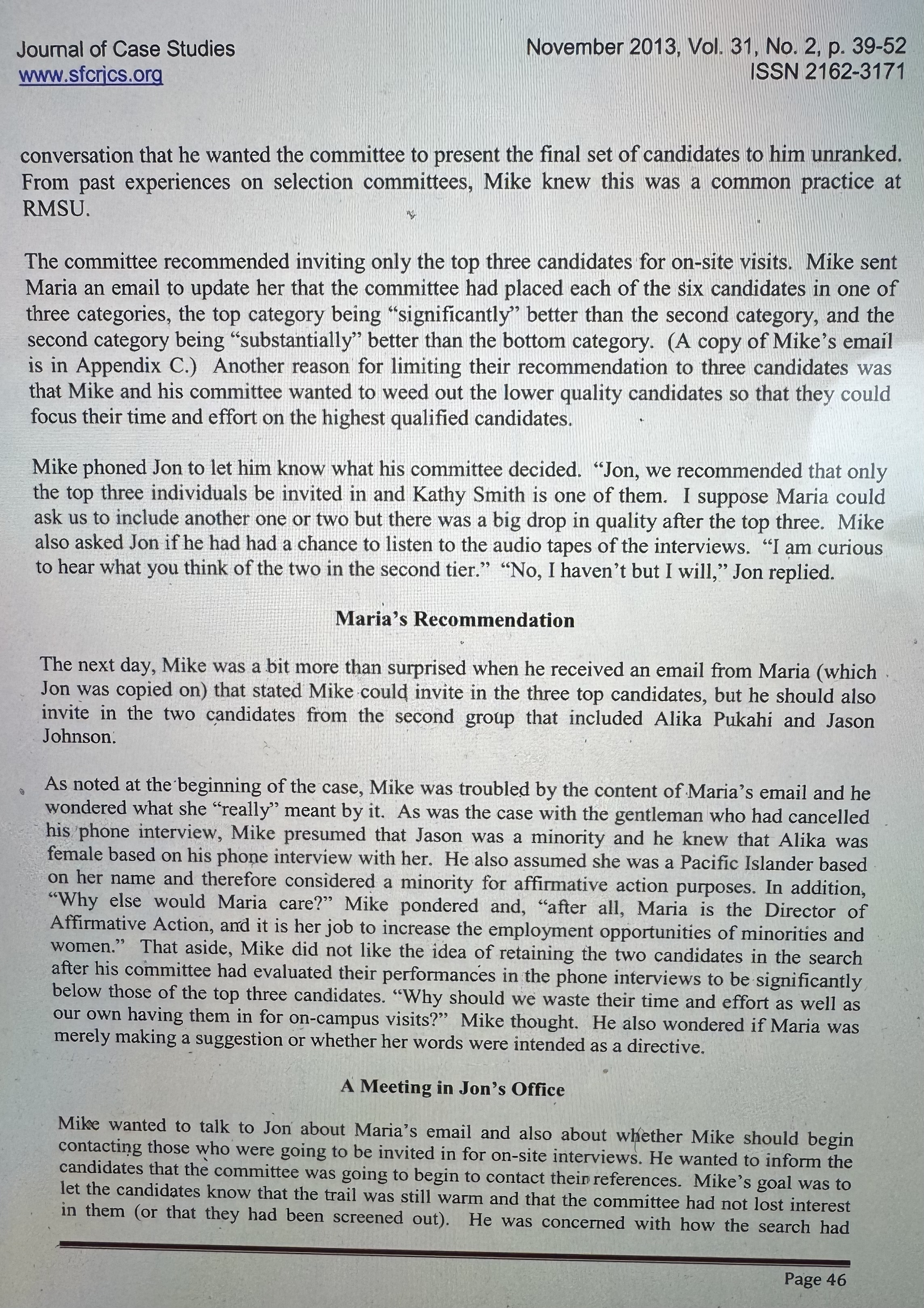
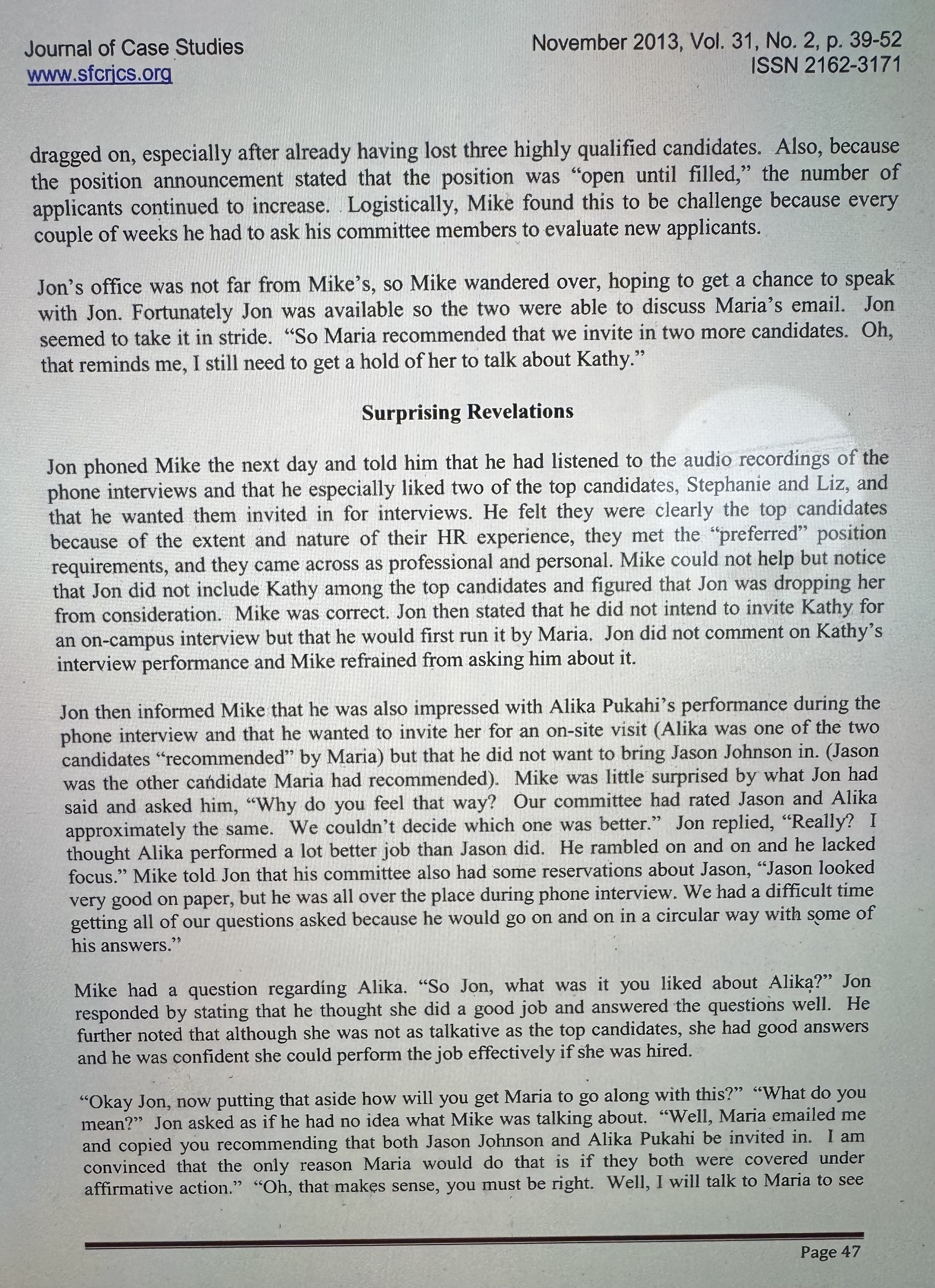
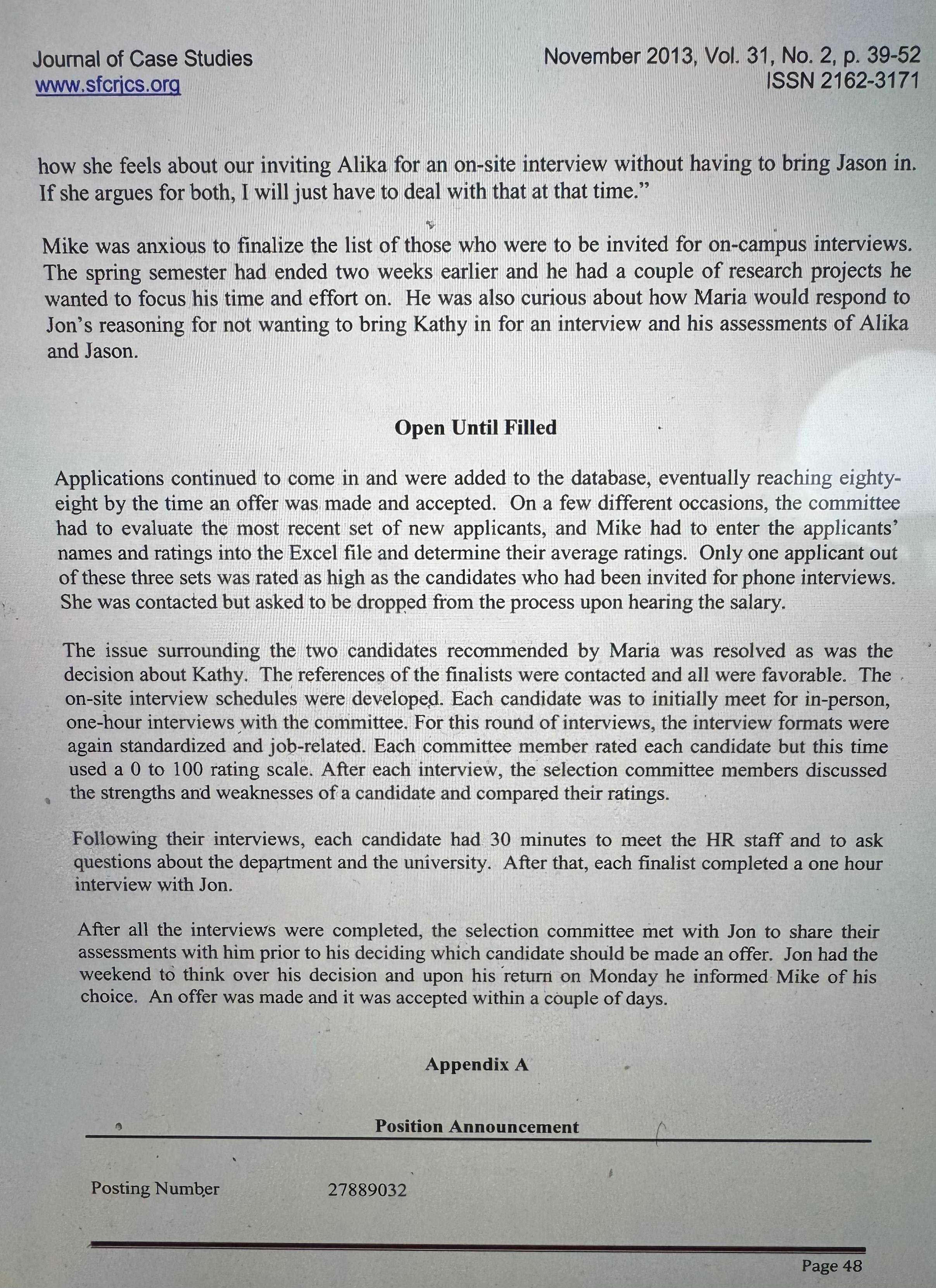
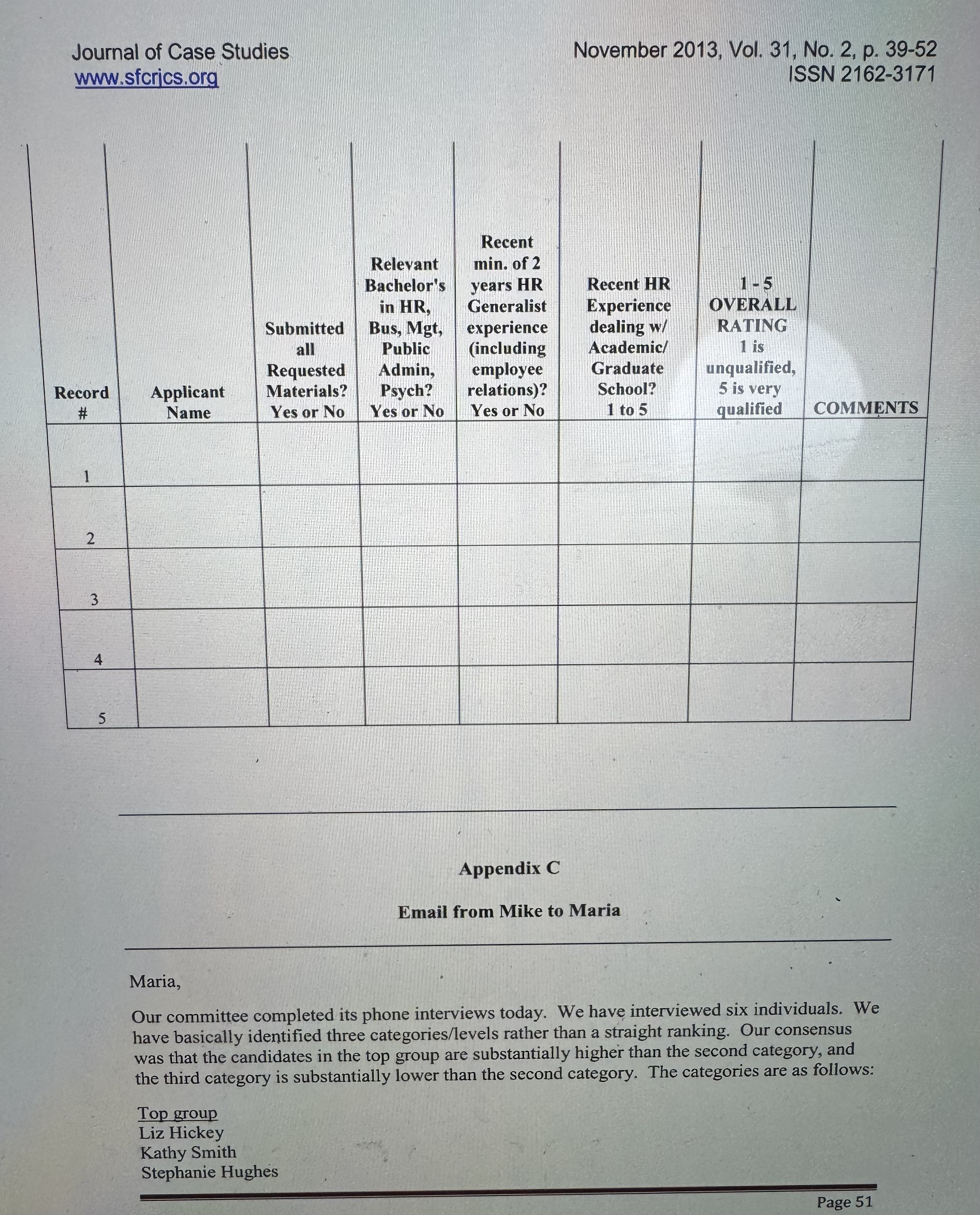
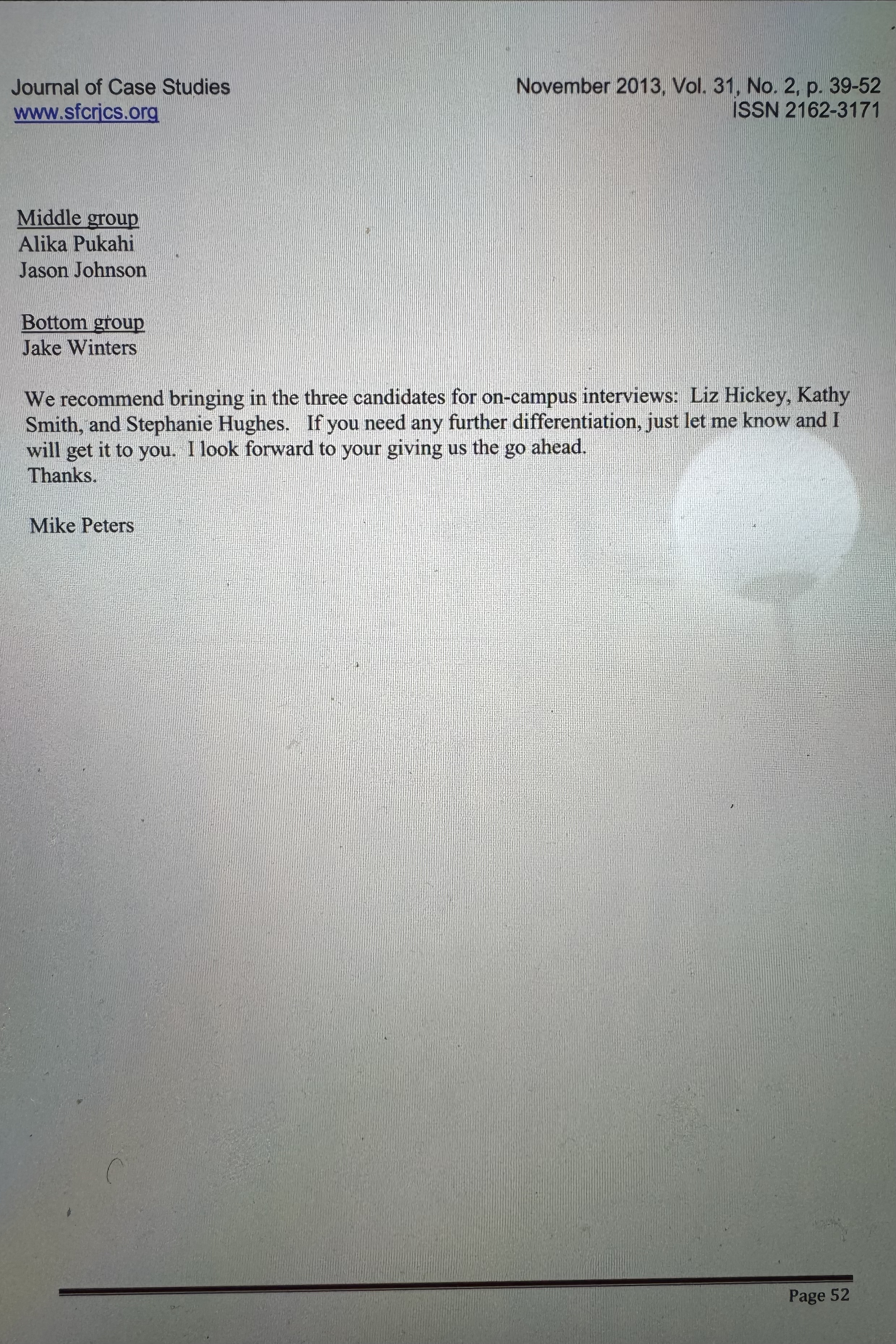
v Journal of Case Studies November 2013, Vol. 31, No. 2, p. 39-52 www.sfcrics.org ISSN 2162-3171 Selection of an HR Generalist at a Public University Mark A. Johnson, Idaho State University Gundars E. Kaupins, Boise State University This case'was prepared by the authors and is intended to be used as a basis for class discussion. The views presented here are those of the case authors based on their professional judgment and do not necessarily reflect the views of the Society for Case Research. The names of individuals, the organization, and its location, etc. have been disguised to preserve anonymity. Copyright 2013 by the Society for Case Research and the authors. No part of this work may be reproduced or used in any form or by any means without the written permission of the Society for Case Research. Mike Peters, the Chair of the Selection Committee for the position of Human Resource Partner (Generalist), received an email from Maria Hernandez, the new Director of Affirmative Action. She was responding to his message which informed her that his committee had completed its phone interviews with the top six candidates and it wanted to invite three of the candidates in for on-campus interviews. As he read Maria's email, he thought: Whaaaaatt! What does she mean \"it might be best to consider\" inviting two more of the phone interviewees in for on-site interviews? The email I sent her clearly stated that \"three\" candidates were \"significantly\" better than the two in the next group. Does she believe that just because they initially looked good on paper that they can't be rated lower now? What is the purpose of conducting screening interviews if we can't make decisions based on the information we obtain? Our committee conducted phone interviews for a reason, \"to better assess'\" the candidates for the HR Partner job here at the university. Keeping lower ranking candidates in the process is only going to delay our hiring of the most qualified candidate, get these lower quality candidates' hopes up, cost the university more money to bring them to campus, and waste those candidates' time as well as the time of numerous university personnel. Is this really necessary? Is she making a recommendation or is it a directive? Background Mike Peters was a Professor of Industrial and Organizational Psychology at Rocky Mountain State University (RMSU). The university had approximately 20,000 students enrolled and employed approximately 2,200 faculty and staff. Mike had been a faculty member at RMSU for over 15 years and taught courses including Human Resources Psychology, Measurement of Human Resources, and Human Resource Selection. Before earning his doctorate, Mike had worked as an HR manager for a mid-sized software company. Mike considered himself to be an expert in personnel measurement,; particularly in the areas of personnel selection and performance appraisal. ] QOver the years, Mike had served on a number of selection committees for the University's Human Resources Department. He liked being involved in these job searches to keep himself in the HR game so to speak. It provided him with an opportunity to practice a little of what he Page 39 Joumal of Case Studies November 2013, Vol. 31, No. 2, p. 39-52 www.sfcrics.org ISSN 2162-3171 taught and helped him to maintain a working relationship with the HR practitioners at the university. 5 . ( Mike first learned of the opening for the HR Partner position from one of his students. The next day, he went on-line to look at the opening and then sent an email to Jon Hill, the Director of HR, to let him know that he would like to serve on the selection committee if that would work for Jon. Jon responded the next day and informed Mike that he had been thinking about the composition of the committee, that Mike's name had come to mind, and that he would like to take Mike up on his offer. Mike ran into Kathy Smith while he was grocery shopping. She had been employed in three different positions at the university. Initially she had worked as an HR Partner, then had a job as a Budget Officer, and then later had worked as the Payroll Administrator. After working less than three years, she terminated her employment with the university taking a higher paying position with a much larger national organization. She explained to Mike that the job she had taken required a lot more traveling than she had been told, and she left that job after only three months because of the excessive travel requirements. Subsequently, after a few months' hiatus, she accepted a position locally as a. Compensation Administrator. It was then that Mike mentioned to her that one of the HR Partner positions was open, and that he was going to be on the search committee for that job. She asked Mike if he was going to be the chair of the committee and Mike answered, \"Oh no, Jon is too smart for that. He is going to want someone . ~ he can control: I am not the guy for that. Jon will likely designate his Assistant Director or one of the other HR generalists to be chair of the search committee.\" Mike thought that Kathy's question was odd and he suspected that she was considering applying for the position. Also, in her current job, she was working as an HR specialist. Mike thought she would probably be better off career-wise in the long term if she worked as an HR generalist from which she could more easily move into an HR management position. J A couple of weeks later, Jon left a phone message for Mike mentioning that he wanted to meet with the search committee. He also indicated that he would appreciate it if Mike would agree to " serve as chair of the committee. The next day Mike phoned Jon and accepted Jon's request to serve as chair. Mike asked Jon about the composition of the committee and was pleasantly surprised to learn that only three people were going to serve on it. \"Thank goodness\" he thought to himself that Jon did not load it up with a lot of people to represent different constituencies as. was typically the case at the university and at many other government agencies. He also knew that with only a few members it would be a lot easier to schedule meetings and to complete the hiring process. ' Jon's meeting was held two weeks later and five people were in attendance. Jon began by introducing the attendees to one another. In addition to Jon and Mike, in attendance were Maria, the Director of Affirmative Action; Ted, the Assistant Director of Gradate Studies; and Brianna, a faculty member from the College of Nursing. When Jon introduced Mike, he announced that he had asked Mike to serve as the chair of the committee. ' ' i STk - ' ' ' Page 40 Journal of Case Studies November 2013, Vol. 31, No. 2, p. 39-52 www.sferics.org | ISSN 2162-3171 Jon passed out copies of the position announcement. \\He clarified that the five HR Partners that worked at the university were assigned to different segments of the faculty and staff. The position for the current search would require the job incumbent to work with units that were comprised of highly educated faculty and staff. Jon indicated that the person who filled this position should ideally have experience working with these kinds of professionals or have worked in a non-university setting with medical, scientific, or engineering professionals. The position announcement referred to these as \"preferred\" qualifications. (The position announcement is in Appendix A). As the meeting progressed, it became clear that Maria's purpose for attending was to provide information about the selection process and the role of her Affirmative Action Department. In addition, she and Jon shared with the committee the different recruiting sources they had used to advertise the position, Jon stated that it had been put on RMSU's Intranet and Internet, posted with the state's Department of Labor, and with the professional association of Colleges and Universities Personnel Association (CUPA). Maria also informed the committee that she had posted the job to Higheredjobs.com, Diverse Issues in Higher Education, and that it had been advertised in newspapers from a half-dozen large cities in the Rocky Mountain region. In addition, Maria had sent emails containing the position announcement to over three hundred colleges and universities that served Black, Hispanic, Asian, tribal and women groups. Maria provided each committee member with a copy of the university's Selection Guidelines that had been jointly developed by the HR and Affirmative Action depa'_k'ments. She also described how search committees generally proceeded. For example, when reviewing rsumes and other candidate information, committees generally rated candidates from 1 to 5 (5 being the highest rating) on a rating form. According to Maria, a rating form generally included multiple columns to rate ach candidate on each of the important job requirements as well as to make an ~ overall evaluation. (A copy of the rating form used by this selection committee is in Appendix B.) Maria noted that when the committee met to discuss the candidates' qualifications, the committee should determine the members' average rating for each candidate, and then rank order those candidates who were assessed to meet the minimum qualifications of the job. The committee was also directed to indicate which candidates it wanted to invite for phone interviews. The aggregate ratings, the rankings of the candidates, and the committee's recommendations for invites were to be sent to Maria. Maria would then review the materials and give the committee a go-ahead but might also recommend that one or more additional candidates be invited to conduct phone interviews. Maria told the committee that typically eight to ten candidates were invited to participate in phone interviews. Maria also informed the committee that after the. phone- interviews were completed the committee would need to submit to her the names and rankings of all candidates who completed phone interviews. In addition, the committee was to inform her of which candidates it wished to invite in for on-site interviews. As before, Maria would review these materials, and might recommend that one or more additiqnal candidates also be invited for on-site interviews. 4 . - : .Pagedl Ul Joumnal of Cse Seldies November 2013, V'?l'"\"a""qfl'}';z' p. 39-52 www.sfcrics.org | | ISSN 21 Although Mike had served on several selection committees, this was the first time he had Maria, and he sensed that she was going to play a much more active role in searches thanher predecessor. 5 how long the search took to complete than he was in hiring a highly qualified person. When queried about how long he expected the hired person to stay in the job, Jon indicated thgt\\_he would be disappointed if he did not get at least two years out of the person. The position announcement did mot include the salary or salary range but the committee was told that the person who had been in the position earned approximately $60,000. - End-of-Semester Challenges Reality Sinks In Mike questioned his decision to serye as the chair of the committee. Yes, he wanted to perform HR-related activities but he felt he may have taken on more than he should have. He had a lot going on during the final weeks of the semester, not to mention preparing for classes and grading papers and final exams. In addition, he had a chance to think about how much more was required of the chair of a selection committee in contrast to members on that committee. \"It is not as if I can delegate some of these activities to the committee members. I have to do them myself. T don't know what 1 was thinking. I am going to have to develop the rating instrument, schedule - ~ and lead the screening meetings, develop the aggregate rating form, contact the top candidates to check if they are still interested, invite them for phone interviews, develop questions for the phone interviews, coordinate and conduct the phone interviews, setup on-site visits for the finalists, develop questions for the on-campus interviews, conduct those interviews, complete some of the reference checks, and on top of all that, keep Jon and Maria informed, among other things.\" ] A \"Special\" Applicant The next day Mike went to the recruiting database that contained the list of applicants for the HR Partner position along with their cover letters and rsums. As he looked through the list of names, he rqecognized the names of approximately ten of the applicants. However, one name in particular stood out-- Kathy Smith, the woman he had run into at the store. Kathy left the employment of RMSU less than a year ago, and for a time worked as an HR - Partner with highly educated professionals and this met the \"preferred\" requirements described in the position announcement. Mike assumed she would be highly qualified this time around as well. Mike was very curious about the details of Kathy's background and performed a review of her cover letter and rsum. ' s A \\ Mike_ had lcnown';l'(athy for many years. He had run into her at a number of HR professional meetings. In adqun, he was on the selection committee that had hired her a few years earlier, and he also had dealings with her when she was on the HR staff at the university. 'm ' : : s - Page 42 62-3171 The committee members then had an opportunity to direct their questions to Jon and Mana When asked about the time frame of the search, Jon indicated that he was less concerned with | Journal of Case Studies November 2013, Vol. 31, No. 2, p. 39-52 www.sfcrics.org ISSN 2162-3171 Mike was curious about how Jon would react when he found out that Kathy had applied, so he gave Jon a phone call. "Jon, Kathy Smith has applied for the HR Partner position. I could not help but wonder what your thoughts are on the viability of her as a candidate." "Kathy applied? Really! Well that is interesting." Jon commented. Mike followed with another question, "Well, what are your thoughts on her?" Jon paused for a few seconds and then he let out a sigh, "Well, she had earned more money with the employer where she worked prior to joining us at the university, but she was tired of the long commutes. After working for us only a short time, she wanted more responsibility and pay than her position had to offer. She worked in three different capacities at the university before she left us. Initially she was hired as an HR Partner, but after a little more than a year in that position she moved out of HR into the Budget Office. After less than a year in that position, she took a job with the Payroll Department where she served as the Payroll Administrator but she quit after only six months to take a better job elsewhere." Mike could tell that Kathy was a touchy subject for Jon and moved away from the topic. However, he sensed that Jon had some serious reservations about Kathy and figured these would surface as the search progressed. Mike realized that the final decision regarding who to hire was Jon's and he was glad he was not going to have to make that call himself. The Initial Screening of Applicants Mike had difficulty coordinating the schedules of his committee members but was finally able to schedule a meeting time for the committee to discuss their ratings of the candidates and to rank order those who met the minimum qualifications. However, the first meeting would not be held for another two and a half weeks after Jon's meeting. Already, nearly sixty candidates had applied and Mike and his committee members would each have to read through the cover letters and resumes of each candidate and rate each candidate "before" they met. When the committee met, Mike began by identifying each candidate he had evaluated to be unqualified and then asked the other committee members to share how they rated each of these candidates. Fortunately, as it turned out it was fairly easy for members to identify those who did not meet the minimum qualifications. If someone did not hold a bachelor's degree, that person was disqualified. If someone did not have two years' HR generalist experience, that person was dropped. Given these criteria, the committee was quickly able to disqualify more than two-thirds of the applicants. After weeding out the unqualified candidates, the committee discussed the numerical ratings of the remaining nineteen "qualified" candidates and some of the particulars about each of them. Although each of the three committee members did not rate all of the candidates the same, their ratings across candidates were very similar using the 1 to 5 rating scale. Generally, if a candidate met only the minimum qualifications, the committee members gave the candidate a score of 2 while those with more extensive and relevant experience received higher ratings. Those applicants who were assessed as meeting the "preferred qualifications" were generally rated with a 4 or higher. One of the committee members rated some of the candidates out to one decimal point (i.e., 2.2, 3.5, 4.7, etc.) whereas the other two limited their ratings to the whole numbers 1 to 5. Page 43Joumal of Case Studies November 2013, Vol. 31, No. 2, p. 39-52 www.sfcrics.org ISSN 2162-3171 Ultimately, based on the average ratings of the candidates, in conjunction with the discussion of the candidates, the committee identified nine applicants it wanted to invite for phone interviews. The committee ranked the candidates and Mike sent the ratings and the rankings to Maria. Candidates Recommended for Phone Interviews Mike sent an email to Maria with an Excel file attachment which contained each committee member's ratings for each candidate and the average rating of the committee for each candidate. In the last column of the matrix, Mike had indicated the committee's decision regarding which applicants were being recommended for phone interviews and which had been evaluated to be unqualified. The email stated that the committee recommended inviting nine candidates for phone interviews and it listed the names of the nine individuals. The next day, Mike received a reply from Maria which informed him that he could contact the nine candidates and schedule their phone interviews. Mike began contacting the candidates and told them that the salary of the person who had been in the position was approximately $60,000, and asked each of the candidates if they were still interested in the position. Upon hearing the salary, two of the candidates indicated that they were no longer interested in the position because the salary was too low. One other candidate withdrew because she had recently accepted a position with another employer. As a result, only . six candidates remained on the phone interview list. Mike scheduled interviews with these candidates. : When Maria was informed about the attrition, she notified Mike and Jon that she felt that the tenth candidate should also be invited for a phone interview. Mike was agreeable because the cutoff of nine initial candidates was a judgment call made to limit the number of phone interviews that would have had to be scheduled and conducted. Mike concluded that this candidate was a minority applicant because Maria had indicated that the candidate be afforded the opportunity to have a phone interview. Mike knew that the purpose of affirmative action was to make an extra effort to recruit, hire, and advance minorities and women. Affirmative action includes the removal of unnecessary barriers to the employment of and advancement of these groups. Mike realized that he could not ask Maria if the recommended individual was a minority. As a human resource professional, Mike knew that organizations used tear-off sheets from their, application forms to allow applicants to self-report their race, national origin, and gender. The managers doing the hiring would not see the self-reported data on these tear-offs. These materials are typically received by and retained by the EEO or Affirmative Action departments of organizations. ' ' . Mike contacted the applicant named by Maria to inquire about his current interest in the position. A phone interview was scheduled to be held in few days. On the day the interview was to occur, Mike received an email from the candidate indicating that he had just accepted a position elsewhere and that he was no longer interested in the position at RMSU. The Phone Interviews and the Committee's Recommendation ____!' 4l - : Page 44 Journal of Case Studies f November 2013, Vol. 31, No. 2, p. 39-52 www.sfcrics.orgq ISSN 2162-3171 For several reasons Mike did not ask the other committee members for input regarding which questions to ask. He did not want to bother them. He believed that it was his responsibility and believed he was the most qualified to develop the questions based on his training, past experiences, and his involvement in other selection committees for the HR department. As previously noted, Mike considered himself to be an expert in personnel selection. With that expertise, he was acutely aware of the importance of using standardized (structured) interviews and asking only job related questions. Standardized interviews involve asking the same questions in the same order to each interviewee. Job related questions are questions that are based on the requirements of the job. Mike had retained interview questions from a previous search that he had served on for the HR Partner position. The position announcements for the two searches were practically the same, except for the \"preferred\" requirement of having worked with highly educated professionals. Mike used a few of the previous questions and he developed a few others. In the past, phone interviews for jobs at this level were 30 minutes but 5 - 10 minutes of that time were set aside to answer any questions a candidate had. As a result, Mike limited the number of questions to a total of eight, one of which would specifically address any issues or questions related to the particulars of each candidate's rsum and cover letter. The committee conducted the phone interviews with the six candidates. At the beginning of each interview, the candidate was asked if it was alright for the committee to tape record the interview so the committee members and the Director of HR could listen to them at a later time. All of the candidates agreed to have the interviews audio recorded. The interview portion of four of the interviews lasted approximately 20 minutes while that of one candidate, who spoke more rapidly, lasted only 12 minutes. She apparently recognized that her answers were brief and she asked more questions than the other candidates. Another candidate meandered during the interview and Mike had to cut him short a few times in order to cover all of the questions. Given that the interviews were conducted back-to-back on two afternoons, the schedule, though efficient, seemed a bit stringent to Mike. : Rather than ranking these applicants from 1 to 6 based strictly on their average ratings, the committee assigned them to one of three groups, each group representing candidates with similar qualifications: the top three candidates (which included Kathy Smith), the middle two candidates, and the lowest group which included only one candidate. Those in the top group had met all of the required qualifications as well as having had experience that met the \"preferred\" qualifications. ~ Candidates in the second group also possessed the required qualifications, but were not as strong on the preferred. The sole candidate in the third category met the required qualifications, but did not possess experiences sufficient to meet the preferred qualifications. - The committee members realized that the categorical method they used deviated from the directions provided by Maria. Nevertheless, they had decided that the grouping method effectively reflected the similarity among candidates within a group and the differences across groups in terms: of their overall qualifications. Jon had also indicated to Mike in an earlier Page 45 Joumal of Case Studies November 2013, Vol. 31, No. 2, p. 39-52 www.sfcrics.org ISSN 2162-3171 conversation that he wanted the committee to present the final set of candidates to him unr'a'nked. From past experiences on selection committees, Mike knew this was a common practice at RMSU. " ! The committee recommended inviting only the top three candidates for on-site visits. Mike sent Maria an email to update her that the committee had placed each of the six candidates in one of three categories, the top category being \"significantly\" better than the second category, and the second category being \"substantially\" better than the bottom category. (A copy of Mike's email 1s in Appendix C.) Another reason for limiting their recommendation to three candidates was that Mike and his committee wanted to weed out the lower quality candidates so that they could focus their time and effort on the highest qualified candidates. Mike phoned Jon to let him know what his committee decided. \"Jon, we recommended that only the top three individuals be invited in and Kathy Smith is one of them. I suppose Maria could ask us to include another one or two but there was a big drop in quality after the top three. Mike also asked Jon if he had had a chance to listen to the audio tapes of the interviews. \"I am curious to hear what you think of the two in the second tier.\" \"No, I haven't but I will,\" Jon replied. Maria's Recommendation The next day, Mike was a bit more than surprised when he received an email from Maria (which . _ Jon was copied on) that stated Mike -could invite in the three top candidates, but he should also invite in the two candidates from the second group that included Alika Pukahi and Jason Johnson:; - ' ' : As noted at the beginning of the case, Mike was troubled by the content of Maria's email and he wondered what she \"really\" meant by it. As was the case with the gentleman who had cancelled ~ his 'phone interview, Mike presumed that Jason was a minority and he knew that Alika was female based on his phone interview with her. He also assumed she was a Pacific Islander based - on her name and therefore considered a minority for affirmative action purposes. In addition, \"Why else would Maria care?\" Mike pondered and, \"after all, Maria is the Director of Affirmative Action, and it is her Job to increase the employment opportunities of minorities and women.\" That aside, Mike did not like the idea of retaining the two candidates in the search after his committee had evaluated their performances in the phone interviews to be significantly below those of the top three candidates _ . \"Why should we waste their time and effort as well as our own having them in for on-campus visits?\" Mike thought. He also wondered if Maria was : merely making a suggestion or whether her words were intended as a directive. o A Meeting in Jon's Office Mike wanted to talk to Jon about Maria's email and also about contacting those who were going to be invited in for on candidates that the committee was going to begin to co let the candidates know that the trail was still warm in them (or that they had been screened out). wlzfther Mike should begin -site interviews. He wanted to inform the ntact their references. Mike's goal was to and that the committee had not lost interest He was concerned with how the search had Page 46 Journal of Case Studies November 2013, Vol. 31, No. 2, p. 39-62 www.sfcrics.org ISSN 2162-3171 dragged on, especially after already having lost three highly qualified candidates. Also, because the position announcement stated that the position was \"open until filled,\" the number of applicants continued to increase. = Logistically, Mike found this to be challenge because every couple of weeks he had to ask his committee members to evaluate new applicants. Jon's office was not far from Mike's, so Mike wandered over, hoping to get a chance to speak with Jon. Fortunately Jon was available so the two were able to discuss Maria's email. Jon seemed to take it in stride. \"So Maria recommended that we invite in two more candidates. Oh, that reminds me, I still need to get a hold of her to talk about Kathy.\" Surprising Revelations Jon phoned Mike the next day and told him that he had listened to the audio recordings of the phone interviews and that he especially liked two of the top candidates, Stephanie and Liz, and that he wanted them invited in for interviews. He felt they were clearly the top candidates because of the extent and nature of their HR experience, they met the \"preferred\" position requirements, and they came across as professional and personal. Mike could not help but notice that Jon did not include Kathy among the top candidates and figured that Jon was dropping her from consideration. Mike was correct. Jon then stated that he did not intend to invite Kathy for an on-campus interview but that he would first run it by Maria. Jon did not comment on Kathy's interview performance and Mike refrained from asking him about it. Jon then informed Mike that he was also impressed with Alika Pukahi's performance during the phone interview and that he wanted to invite her for an on-site visit (Alika was one of the two candidates \"recommended\" by Maria) but that he did not want to bring Jason Johnson in. (Jason was the other candidate Maria had recommended). Mike was little surprised by what Jon had said and asked him, \"Why do you feel that way? Our committee had rated Jason and Alika approximately the same. We couldn't decide which one was better.\" Jon replied, \"Really? I thought Alika performed a lot better job than Jason did. He rambled on and on and he lacked focus.\" Mike told Jon that his committee also had some reservations about Jason, \"Jason looked very good on paper, but he was all over the place during phone interview. We had a difficult time getting all of our questions asked because he would go on and on in a circular way with some of his answers.\" ' Mike had a question regarding Alika. \"So Jon, what was it you liked about Alika?\" Jon responded by stating that he thought she did a good job and answered the questions well. He further noted that although she was not as talkative as the top candidates, she had good answers and he was confident she could perform the job effectively if she was hired. \"Qkay Jon, now putting that aside how will you get Maria to go along with this?\" \"What do you mean?\" Jon asked as if he had no idea what Mike was talking about. \"Well, Maria emailed me and copied you recommending that both Jason Johnson and Alika Pukahi be invited in. I am convinced that the only reason Maria would do that is if they both were covered under affirmative action.\" \"Oh, that makes sense, you must be right. Well, I will talk to Maria to see % Page 47 Journal of Case Studies November 2013, Vol. 31, No. 2, p. 39-52 www.sfcrics.org ISSN 2162-3171 how she feels about our inviting Alika for an on-site interview without having to bring Jason in. If she argues for both, I will just have to deal with that at that time." Mike was anxious to finalize the list of those who were to be invited for on-campus interviews. The spring semester had ended two weeks earlier and he had a couple of research projects he wanted to focus his time and effort on. He was also curious about how Maria would respond to Jon's reasoning for not wanting to bring Kathy in for an interview and his assessments of Alika and Jason. Open Until Filled Applications continued to come in and were added to the database, eventually reaching eighty- eight by the time an offer was made and accepted. On a few different occasions, the committee had to evaluate the most recent set of new applicants, and Mike had to enter the applicants' names and ratings into the Excel file and determine their average ratings. Only one applicant out of these three sets was rated as high as the candidates who had been invited for phone interviews. She was contacted but asked to be dropped from the process upon hearing the salary. The issue surrounding the two candidates recommended by Maria was resolved as was the decision about Kathy. The references of the finalists were contacted and all were favorable. The on-site interview schedules were developed. Each candidate was to initially meet for in-person, one-hour interviews with the committee. For this round of interviews, the interview formats were again standardized and job-related. Each committee member rated each candidate but this time used a 0 to 100 rating scale. After each interview, the selection committee members discussed the strengths and weaknesses of a candidate and compared their ratings. Following their interviews, each candidate had 30 minutes to meet the HR staff and to ask questions about the department and the university. After that, each finalist completed a one hour interview with Jon. After all the interviews were completed, the selection committee met with Jon to share their assessments with him prior to his deciding which candidate should be made an offer. Jon had the weekend to think over his decision and upon his return on Monday he informed Mike of his choice. An offer was made and it was accepted within a couple of days. Appendix A Position Announcement Posting Number 27889032 Page 48Journal of Case Studies November 2013, Vol. 31, No. 2, p. 39-52 www.sfcrics.org ISSN 2162-3171 Job/Position Title: Human Resources Partner Agency: Rocky Mountain State University Department: Human Resources Primary Purpose: Provide professional HR generalist support to specified divisions. Serve as a business partner with assigned areas in dealing with any HR related issues, this includes but not limited to: employment, classification, compensation, employee relations, benefits, leaves, and management practices. Key Responsibilities: Provide a wide range of professional HR generalist support services to assigned areas of the University, including: a large academic division and the Graduate College. Counsels managers, faculty and staff on grievances, performance management, standards of conduct, disciplinary actions, productivity as well as other issues to resolve employer/employee matters. Complete related investigations as required and recommend corrective actions, problem resolution, or work improvement. Advise managers, faculty and staff on how to comply with federal, state, and university regulations, policies and procedures regarding human resource related matters Guides hiring authorities and search committees through the recruitment process; provides direction/advice regarding the proper and most effective interview and selection tools; ensures compliance with relevant hiring policies, state and federal laws; works closely with the Office of EO/AA & Diversity to ensure all Affirmative Action and Equal Opportunity guidelines are followed. Develop, evaluate and interpret personnel programs and policies. Conduct position audits, analyze and evaluate jobs using established classification system, and recommend appropriate classification and pay level. Other duties as assigned. Minimum Qualifications: Bachelor's degree in human resources, management, business or public administration, sociology, psychology or related field. Page 49Journal of Case Studies November 2013, Vol. 31, No. 2, p. 39-52 www.sfcrics.org ISSN 2162-3171 At least two years recent professional work experience in an office of human resources with HR Generalist responsibilities, which includes employee relations experience and completing related investigations. Strong interpersonal skills and demonstrated ability to relate to individuals with diverse backgrounds. Experience with Microsoft Office applications. Preferred Qualifications: Recent professional work experience in an institution of higher education's office of human resources performing HR Generalist and employee relations duties supporting academic and/or research units. Closing Date: Open Until Filled EEO: RMSU is an equal opportunity/affirmative action employer. We have an institution-wide commitment to inclusion and diversity and encourage all qualified individuals to apply. Veterans' preference. Upon request, reasonable accommodations in the application process will be provided to individuals with disabilities. Special Instructions: Please submit a cover letter addressing how you meet the qualifications, resume, and contact information for three professional references. Location: Rocky Mountain City Salary/Pay Information: Commensurate with education and experience; competitive benefits package. Appendix B Partial Screening Rating Form ISU HR Consultant Search Committee Resume Screening Matrix Minimum Qualifications Preferred OVERALL Page 50Journal of Case Studies November 2013, Vol. 31, No. 2, p. 39-52 www.sfcrics.org ISSN 2162-3171 Recent Relevant min. of 2 Bachelor's years HR Recent HR 1 - 5 in HR, Generalist Experience OVERALL Submitted Bus, Mgt, experience dealing w/ RATING all Public (including Academic/ 1 is Requested Admin, employee Graduate unqualified, Record Applicant Materials? Psych? relations)? School? 5 is very # Name Yes or No Yes or No Yes or No 1 to 5 qualified COMMENTS Appendix C Email from Mike to Maria Maria, Our committee completed its phone interviews today. We have interviewed six individuals. We have basically identified three categories/levels rather than a straight ranking. Our consensus was that the candidates in the top group are substantially higher than the second category, and the third category is substantially lower than the second category. The categories are as follows: Top group Liz Hickey Kathy Smith Stephanie Hughes Page 51Journal of Case Studies November 2013, Vol. 31, No. 2, p. 39-52 www.sfcrics.org ISSN 2162-3171 Middle group Alika Pukahi Jason Johnson Bottom group Jake Winters We recommend bringing in the three candidates for on-campus interviews: Liz Hickey, Kathy Smith, and Stephanie Hughes. If you need any further differentiation, just let me know and I will get it to you. I look forward to your giving us the go ahead. Thanks. Mike Peters Page 52
Step by Step Solution
There are 3 Steps involved in it
1 Expert Approved Answer
Step: 1 Unlock
Question Has Been Solved by an Expert!
Get step-by-step solutions from verified subject matter experts
Step: 2 Unlock
Step: 3 Unlock
Students Have Also Explored These Related General Management Questions!