



Question: In your own words, please provide a relatively brief (3/4 to 1 full page) summary of the chapter. You may use your chapter notes, textbook,
In your own words, please provide a relatively brief (3/4 to 1 full page) summary of the chapter. You may use your chapter notes, textbook, etc. 
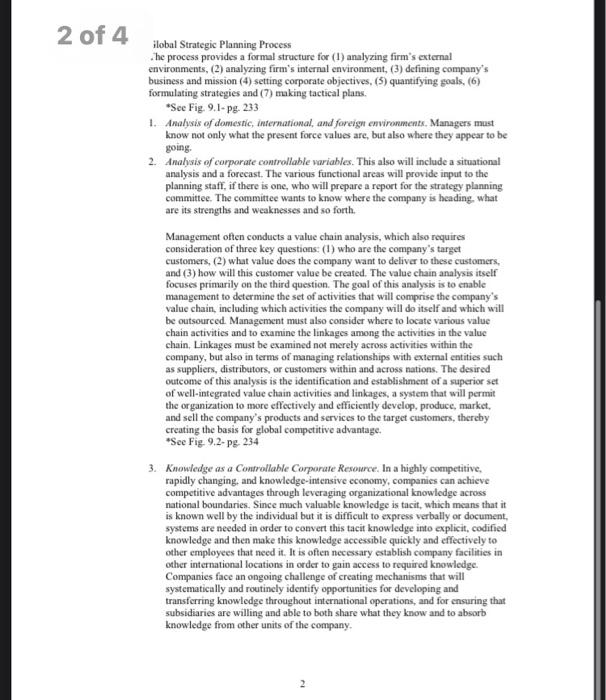
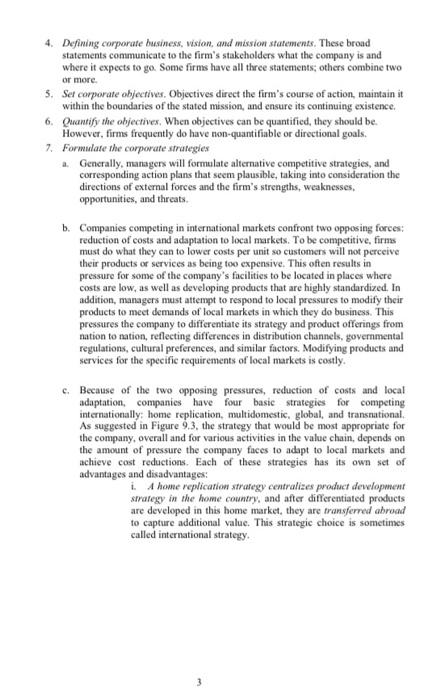
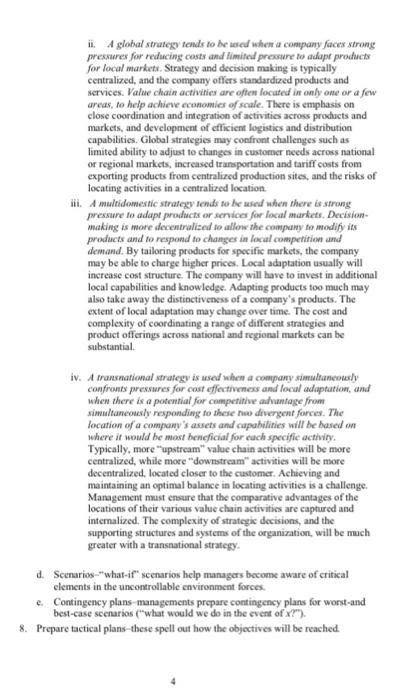
of 4 Chapter 9 Lecture Outline The opening section discusses how to think about the future in an uncertain world. This concern rests on the seeming paradox: planning in chaos. With constant change bordering on chaos, with limited predictability in a fast-change world, planning might appear futile. Yet, to succeed in today's competitive global marketplace, managers must have a clear understanding of the company's mission, a vision for how to achieve that mission, and an understanding of how they will compete with other companies. Managers must understand the company's strengths and weaknesses, and compare them with those of worldwide competitors. Strategic planning provides valuable tools to assist managers in addressing these challenges, as discussed in this chapter. One of the newer ones is scenario planning, as described in the opening section. 1 What Is International Strategy, and Why Is It Important? A. International strategy is concerned with the way firms make fundamental choices about developing and deploying scarce resources internationally. To be effective, strategy needs to be consistent among the company's various functions, products, and regional units (internal consistency) and with the demands of the international competitive environment (external consistency). B. The goal of international strategy is to achieve competitive advantage, both in a nation and globally. To create a competitive advantage that is sustainable over time, a company must develop competencies that (1) create value for which customers are willing to pay. (2) are rare, (3) are difficult to imitate or substitute for, and (4) the firm must be organized to allow it to exploit fully the competitive potential of these competencies. C. The challenge for international companies is that resources are always scarce, there are many alternatives for using these scarce resources (for example, which nations to enter), and these alternatives are not equally attractive Managers must make choices regarding what to do, and what not to do, now and over time. Different companies make different choices, and those choices have implications for each company's ability to meet the needs of customers and create a defensible competitive position internationally. Without adequate planning, managers are more likely to make decisions that do not make good sense competitively. IL Global Strategic Planning A. Why Plan Globally? Formal global strategic planning provides a means for managers to identify opportunities and threats, formulate strategies to handle them and stipulate how to finance their implementation. Plans provide for consistency of action among the managers. B. Standardization and Planning There is a growing tendency to standardize marketing strategies and total products. Their standardization can also be the result of strategic planning, 2 of 4 ilobal Strategic Planning Process he process provides a formal structure for (I) analyzing firm's external environments, (2) analyzing firm's internal environment, (3) defining company's business and mission (4) setting corporate objectives, (5) quantifying goals, (6) formulating strategies and (7) making tactical plans. *See Fig. 9. 1- pg. 233 1. Analysis of domestic, international, and foreign environments. Managers must know not only what the present force values are, but also where they appear to be going 2. Analysis of corporate controllable variables. This also will include a situational analysis and a forecast. The various functional areas will provide input to the planning staff, if there is one, who will prepare a report for the strategy planning committee. The committee wants to know where the company is heading what are its strengths and weaknesses and so forth. Management often conducts a value chain analysis, which also requires consideration of three key questions: (1) who are the company's target customers, (2) what value does the company want to deliver to these customers. and (3) how will this customer value be created. The value chain analysis itself focuses primarily on the third question. The goal of this analysis is to enable management to determine the set of activities that will comprise the company's value chain, including which activities the company will do itself and which will be outsourced Management must also consider where to locate various value chain activities and to examine the linkages among the activities in the value chain, Linkages must be examined not merely across activities within the company, but also in terms of managing relationships with external entities such as suppliers, distributors, or customers within and across nations. The desired outcome of this analysis is the identification and establishment of a superior set of well-integrated value chain activities and linkages, a system that will permit the organization to more effectively and efficiently develop, produce, market, and sell the company's products and services to the target customers, thereby creating the basis for global competitive advantage. *See Fig. 9.2-pg 234 3. Knowledge as a Controllable Corporate Resource. In a highly competitive, rapidly changing, and knowledge-intensive economy, companies can achieve competitive advantages through leveraging organizational knowledge across national boundaries. Since much valuable knowledge is tacit, which means that it is known well by the individual but it is difficult to express verbally or document, systems are needed in order to convert this tacit knowledge into explicit, codified knowledge and then make this knowledge accessible quickly and effectively to other employees that need it. It is often necessary establish company facilities in other international locations in order to gain access to required knowledge. Companies face an ongoing challenge of creating mechanisms that will systematically and routinely identify opportunities for developing and transferring knowledge throughout international operations, and for ensuring that subsidiaries are willing and able to both share what they know and to absorb knowledge from other units of the company. 4. Defining corporate business, vision, and mission statements. These broad statements communicate to the firm's stakeholders what the company is and where it expects to go. Some firms have all three statements, others combine two or more 5. Set corporate objectives. Objectives direct the firm's course of action, maintain it within the boundaries of the stated mission, and ensure its continuing existence, 6. Quantify the objectives. When objectives can be quantified, they should be However, firms frequently do have non-quantifiable or directional goals 7. Formulate the corporate strategies a. Generally, managers will formulate alternative competitive strategies, and corresponding action plans that seem plausible, taking into consideration the directions of external forces and the firm's strengths, weaknesses, opportunities, and threats. b. Companies competing in international markets confront two opposing forces: reduction of costs and adaptation to local markets. To be competitive, firms must do what they can to lower costs per unit so customers will not perceive their products or services as being too expensive. This often results in pressure for some of the company's facilities to be located in places where costs are low, as well as developing products that are highly standardized. In addition, managers must attempt to respond to local pressures to modify their products to meet demands of local markets in which they do business. This pressures the company to differentiate its strategy and product offerings from nation to nation, reflecting differences in distribution channels, governmental regulations, cultural preferences, and similar factors. Modifying products and services for the specific requirements of local markets is costly. c. Because of the two opposing pressures, reduction of costs and local adaptation, companies have four basic strategies for competing internationally home replication, multidomestic, global, and transnational As suggested in Figure 9.3. the strategy that would be most appropriate for the company, overall and for various activities in the value chain, depends on the amount of pressure the company faces to adapt to local markets and achieve cost reductions. Each of these strategies has its own set of advantages and disadvantages: i. A home replication strategy centralizes product development strategy in the home country, and after differentiated products are developed in this home market, they are transferred abroad to capture additional value. This strategic choice is sometimes called international strategy ii. A global strategy tends to be used when a company faces strong pressures for reducing costs and limited pressure to adapt products for local markets. Strategy and decision making is typically centralized, and the company offers standardized products and services. Value chain activities are often located in only one or a few areas, to help achieve economies of scale. There is emphasis on close coordination and integration of activities across products and markets, and development of efficient logistics and distribution capabilities. Global strategies may confront challenges such as limited ability to adjust to changes in customer needs across national or regional markets, increased transportation and tariff costs from exporting products from centralized production sites, and the risks of locating activities in a centralized location iii. A multidomestic strategy tends to be used when there is strong pressure to adapt products or services for local markets. Decision making is more decentralized to allow the company to modify its products and to respond to changes in local competition and demand. By tailoring products for specific markets, the company may be able to charge higher prices. Local adaptation usually will increase cost structure. The company will have to invest in additional local capabilities and knowledge. Adapting products too much may also take away the distinctiveness of a company's products. The extent of local adaptation may change over time. The cost and complexity of coordinating a range of different strategies and product offerings across national and regional markets can be substantial iv. A transnational strategy is used when a company simultaneously confronts pressures for cost effectiveness and local adaptation, and when there is a potential for competitive advantage from simultaneously responding to these two divergent forces. The location of a company's assets and capabilities will be based on where it would be most beneficial for each specific activity. Typically, more "upstream" value chain activities will be more centralized, while more "downstream" activities will be more decentralized, located closer to the customer. Achieving and maintaining an optimal balance in locating activities is a challenge. Management must ensure that the comparative advantages of the locations of their various value chain activities are captured and internalized. The complexity of strategic decisions, and the supporting structures and systems of the organization will be much greater with a transnational strategy d. Scenarios-what-if" scenarios help managers become aware of critical elements in the uncontrollable environment forces 4. Contingency plans-managements prepare contingency plans for worst-and best-case scenarios ("What would we do in the event of X?"). 8. Prepare tactical plans-these spell out how the objectives will be reached Step by Step Solution
There are 3 Steps involved in it
1 Expert Approved Answer
Step: 1 Unlock

Question Has Been Solved by an Expert!
Get step-by-step solutions from verified subject matter experts
Step: 2 Unlock
Step: 3 Unlock