







Question: inal assignment Ready for the assignment? You will find instructions below to submit. Instructions My submission Discussions Please read the Valve case study. The case
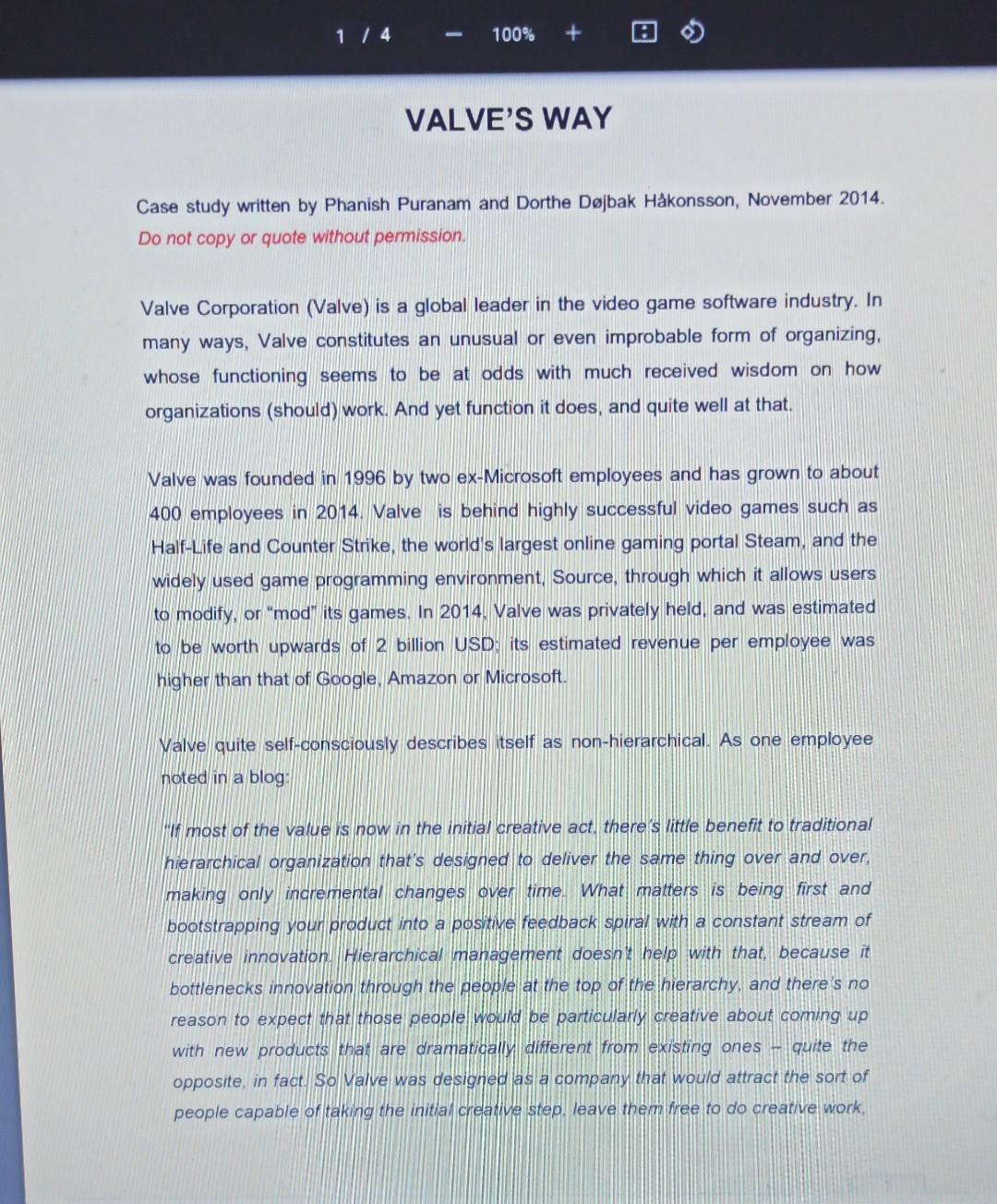
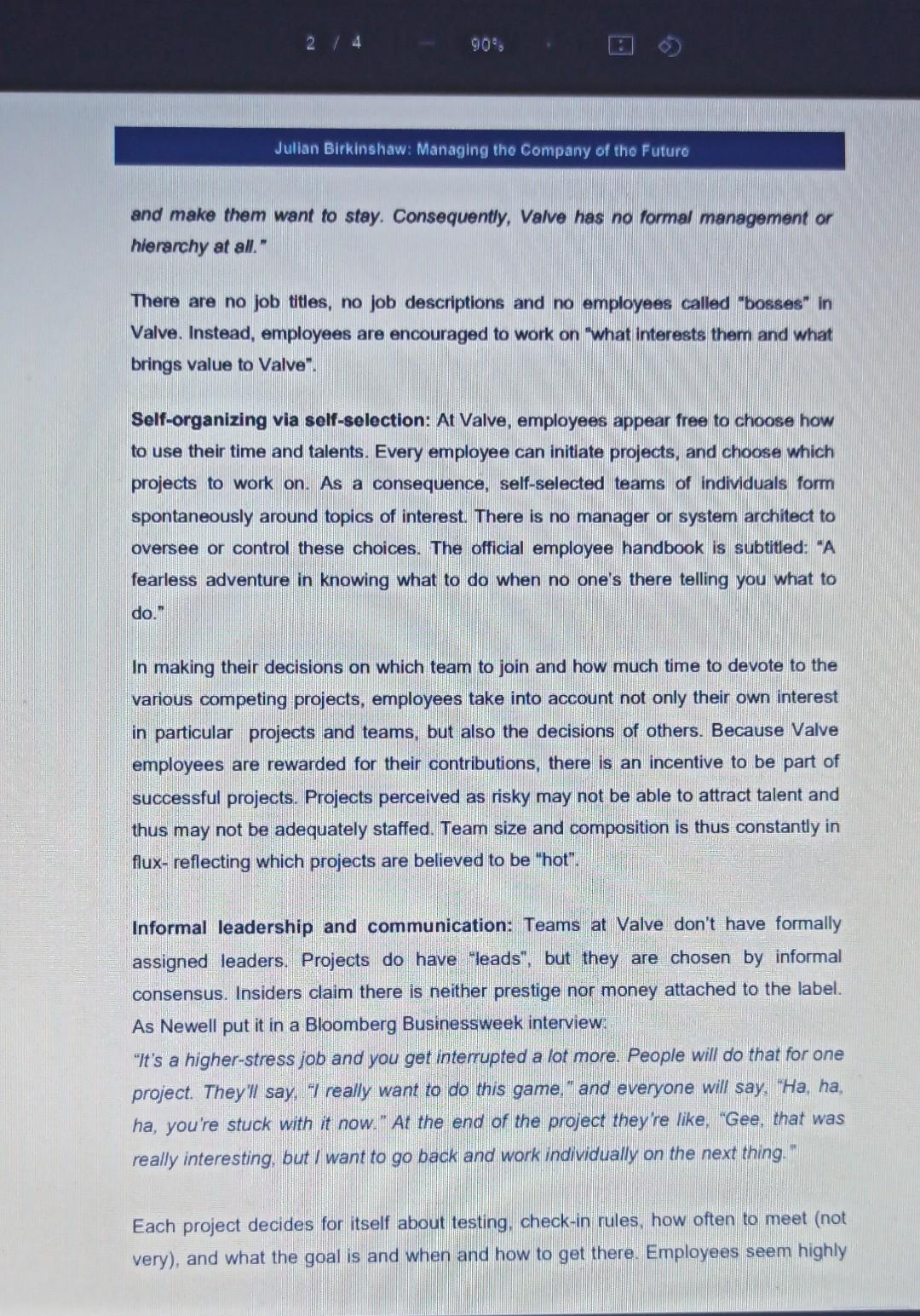
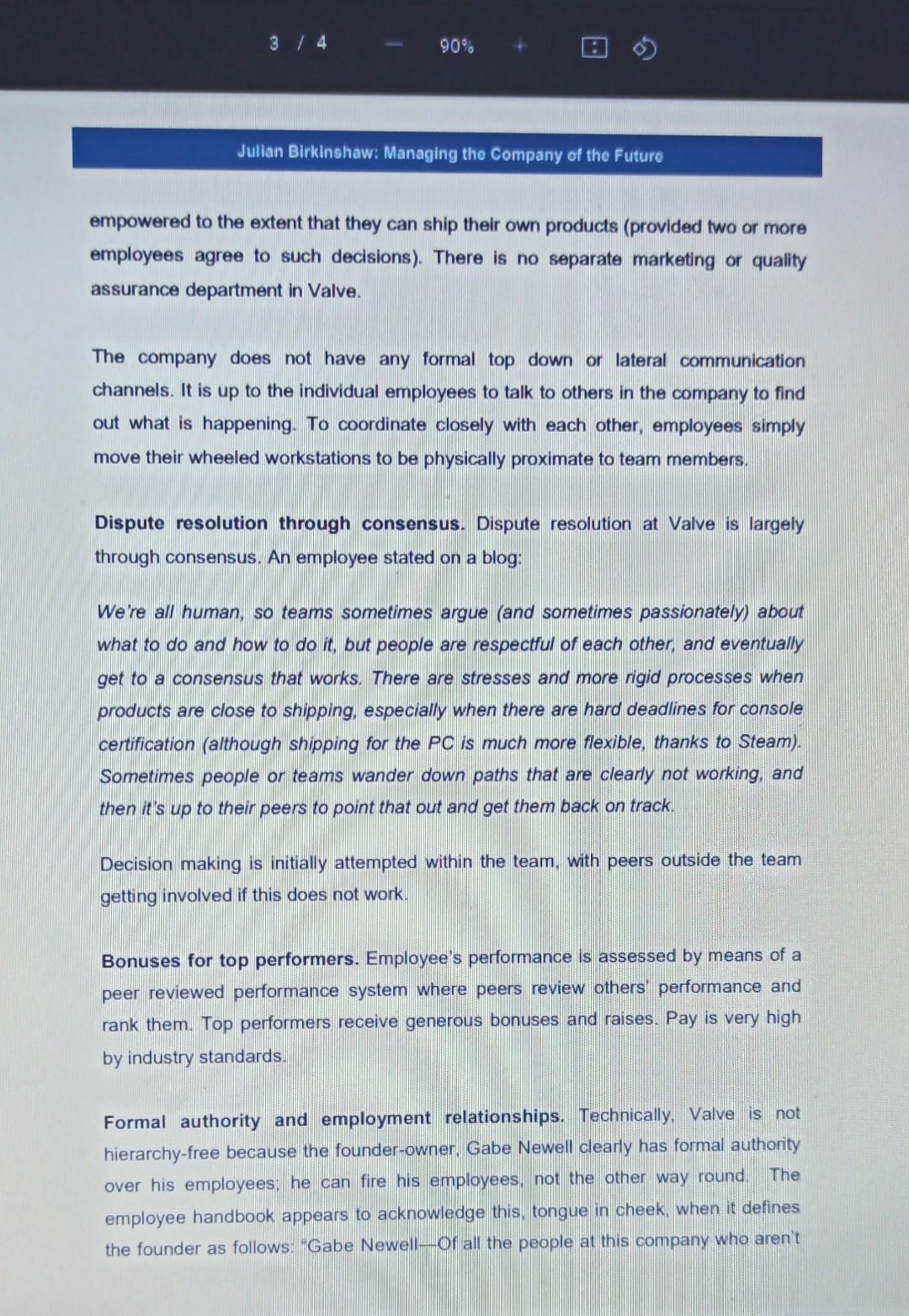
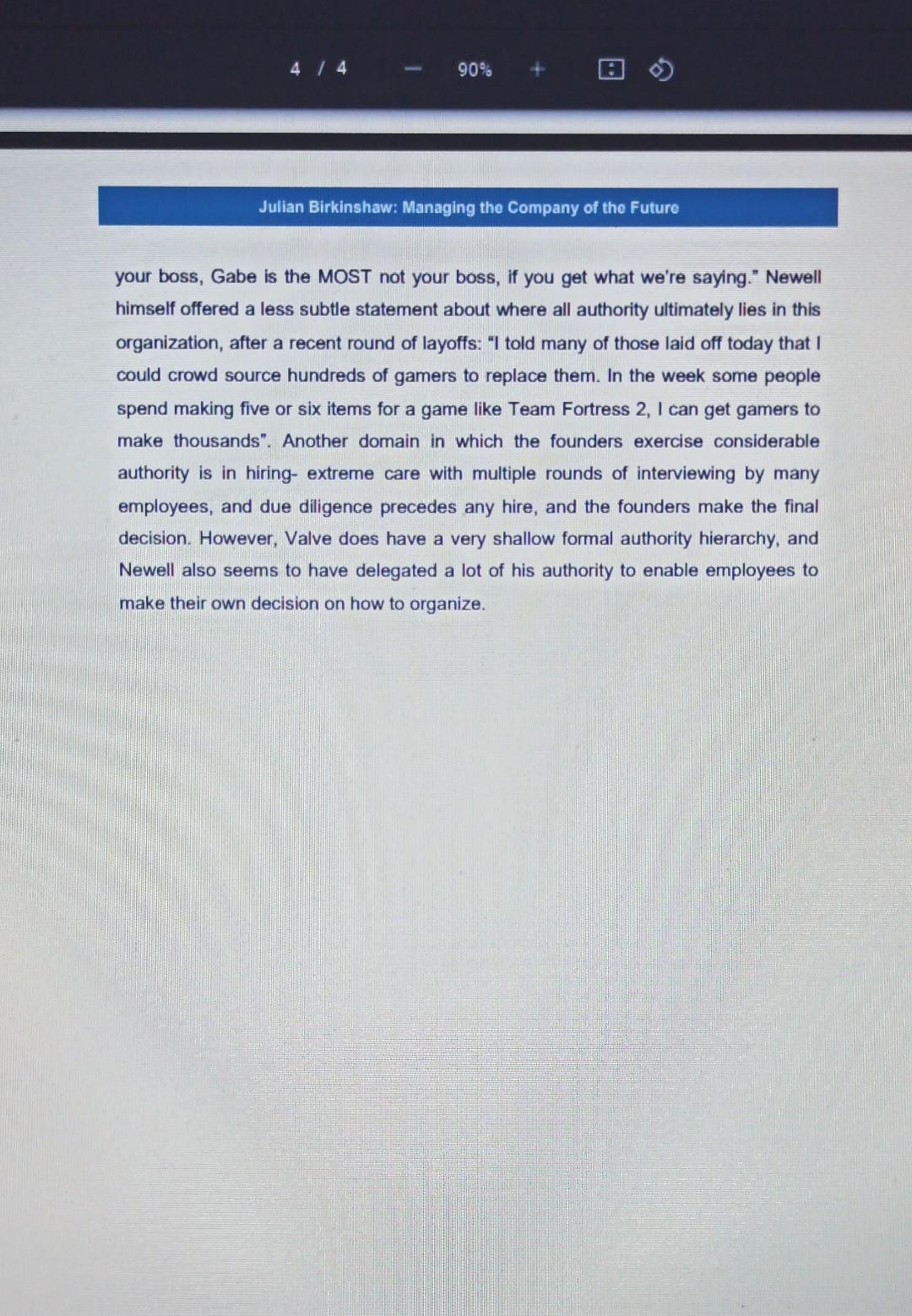
inal assignment Ready for the assignment? You will find instructions below to submit. Instructions My submission Discussions Please read the Valve case study. The case study provides an overview of the "management model" at Valve, a highly successful gaming company. As you will see, it is an unorthodox model characterized by having no "managers" and giving employees enormous freedom in choosing what projects to work on. After reading the case study, please answer the following questions. You will be asked to write up to 100200 words per question. There is no minimum word count, you can write as little as you want as long as you provide a complete answer. We've put together a few points to help you perform well in this assignment: DO... ... Read the questions carefully. Make sure to answer every part of each question and to provide examples where asked. ... Pay attention to the word limits. We've set word limits to give you an idea how detailed your answer should be. Don't worry too much about using the exact number of words though, you will not be graded according to word count, only on the content of your answer. ... Keep it simple. A good answer is not only correct but also easy to understand. Clear and simple writing will ensure that whoever is grading you will be able to understand what you are trying to say and give you a better grade. ... Make an effort to use correct spelling and grammar. This will not only ensure that your answer is easy to understand, but you will be graded on the overall quality and style of your answers as well. (You will be able to earn up to 5 points for each question (up to 35 points) and up to 5 further points for overall quality and style, adding up to a maximum of 40 points). . Feel free to make changes. You can change and re-submit your answers as often as you want up until the submission deadline. DON'T... Discuss the assignment questions in the discussion forums. We will delete any posts discussing assignment answers immediately. Final assignment DO... ... Read the questions carefully. Make sure to answer every part of each question and to provide examples where asked. ... Pay attention to the word limits. We've set word limits to give you an idea how detailed your answer should be. Don't worry too much about using the exact number of words though, you will not be graded according to word count, only on the content of your answer. ... Keep it simple. A good answer is not only correct but also easy to understand. Clear and simple writing will ensure that whoever is grading you will be able to understand what you are trying to say and give you a better grade. ... Make an effort to use correct spelling and grammar. This will not only ensure that your answer is easy to understand, but you will be graded on the overall quality and style of your answers as well. (You will be able to earn up to 5 points for each question (up to 35 points) and up to 5 further points for overall quality and style, adding up to a maximum of 40 points). ... Feel free to make changes. You can change and re-submit your answers as often as you want up until the submission deadline. DON'T... ... Discuss the assignment questions in the discussion forums. We will delete any posts discussing assignment answers immediately. ... Plagiarise. In accordance with the Honor Code, you are required to submit only answers that are your own work. Do not copy from other students, external sources or the case text itself. Good Luck! Review criteria There are 8 questions to answer. You will be graded on your understanding of the case study including your analysis of the strengths less^ and weaknesses of the case study. Case study written by Phanish Puranam and Dorthe Djbak Hkonsson, November 2014. Do not copy or quote without permission. Valve Corporation (Valve) is a global leader in the video game software industry. In many ways, Valve constitutes an unusual or even improbable form of organizing, whose functioning seems to be at odds with much received wisdom on how organizations (should) work. And yet function it does, and quite well at that. Valve was founded in 1996 by two ex-Microsoft employees and has grown to about 400 employees in 2014. Valve is behind highly successful video games such as Half-Life and Counter Strike, the world's largest online gaming portal Steam, and the widely used game programming environment, Source, through which it allows users to modify, or "mod" its games. In 2014, Valve was privately held, and was estimated to be worth upwards of 2 billion USD: its estimated revenue per employee was higher than that of Google. Amazon or Microsoft. Valve quite self-consciously describes itself as non-hierarchical. As one employee noted in a blog: "If most of the value is now in the initial creative act. there's little benefit to traditional hierarchical organization that's designed to deliver the same thing over and over. making only incremental changes over time. What matters is being first and bootstrapping your product into a positive feedback spiral with a constant stream of creative innovation. Hierarchical management doesnt help with that, because it bottlenecks innovation through the people at the top of the hierarchy, and there's no reason to expect that those people would be particularly creative about coming up with new products that are dramatically different from existing ones - quite the opposite, in fact. So Valve was designed as a company that would attract the sort of people capable of taking the initial creative step. leave them free to do creative work, Julian Birkinshaw: Managing the Company of the Future and make them want to stay. Consequently, Valve has no formal management or hierarchy at all." There are no job titles, no job descriptions and no employees called "bosses" in Valve. Instead, employees are encouraged to work on "what interests them and what brings value to Valve". Self-organizing via self-selection: At Valve, employees appear free to choose how to use their time and talents. Every employee can initiate projects, and choose which projects to work on. As a consequence, self-selected teams of individuals form spontaneously around topics of interest. There is no manager or system architect to oversee or control these choices. The official employee handbook is subtitled: "A fearless adventure in knowing what to do when no one's there telling you what to do." In making their decisions on which team to join and how much time to devote to the various competing projects, employees take into account not only their own interest in particular projects and teams, but also the decisions of others. Because Valve employees are rewarded for their contributions, there is an incentive to be part of successful projects. Projects perceived as risky may not be able to attract talent and thus may not be adequately staffed. Team size and composition is thus constantly in flux-reflecting which projects are believed to be "hot". Informal leadership and communication: Teams at Valve don't have formally assigned leaders. Projects do have "leads", but they are chosen by informal consensus. Insiders claim there is neither prestige nor money attached to the label. As Newell put it in a Bloomberg Businessweek interview. "It's a higher-stress job and you get interrupted a lot more. People will do that for one project. They'll say, 7 really want to do this game," and everyone will say. "Ha, ha, ha, you're stuck with it now." At the end of the project they're like, "Gee, that was really interesting, but I want to go back and work individually on the next thing." Each project decides for itself about testing, check-in rules, how often to meet (not very), and what the goal is and when and how to get there. Employees seem highly Julian Birkinshaw: Managing the Company of the Futuro empowered to the extent that they can ship their own products (provided two or more employees agree to such decisions). There is no separate marketing or quality assurance department in Valve. The company does not have any formal top down or lateral communication channels. It is up to the individual employees to talk to others in the company to find out what is happening. To coordinate closely with each other, employees simply move their wheeled workstations to be physically proximate to team members. Dispute resolution through consensus. Dispute resolution at Valve is largely through consensus. An employee stated on a blog: We're all human, so teams sometimes argue (and sometimes passionately) about what to do and how to do it, but people are respectful of each other, and eventually get to a consensus that works. There are stresses and more rigid processes when products are close to shipping, especially when there are hard deadlines for console certification (although shipping for the PC is much more flexible, thanks to Steam). Sometimes people or teams wander down paths that are clearly not working, and then it's up to their peers to point that out and get them back on track. Decision making is initially attempted within the team, with peers outside the team getting involved if this does not work. Bonuses for top performers. Employee's performance is assessed by means of a peer reviewed performance system where peers review others performance and rank them. Top performers receive generous bonuses and raises. Pay is very high by industry standards. Formal authority and employment relationships. Technically, Valve is not hierarchy-free because the founder-owner. Gabe Newell clearly has formal authority over his employees; he can fire his employees, not the other way round. The employee handbook appears to acknowledge this, tongue in cheek, when it defines the founder as follows: "Gabe Newell-Of all the people at this company who aren't your boss, Gabe is the MOST not your boss, if you get what we're saying." Newell himself offered a less subtle statement about where all authority ultimately lies in this organization, after a recent round of layoffs: "I told many of those laid off today that I could crowd source hundreds of gamers to replace them. In the week some people spend making five or six items for a game like Team Fortress 2, I can get gamers to make thousands". Another domain in which the founders exercise considerable authority is in hiring- extreme care with multiple rounds of interviewing by many employees, and due diligence precedes any hire, and the founders make the final decision. However, Valve does have a very shallow formal authority hierarchy, and Newell also seems to have delegated a lot of his authority to enable employees to make their own decision on how to organize
Step by Step Solution
There are 3 Steps involved in it
1 Expert Approved Answer
Step: 1 Unlock

Question Has Been Solved by an Expert!
Get step-by-step solutions from verified subject matter experts
Step: 2 Unlock
Step: 3 Unlock
 Study Help