







Question: - Include clear explanations for your calculations. Remember that mere numerical expressions without accompanying explanations do not always convey the correct meaning. - Please turn
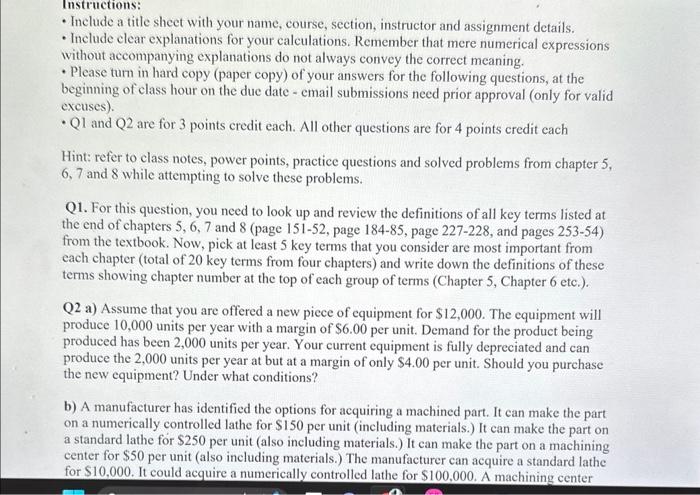
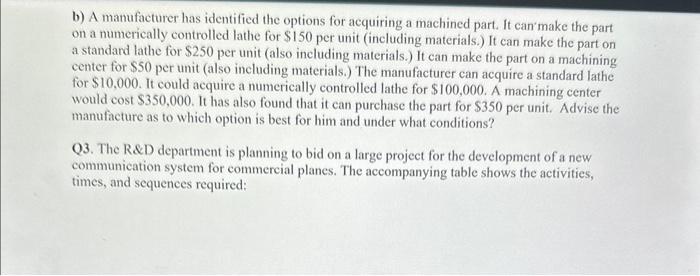
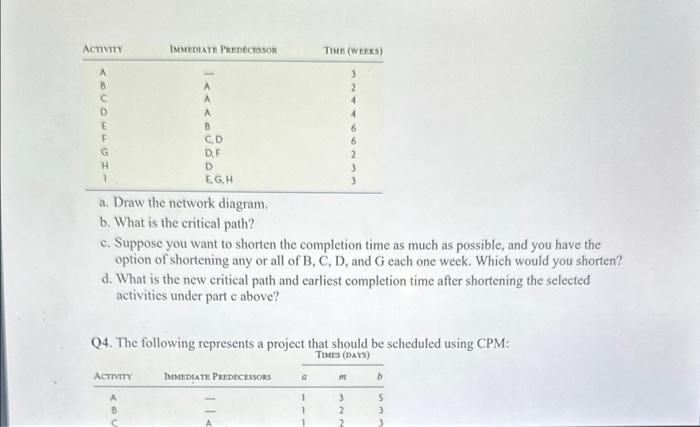
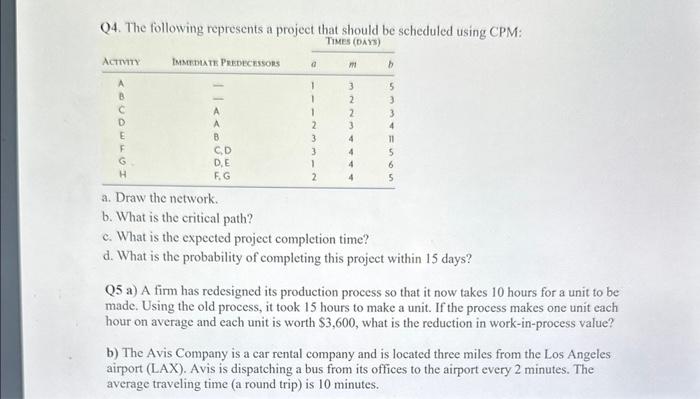
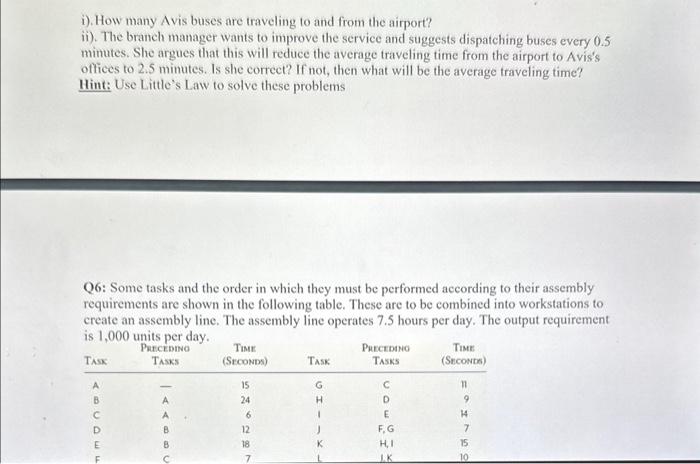
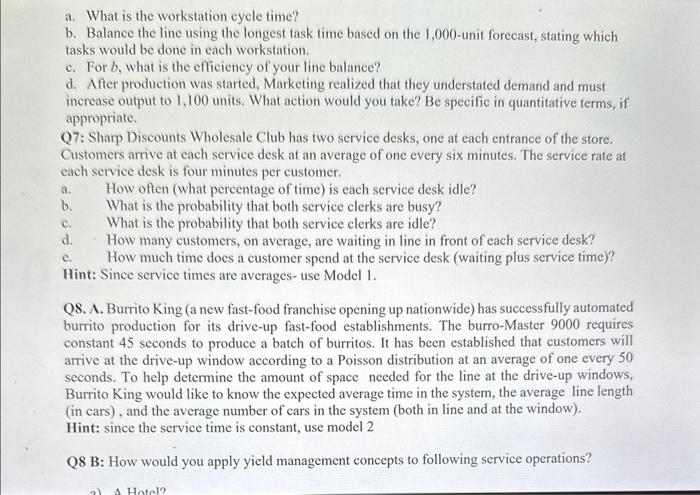
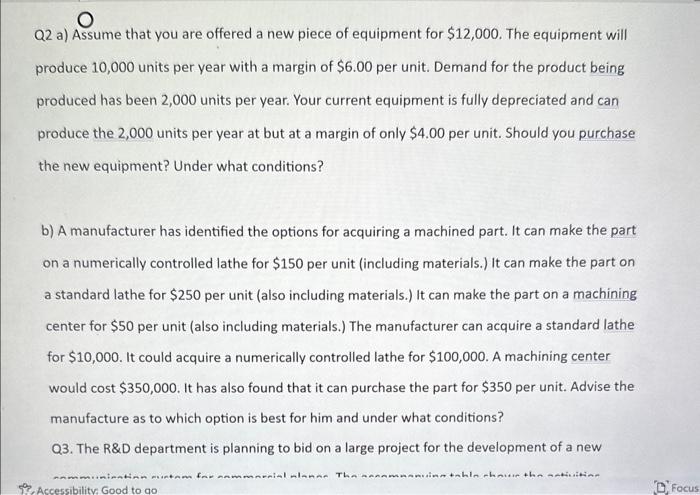
- Include clear explanations for your calculations. Remember that mere numerical expressions without accompanying explanations do not always convey the correct meaning. - Please turn in hard copy (paper copy) of your answers for the following questions, at the beginning of elass hour on the due date - email submissions need prior approval (only for valid excuses). - Q1 and Q2 are for 3 points credit each. All other questions are for 4 points credit cach Hint: refer to class notes, power points, practice questions and solved problems from chapter 5 , 6,7 and 8 while attempting to solve these problems. Q1. For this question, you need to look up and review the definitions of all key terms listed at the end of chapters 5,6,7 and 8 (page 151-52, page 184-85, page 227-228, and pages 253-54) from the textbook. Now, pick at least 5 key terms that you consider are most important from each chapter (total of 20 key terms from four chapters) and write down the definitions of these terms showing chapter number at the top of each group of terms (Chapter 5 , Chapter 6 etc.). Q2 a) Assume that you are offered a new piece of equipment for $12,000. The equipment will produce 10,000 units per year with a margin of $6.00 per unit. Demand for the product being produced has been 2,000 units per year. Your current equipment is fully depreciated and can produce the 2,000 units per year at but at a margin of only $4.00 per unit. Should you purchase the new equipment? Under what conditions? b) A manufacturer has identified the options for acquiring a machined part. It can make the part on a numerically controlled lathe for \$150 per unit (including materials.) It can make the part on a standard lathe for $250 per unit (also including materials.) It can make the part on a machining b) A manufacturer has identified the options for acquiring a machined part. It can'make the part on a numerically controlled lathe for $150 per unit (including materials.) It can make the part on a standard lathe for $250 per unit (also including materials.) It can make the part on a machining center for $50 per unit (also including materials.) The manufacturer can acquire a standard lathe for $10,000. It could acquire a numerically controlled lathe for $100,000. A machining center would cost $350,000. It has also found that it can purchase the part for $350 per unit. Advise the manufacture as to which option is best for him and under what conditions? Q3. The R\&D department is planning to bid on a large project for the development of a new communication system for commercial planes. The accompanying table shows the activities, times, and sequences required: a. Draw the network diagram. b. What is the critical path? c. Suppose you want to shorten the completion time as much as possible, and you have the option of shortening any or all of B,C,D, and G each one week. Which would you shorten? d. What is the new critical path and earliest completion time after shortening the selected activities under part c above? Q4. The following represents a project that should be scheduled using CPM: Toers (Da1s) Q4. The following represents a project that should be scheduled using CPM: a. Draw the network. b. What is the critical path? c. What is the expected project completion time? d. What is the probability of completing this project within 15 days? Q5 a) A firm has redesigned its production process so that it now takes 10 hours for a unit to be made. Using the old process, it took 15 hours to make a unit. If the process makes one unit cach hour on average and each unit is worth $3,600, what is the reduction in work-in-process value? b) The Avis Company is a car rental company and is located three miles from the Los Angeles airport (LAX). Avis is dispatching a bus from its offices to the airport every 2 minutes. The average traveling time (a round trip) is 10 minutes. i). How many Avis buses are traveling to and from the airport? ii). The branch manager wants to improve the service and suggests dispatching buses every 0.5 minutes. She argues that this will reduce the average traveling time from the airport to Avis's offices to 2.5 minutes. Is she correct? If not, then what will be the average traveling time? Hint: Use Little's Law to solve these problems Q6: Some tasks and the order in which they must be performed according to their assembly requirements are shown in the following table. These are to be combined into workstations to create an assembly line. The assembly line operates 7.5 hours per day. The output requirement ie 1nn white waw dow a. What is the workstation cycle time? b. Balance the line using the longest task time based on the 1,000-unit forecast, stating which tasks would be done in each workstation. c. For b, what is the efficiency of your line balance? d. After production was started, Marketing realized that they understated demand and must increase output to 1,100 units. What action would you take? Be specific in quantitative terms, if appropriate. Q7: Sharp Discounts Wholesale Club has two service desks, one at each entrance of the store. Customers arrive at each service desk at an average of one every six minutes. The service rate at each service desk is four minutes per customer. a. How often (what percentage of time) is each service desk idle? b. What is the probability that both service clerks are busy? c. What is the probability that both service clerks are idle? d. How many customers, on average, are waiting in line in front of each service desk? e. How much time does a customer spend at the service desk (waiting plus service time)? Hint: Since service times are averages- use Model 1. Q8. A. Burrito King (a new fast-food franchise opening up nationwide) has successfully automated burrito production for its drive-up fast-food establishments. The burro-Master 9000 requires constant 45 seconds to produce a batch of burritos. It has been established that customers will arrive at the drive-up window according to a Poisson distribution at an average of one every 50 seconds. To help determine the amount of space needed for the line at the drive-up windows, Burrito King would like to know the expected average time in the system, the average line length (in cars), and the average number of cars in the system (both in line and at the window). Hint: since the service time is constant, use model 2 Q8 B: How would you apply yield management concepts to following service operations? Q2 a) Assume that you are offered a new piece of equipment for $12,000. The equipment will produce 10,000 units per year with a margin of $6.00 per unit. Demand for the product being produced has been 2,000 units per year. Your current equipment is fully depreciated and can produce the 2,000 units per year at but at a margin of only $4.00 per unit. Should you purchase the new equipment? Under what conditions? b) A manufacturer has identified the options for acquiring a machined part. It can make the part on a numerically controlled lathe for $150 per unit (including materials.) It can make the part on a standard lathe for $250 per unit (also including materials.) It can make the part on a machining center for $50 per unit (also including materials.) The manufacturer can acquire a standard lathe for $10,000. It could acquire a numerically controlled lathe for $100,000. A machining center would cost $350,000. It has also found that it can purchase the part for $350 per unit. Advise the manufacture as to which option is best for him and under what conditions? Q3. The R\&D department is planning to bid on a large project for the development of a new
Step by Step Solution
There are 3 Steps involved in it

Get step-by-step solutions from verified subject matter experts
 Study Help