







Question: #include #include #define MAX LINE 80 /* The maximum length command */ int main(void) { char *args[MAX LINE/2 + 1]; /* command line arguments */
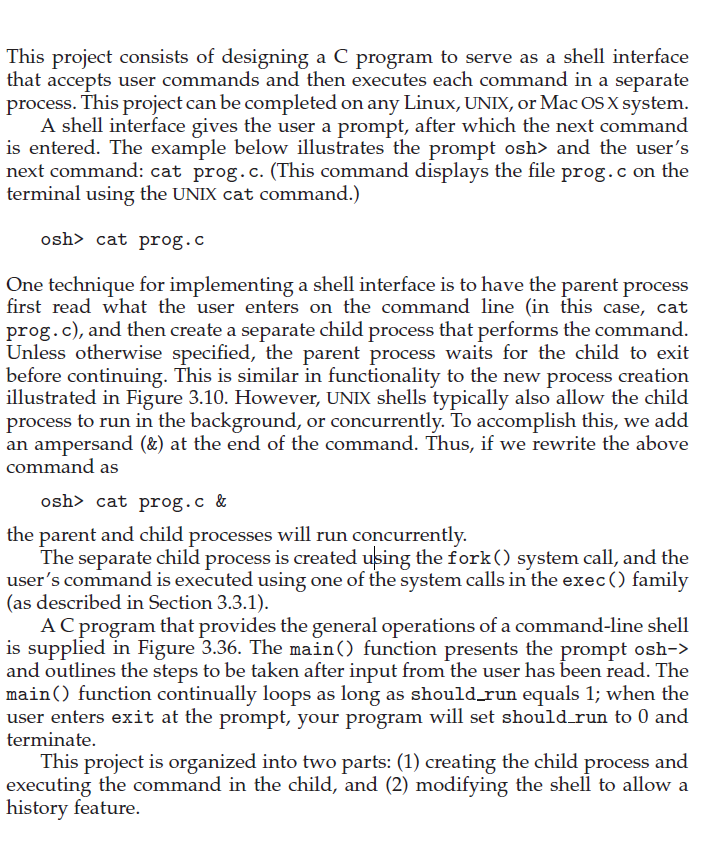
#include
![*/ int main(void) { char *args[MAX LINE/2 + 1]; /* command line](https://dsd5zvtm8ll6.cloudfront.net/si.experts.images/questions/2024/09/66f50bb44f03f_34766f50bb3e3c8e.jpg)
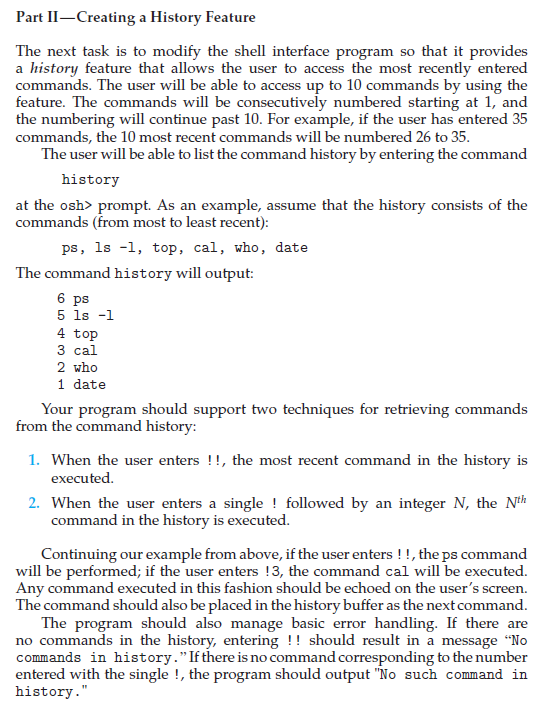
is project consists of designing a C program to serve as a shell interface that accepts user commands and then executes each command in a separate process. This project can be completed on any Linux, UNIX, or Mac OS X system A shell interface gives the user a prompt, after which the next command is entered. The example below illustrates the prompt osh> and the user's next command: cat prog.c. (This command displays the file prog.c on the Thi terminal using the UNIX cat command.) osh> cat prog.c One technique for implementing a shell interface is to have the parent process first read what the user enters on the command line (in this case, cat prog.c), and then create a separate child process that performs the command Unless otherwise specified, the parent process waits for the child to exit before continuing. This is similar in functionality to the new process creation illustrated in Figure 3.10. However, UNIX shells typically also allow the child process to run in the background, or concurrently. To accomplish this, we add an ampersand (&)at the end of the command. Thus, if we rewrite the above command as osh> cat prog.c & the parent and child processes will run concurrently. The separate child process is created using the fork) system call, and the user's command is executed using one of the system calls in the exec ) family (as described in Section 3.3.1) A C program that provides the general operations of a command-line shell is supplied in Figure 3.36. The main() function presents the prompt osh-> and outlines the steps to be taken after input from the user has been read. The main) function continually loops as long as should.run equals 1; when the user enters exit at the prompt, your program will set should run to 0 and terminate This project is organized into two parts: (1) creating the child process and executing the command in the child, and (2) modifying the shell to allow a history feature
Step by Step Solution
There are 3 Steps involved in it

Get step-by-step solutions from verified subject matter experts
 Study Help