







Question: #include #include #include #define TOTAL_THREADS 2 int count; int turn; // Shared variable, indicates // whose turn it is to execute bool interested[TOTAL_THREADS]; // Shared
#include
#define TOTAL_THREADS 2
int count; int turn; // Shared variable, indicates // whose turn it is to execute
bool interested[TOTAL_THREADS]; // Shared variable, indicates // processes interested in executing
// The thread_id will be either 0 or 1 void enter_region(int thread_id) { int other; // ID of the other thread other = 1 - thread_id; // The oposite of thread_id // TODO: Add the code to indicate the // thread's interest in executing. // TODO: Indicate the thread's turn to execute next // TODO: Busy wait until it is the thread's turn to execute
}
void leave_region(int thread_id) { // TODO: Add the code to set the flag // indicating that the thread has // exited the critical region.
}
void* myFunction(void* arg) { int thread_id = *((int*) arg); for(unsigned int i = 0; i
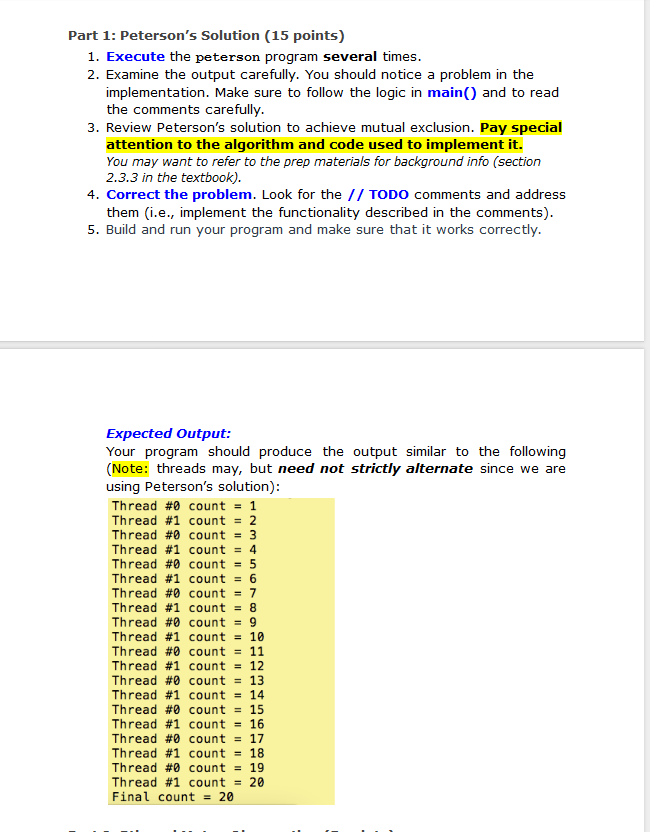
// HINT: It is not necessary to make any changes in main() int main() { int rc[TOTAL_THREADS]; pthread_t ids[TOTAL_THREADS]; int args[TOTAL_THREADS]; count = 0; for(unsigned int i = 0; i Part 1: Peterson's Solution (15 points) 1. Execute the peterson program several times 2. Examine the output carefully. You should notice a problem in the implementation. Make sure to follow the logic in main ) and to read the comments carefully 3. Review Peterson's solution to achieve mutual exclusion. Pay special attention to the algorithm and code used to implement it. You may want to refer to the prep materials for background info (section 2.3.3 in the textbook) 4. Correct the problem. Look for the // TODO comments and address them (i.e., implement the functionality described in the comments) 5. Build and run your program and make sure that it works correctly Expected Output: Your program should produce the output similar to the following (Note: threads may, but need not strictly alternate since we are using Peterson's solution): Thread #0 count 1 Thread #1 count 2 Thread #0 count - 3 Thread #1 count = 4 Thread #0 count - 5 Thread #1 count = 6 Thread #0 count - 7 Thread #1 count = 8 Thread #0 count 9 Thread #1 count - 10 Thread #0 count = 11 Thread #1 count 12 Thread #0 count = 13 Thread #1 count - 14 Thread #0 count = 15 Thread #1 count - 16 Thread #0 count 17 Thread #1 count - 18 Thread #0 count - 19 Thread #1 count 20 Final count-20
Step by Step Solution
There are 3 Steps involved in it

Get step-by-step solutions from verified subject matter experts
 Study Help