







Question: #include #include #include #include using namespace std; class ReviewType { public: ReviewType(); // Default Constructor ReviewType(string, int); // Parameterized Constructor ReviewType(const ReviewType&); // Copy Constructor
#include
using namespace std;
class ReviewType { public: ReviewType(); // Default Constructor ReviewType(string, int); // Parameterized Constructor ReviewType(const ReviewType&); // Copy Constructor ~ReviewType(); // Destructor
// TOTO: Implement the assignment operator overload. ReviewType& operator=(const ReviewType&);
// TODO: Implement the greater than operator overload as a member function. bool operator>(const ReviewType&) const;
// TODO: Implement the less than operator overload as a member function. bool operator
// TODO: Implement the equality operator overload as a member function. bool operator==(const ReviewType&) const;
// TODO: Just for practice implementing a NON-MEMBER function, implement // the not-equal operator overload as a NON-MEMBER function. friend bool operator!=(const ReviewType& first, const ReviewType& second);
bool isGreater(const ReviewType&) const; bool isLess(const ReviewType&) const; bool isEqual(const ReviewType&) const; bool isNotEqual(const ReviewType&) const;
string getMovieName(); void printInfo();
private: int generateRating();
string movieName; int numberOfRatings; int sumOfRatings; int *arrayPointer; };
// Default Constructor ReviewType::ReviewType() { movieName = "Default"; numberOfRatings = 0; sumOfRatings = 0; arrayPointer = NULL; }
// Parameterized Constructor ReviewType::ReviewType(string movieName, int numOfRatings) { this->movieName = movieName;
if (numOfRatings > 0) { this->numberOfRatings = numOfRatings; arrayPointer = new int[numberOfRatings];
for (int i = 0; i
// Copy Constructor ReviewType::ReviewType(const ReviewType &other) { this->movieName = other.movieName; this->numberOfRatings = other.numberOfRatings; this->sumOfRatings = other.sumOfRatings;
if (numberOfRatings > 0) { arrayPointer = new int[numberOfRatings];
for (int i = 0; i
// The array pointer might be NULL if the movie has // 0 ratings. If the movie has more than 0 ratings, // the dynamically allocated memory will be deleted // when an instance of the ReviewType class goes // out of scope. ReviewType::~ReviewType() { if (arrayPointer != NULL) delete[] arrayPointer; }
bool ReviewType::isGreater(const ReviewType &other) const { return sumOfRatings > other.sumOfRatings; }
bool ReviewType::isLess(const ReviewType &other) const { return sumOfRatings
bool ReviewType::isEqual(const ReviewType &other) const { return sumOfRatings == other.sumOfRatings; }
bool ReviewType::isNotEqual(const ReviewType &other) const { return sumOfRatings != other.sumOfRatings; }
string ReviewType::getMovieName() { return movieName; }
void ReviewType::printInfo() { cout
cout
for (int i = 0; i
cout
// For simplicity, a user rating is simulated with a // random number between 1 and 10. int ReviewType::generateRating() { return (rand() % 10) + 1; }
/////////////////////////////////////////////////////////////// /// Please do not change any of the code above this line. /// ///////////////////////////////////////////////////////////////
/// Write your operator overload implementations here:
//////////////////////////////////////////////////////////////// /// After completing your operator overload implementations, /// /// you may uncomment the statements in main that use the /// /// overloads, but other than uncommenting those lines, /// /// please don't change any of the code in main. /// ////////////////////////////////////////////////////////////////
int main() { srand(time(NULL));
ReviewType movie1("Movie 1", 12); ReviewType movie2("Movie 2", 12);
movie1.printInfo(); movie2.printInfo();
cout
if (movie1.isNotEqual(movie2)) cout
cout
// the above tests don't make use of the operator overloads. Uncomment the code below to // test your operator overload implementations.
/* cout movie2) cout
if (movie1 == movie2) cout
if (movie1
if (movie1 != movie2) cout
cout
// Here we're testing the overload of the assignment operator. Because the assignment operator // overload returns a pointer to the current object, these assignments can be chained.
ReviewType movie3("Movie 3", 8);
movie3.printInfo();
movie1 = movie2 = movie3;
// Now movie1 and movie2 should have the same content as movie3. // (including having the same movieName as movie3).
movie1.printInfo(); movie2.printInfo(); movie3.printInfo(); */
return 0; }
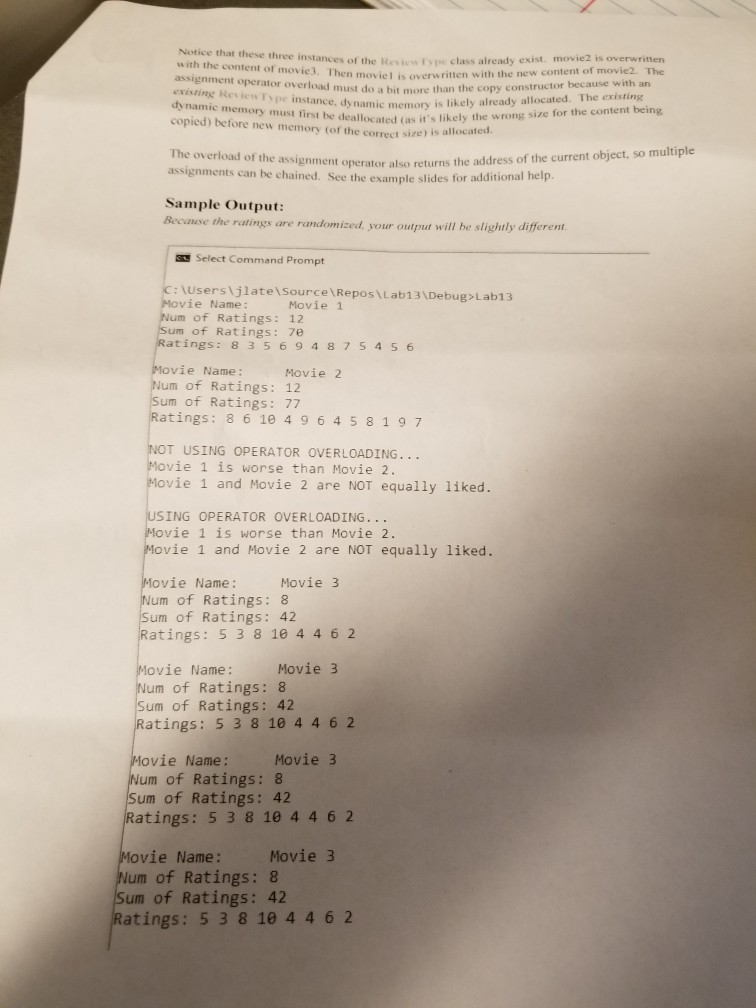
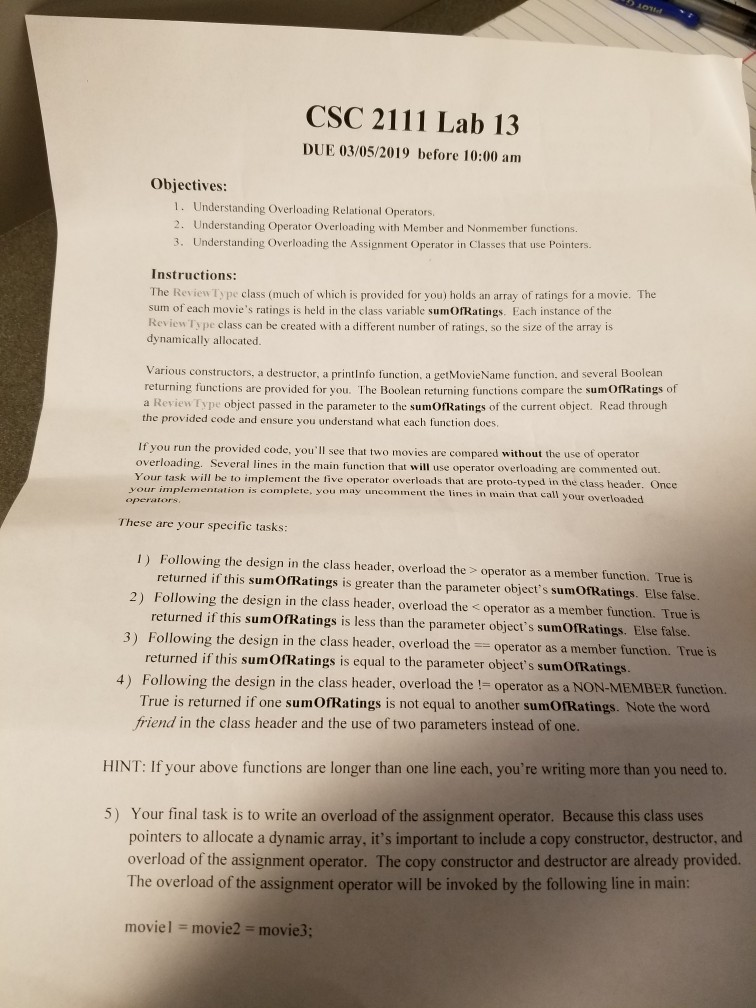
Notice that these three instances of the Review tspe class a already exist. movie2 is overwritten The with the content of movie3. Then movie1 is overw ritten with the assignment operat existing RevievT'pe instance, is lik new content of movie2. or overload must do a bit more than the copy constructor because with an ce dy namic memory is likely already allocated. The existing copied) before new memory tof the correct size) i ocated (as it's likely the wrong size for the content being The overload of the assignment operator also returns the assignments can be chained. See the exa address of the current object, so multiple mple slides for additional help Sample Output: Because the ratings are randomized, your output will be slightly different select Command Prompt Users jlatelsource\ReposLab131Debug>Lab13 vie Name: Movie1 of Ratings: 12 um of Ratings: 7e atings: 8 3 56 9 4 87 5 4 5 6 vie Name: um of Ratings: 12 um of Ratings: 77 atings: 8 6 10 4 96 4 5 819 7 Movie 2 NOT USING OPERATOR OVERLOADING. .. Movie 1 is worse than Movie 2. vie 1 and Movie 2 are NOT equally liked SING OPERATOR OVERLOADNG vie 1 is worse than Movie 2 vie 1 and Movie 2 are NOT equally liked. ovie Name: Movie 3 um of Ratings: 8 Sum of Ratings: 42 Ratings: 5 3 8 10 4 4 6 2 Movie Name: Movie 3 um of Ratings: 8 Sum of Ratings: 42 Ratings: 5 3 8 10 4 462 ovie Name: um of Ratings:8 Movie 3 Sum of Ratings: 42 Ratings: 538 10 4 4 6 2 ovie Name: Movie 3 lum of Ratings: 8 um of Ratings: 42 atings: 5 3 8 10 44 6 2 CSC 2111 Lab 13 DUE 03/05/2019 before 10:00 anm Objectives: 1. Understanding Overloading Relational Operators. 2. Understanding Operator Overloading with Member and Nonmember functions. 3. Understanding Overloading the Assignment Operator in Classes that use Pointers. Instructions: The Review Type class (much of which is provided for you) holds an array of ratings for a movie. The sum of each movie's ratings is held in the class variable sumOfRatings. Each instance of the Review Type class can be created with a different number of ratings, so the size of the array is dynamically allocated. Various constructors, a destructor, a printinfo function, a getMovieName function, and several Boolean returning functions are provided for you. The Boolean returning functions compare the sumOfRatings of a Review Type object passed in the parameter to the sumOfRatings of the current object. Read through the provided code and ensure you understand what each function does If you run the provided code, you'll see that two movies are compared without the use of operator overloading. Several lines in the main function that will use operator overloading are commented out Your task will be to implement the five operator overloads that are proto-typed in the class header. Once your implementation is complete, you may uncomment the lines in main that call y operators our overloaded These are your specific tasks Following the design in the class header, overload the> operator as a member function. True is returned if this sumOfRatings is greater than the parameter object's sumOfRatings. Else false. 1) 2) Following the design in the class header, overload the
Step by Step Solution
There are 3 Steps involved in it

Get step-by-step solutions from verified subject matter experts
 Study Help