







Question: #include #include using namespace std; class Graph { public: Graph(int n); ~Graph(); void addEdge(int src, int tar); void BFTraversal(); void DFTraversal(); void printVertices(); void printEdges();
#include
#include
using namespace std;
class Graph {
public:
Graph(int n);
~Graph();
void addEdge(int src, int tar);
void BFTraversal();
void DFTraversal();
void printVertices();
void printEdges();
private:
int vertexCount;
int edgeCount;
bool** adjMat;
void BFS(int n, bool marked[]);
void DFS(int n, bool marked[]);
};
Graph::Graph(int n=0) {
vertexCount = n;
edgeCount = 0;
if(n == 0)
adjMat = 0;
else {
adjMat = new bool* [n];
for(int i=0; i
adjMat[i] = new bool [n];
for(int i=0; i
for(int j=0; j
adjMat[i][j] = 0;
}
}
Graph::~Graph() {
for(int i=0; i
delete [] adjMat[i];
delete [] adjMat;
}
void Graph::addEdge(int src, int tar) {
if(src vertexCount-1 || tar > vertexCount-1)
cout
else if(src == tar)
cout
else if (adjMat[src][tar] == 1)
cout
else {
adjMat[src][tar] = 1;
edgeCount++;
}
}
void Graph::BFTraversal() {
// TO DO
// You are expected to call BFS() in this function,
// potentially multiple times in loops.
}
void Graph::BFS(int n, bool marked[]) {
// TO DO
// You are expected to use a queue
// This function is not recursive, and you are expected to use a while loop.
}
void Graph::DFTraversal() {
// TO DO
// You are expected to call DFS() in this function,
// potentially multiple times in loops.
}
void Graph::DFS(int n, bool marked[]) {
// TO DO
// You are asked to implement this function using recursion.
// However, a for loop is expected --- the recursive calls are within the loop.
}
void Graph::printVertices() {
cout
cout
}
void Graph::printEdges() {
cout
for(int i=0; i
for(int j=0; j
if(adjMat[i][j])
cout
}
int main() {
cout
cout
int n = 0;
cin >> n;
Graph G(n);
while(1) {
cout
cout
cout
int a;
cin >> a;
cout
int b;
cin >> b;
if( a == -1 && b == -1)
break;
else
G.addEdge(a,b);
}
cout
G.printVertices();
G.printEdges();
cout
G.BFTraversal();
cout
G.DFTraversal();
return 0;
}
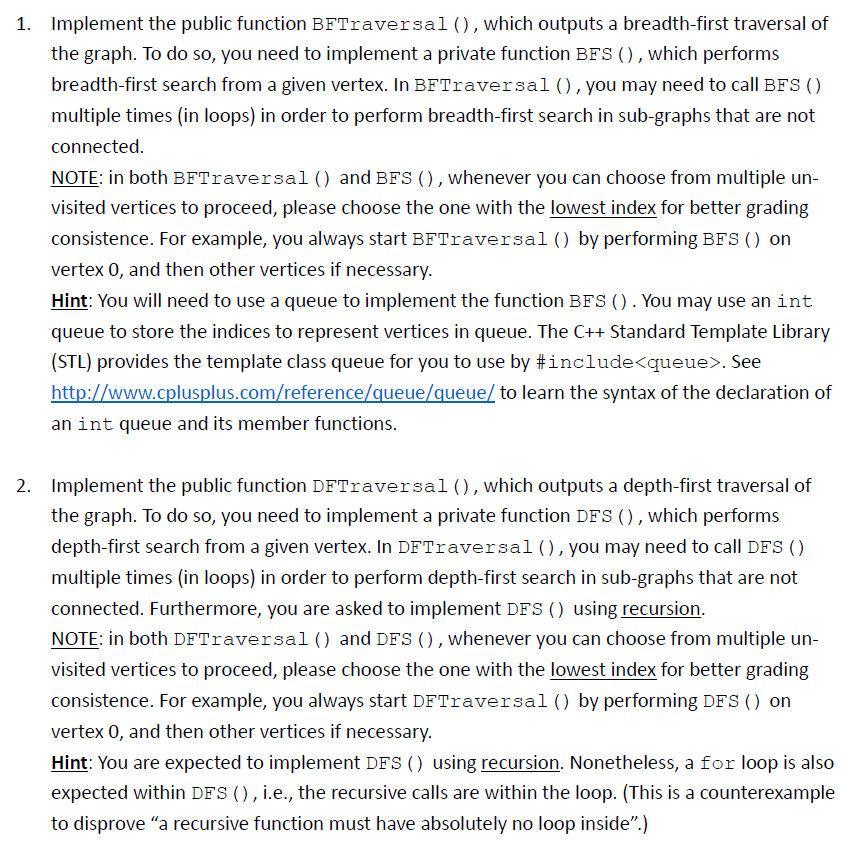
1. Implement the public function BFTraversal ), which outputs a breadth-first traversal of the graph. To do so, you need to implement a private function BFS (), which performs breadth-first search from a given vertex. In BFTraversal (), you may need to call BFS () multiple times (in loops) in order to perform breadth-first search in sub-graphs that are not connected NOTE: in both BFTraversal) and BFS (), whenever you can choose from multiple un visited vertices to proceed, please choose the one with the lowest index for better grading consistence. For example, you always start BFTraversal by performing BFS () or vertex 0, and then other vertices if necessary. Hint: You will need to use a queue to implement the function BFS(). You may use an int queue to store the indices to represent vertices in queue. The C++ Standard Template Library (STL) provides the template class queue for you to use by # include
Step by Step Solution
There are 3 Steps involved in it

Get step-by-step solutions from verified subject matter experts
 Study Help