







Question: Include null/alternative hypotheses, working out the z-test and finding the P-value if possible. Work out z-test and P-value as needed. 40. Belmont and Marolla conducted
 Include null/alternative hypotheses, working out the z-test and finding the P-value if possible. Work out z-test and P-value as needed.
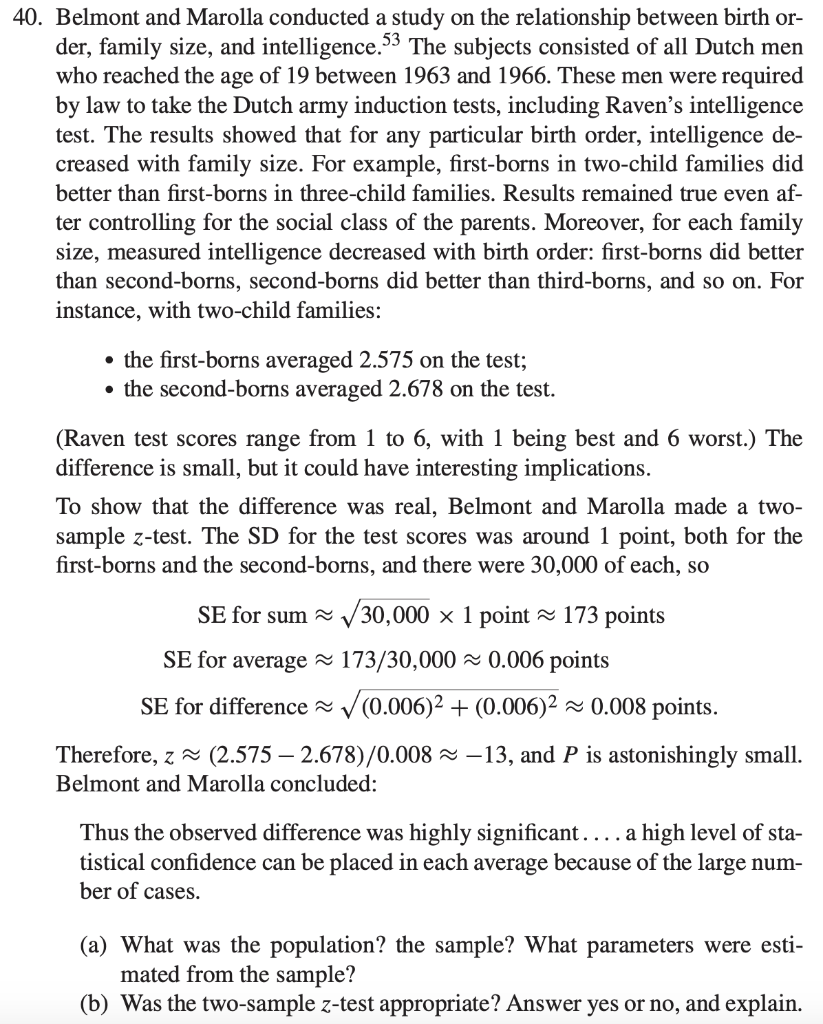
40. Belmont and Marolla conducted a study on the relationship between birth or- der, family size, and intelligence.53 The subjects consisted of all Dutch men who reached the age of 19 between 1963 and 1966. These men were required by law to take the Dutch army induction tests, including Raven's intelligence test. The results showed that for any particular birth order, intelligence de- creased with family size. For example, first-borns in two-child families did better than first-borns in three-child families. Results remained true even af- ter controlling for the social class of the parents. Moreover, for each family size, measured intelligence decreased with birth order: first-borns did better than second-borns, second-borns did better than third-borns, and so on. For instance, with two-child families: the first-borns averaged 2.575 on the test; the second-borns averaged 2.678 on the test. (Raven test scores range from 1 to 6, with 1 being best and 6 worst.) The difference is small, but it could have interesting implications. To show that the difference was real, Belmont and Marolla made a two- sample z-test. The SD for the test scores was around 1 point, both for the first-borns and the second-borns, and there were 30,000 of each, so SE for sum ~ 30,000 1 point ~173 points SE for average ~ 173/30,000 ~ 0.006 points SE for difference ~/(0.006)2 + (0.006)2 ~ 0.008 points. Therefore, z (2.575 2.678)/0.008 13, and P is astonishingly small. Belmont and Marolla concluded: Thus the observed difference was highly significant.... a high level of sta- tistical confidence can be placed in each average because of the large num- ber of cases. (a) What was the population? the sample? What parameters were esti- mated from the sample? (b) Was the two-sample z-test appropriate? Answer yes or no, and explain. 40. Belmont and Marolla conducted a study on the relationship between birth or- der, family size, and intelligence.53 The subjects consisted of all Dutch men who reached the age of 19 between 1963 and 1966. These men were required by law to take the Dutch army induction tests, including Raven's intelligence test. The results showed that for any particular birth order, intelligence de- creased with family size. For example, first-borns in two-child families did better than first-borns in three-child families. Results remained true even af- ter controlling for the social class of the parents. Moreover, for each family size, measured intelligence decreased with birth order: first-borns did better than second-borns, second-borns did better than third-borns, and so on. For instance, with two-child families: the first-borns averaged 2.575 on the test; the second-borns averaged 2.678 on the test. (Raven test scores range from 1 to 6, with 1 being best and 6 worst.) The difference is small, but it could have interesting implications. To show that the difference was real, Belmont and Marolla made a two- sample z-test. The SD for the test scores was around 1 point, both for the first-borns and the second-borns, and there were 30,000 of each, so SE for sum ~ 30,000 1 point ~173 points SE for average ~ 173/30,000 ~ 0.006 points SE for difference ~/(0.006)2 + (0.006)2 ~ 0.008 points. Therefore, z (2.575 2.678)/0.008 13, and P is astonishingly small. Belmont and Marolla concluded: Thus the observed difference was highly significant.... a high level of sta- tistical confidence can be placed in each average because of the large num- ber of cases. (a) What was the population? the sample? What parameters were esti- mated from the sample? (b) Was the two-sample z-test appropriate? Answer yes or no, and explain
Step by Step Solution
There are 3 Steps involved in it

Get step-by-step solutions from verified subject matter experts
 Study Help