







Question: # include using namespace std; #define My_DEBUG 1 int getNumberOfDigits (int n); // returns how many digits in positive number n int* int2DynamicArray (int n,
# include
using namespace std;
#define My_DEBUG 1
int getNumberOfDigits (int n); // returns how many digits in positive number n
int* int2DynamicArray (int n, int &numDigits); // convert n to an dynamic array
int dynamicArray2int (int* intPointer, int numDigits);
int sortDescending (int* intPointer, int numDigits);
int sortAscending ( int* intPointer, int numDigits);
void printArray (int* p, int size);
void test();
void test () {
cout
int k;
int* p;
p = int2DynamicArray (34574, k)
printArray(p,k);
cout
cout
}
int main () {
int n = 1234; //4 digits positive number
int *p = NULL;
int numDigits = 0, descending, ascending;
int count = 0, m, blackHo1e = -1;
const int MAXCOUNT=50;
cout
while (n >= 10) {
cout
cin>>n;
m = n;
cout
while( count
p int2DynamicArray (m, numDigits);
//add code according to the definition of number black hole
blackHo1e = descending - ascending;
cout
delete [] p;
if (blackHo1e) {
break;
}
else{
m = blackHo1e ;
count++;
}
}
if (count == MAXCOUNT) {
cout
}
else{
cout
}
}
return 0;
}
int getNumberOfDigits (int n) { // returns how many digits in positive number n
if (n
return -1;
}
int numDigits = 0;
while (n > 0){
n = n/10; //integer division
numDigits++;
}
return numDigits;
}
// precondition: n >0. n=3898, return an array containing {3,8, 9, 8}
int* int2DynamicArray(int n, int &k){ //convert n to an dynamic array
k = getNumberOfDigits(n);
int *p = new int[k];
int m = k-1;
while ( n > 0) {
p[m--] = n%10;
n = n/10; //integer division
}
return p;
}
//2145 ---{2,1, 4, 5}
int dynamicArray2int (int* p, int numDigits) {
int n = 0;
int base = 1;
for(int i =numDigits - 1; i >= 0; i-- ) {
n += base * p [i];
base *= 10;
}
return n;
}
int sortDescending (int* p, int numDigits) {
int tmp;
for (int i=0; i
for (int j=i+l; j
if(p[i]
tmp = p[i];
p[i] = p[j];
p[j] = tmp;
}
}
}
return dynamicArray2int(p, numDigits);
}
int sortAscending (int* p, int numDigits) {
int tmp;
for (int 1=0; i
for(int j=i+l; j
if(p[i]> p[j]){
tmp = p[i];
p[i] = p[i];
p[j] = tmp;
}
}
return dynamicArray2int (p, numDigits);
}
void printArray(int* p, int size) {
cout
for(int i=0; i
cout
}
cout
}
Make an edit on the source program to run and show the running result using the instructions above.
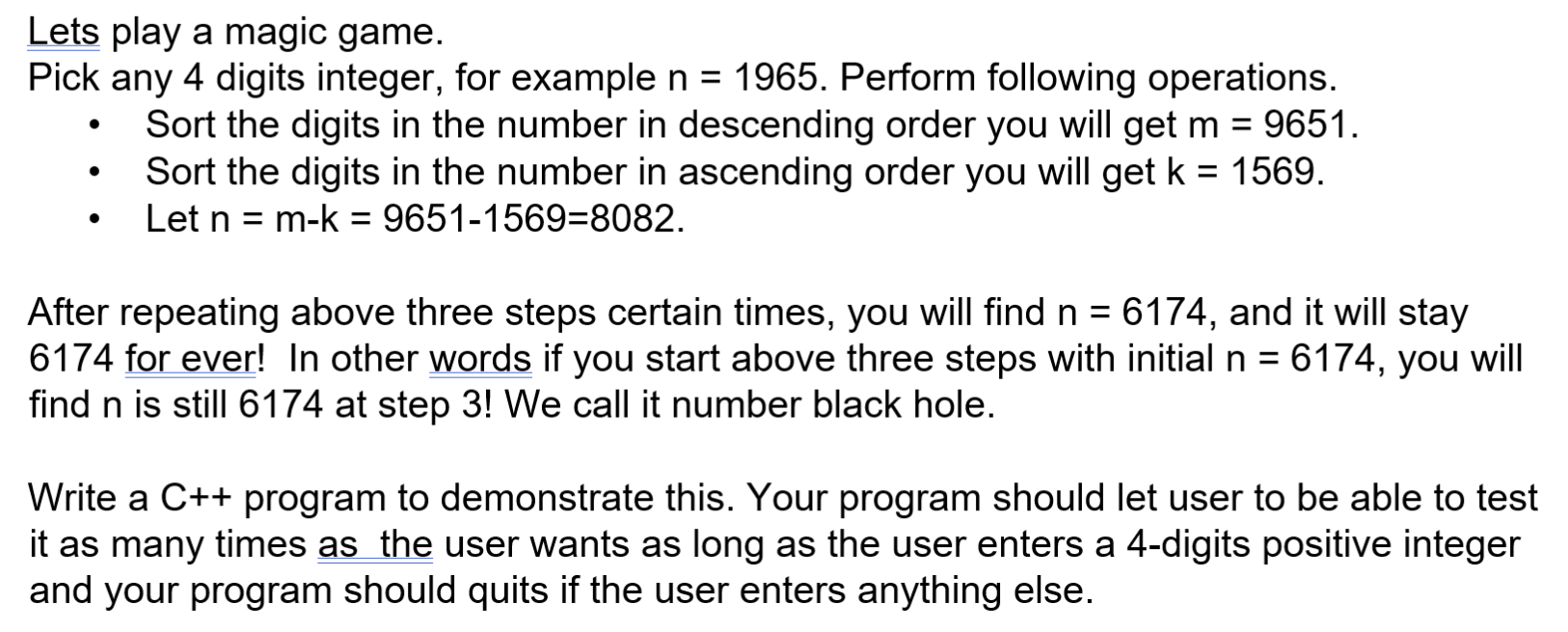
Lets play a magic game. Pick any 4 digits integer, for example n = 1965. Perform following operations. Sort the digits in the number in descending order you will get m = 9651. Sort the digits in the number in ascending order you will get k = 1569. Let n = m-k = 9651-15698082. . After repeating above three steps certain times, you will find n = 6174, and it will stay 6174 for ever! In other words if you start above three steps with initial n = 6174, you will find n is still 6174 at step 3! We call it number black hole. Write a C++ program to demonstrate this. Your program should let user to be able to test it as many times as the user wants as long as the user enters a 4-digits positive integer and your program should quits if the user enters anything else
Step by Step Solution
There are 3 Steps involved in it

Get step-by-step solutions from verified subject matter experts
 Study Help