



Question: Independent Activity 1. 1. How do you determine the values of a random variable? 2. How do you know whether a random variable is continuous
Independent Activity 1.
1. How do you determine the values of a random variable?
2. How do you know whether a random variable is continuous or discrete?
What is the difference between the two types of random variables?
Independent Assessment 1.
Classify the following random variables as discrete or continuous.
1. the speed of a tricycle.
2. the number of female students.
3. the time needed to finish the module.
4. the amount of sugar in a cup of coffee.
5. The number of defective mobile phones produced by a manufacturer.
Independent Activity 2.
Determine whether each of the following experiments/situations involve a discrete random variable or a continuous random variable.
1. choosing an even number less than 150
2. gathering information about the average monthly electric consumption in a certain household
3. tallying the number of family in a certain barangay that have one child
Independent Assessment 2.
Identify whether the given experiment involves a discrete random variable or a continuous random variable. Write your answer on a separate answer sheet.
1. getting the temperature of patient admitted in a hospital
2. collecting data about the weights of students in a certain school
3. the number of patient admitted in the hospital due to COVID-19
4. the number of no work no pay in a certain municipality caused by pandemic
5. the number of families that are members of 4P's in Quezon
6. the number of Balikbayan OFW arrive in the Philippines
7. the number of text messages received by a particular individual in a day
8. the number of possible outcomes in rolling a die
9. the amount of liquid in a 12 ounce can of soda
10. the number of fouls committed by a basketball team during the games
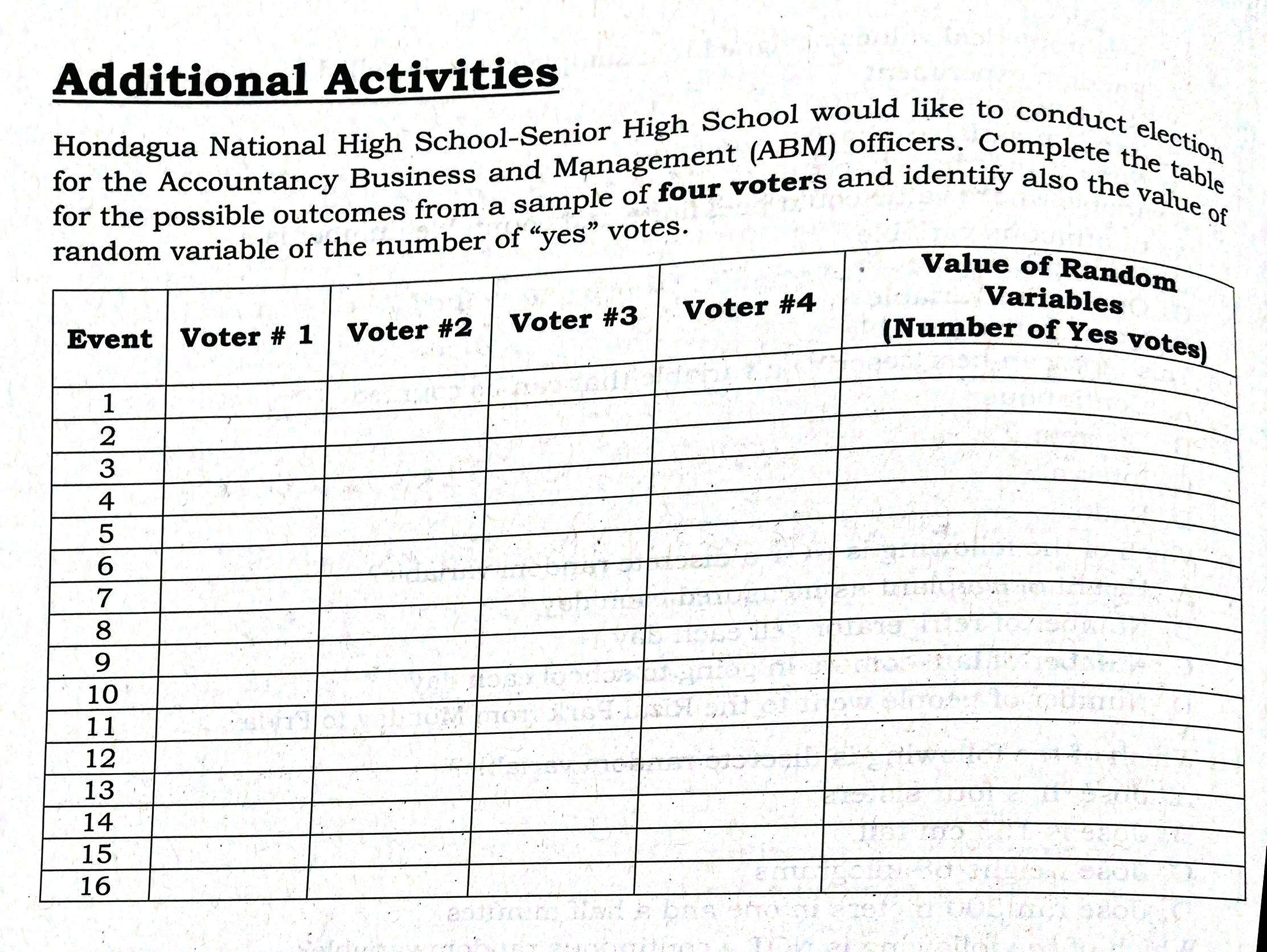
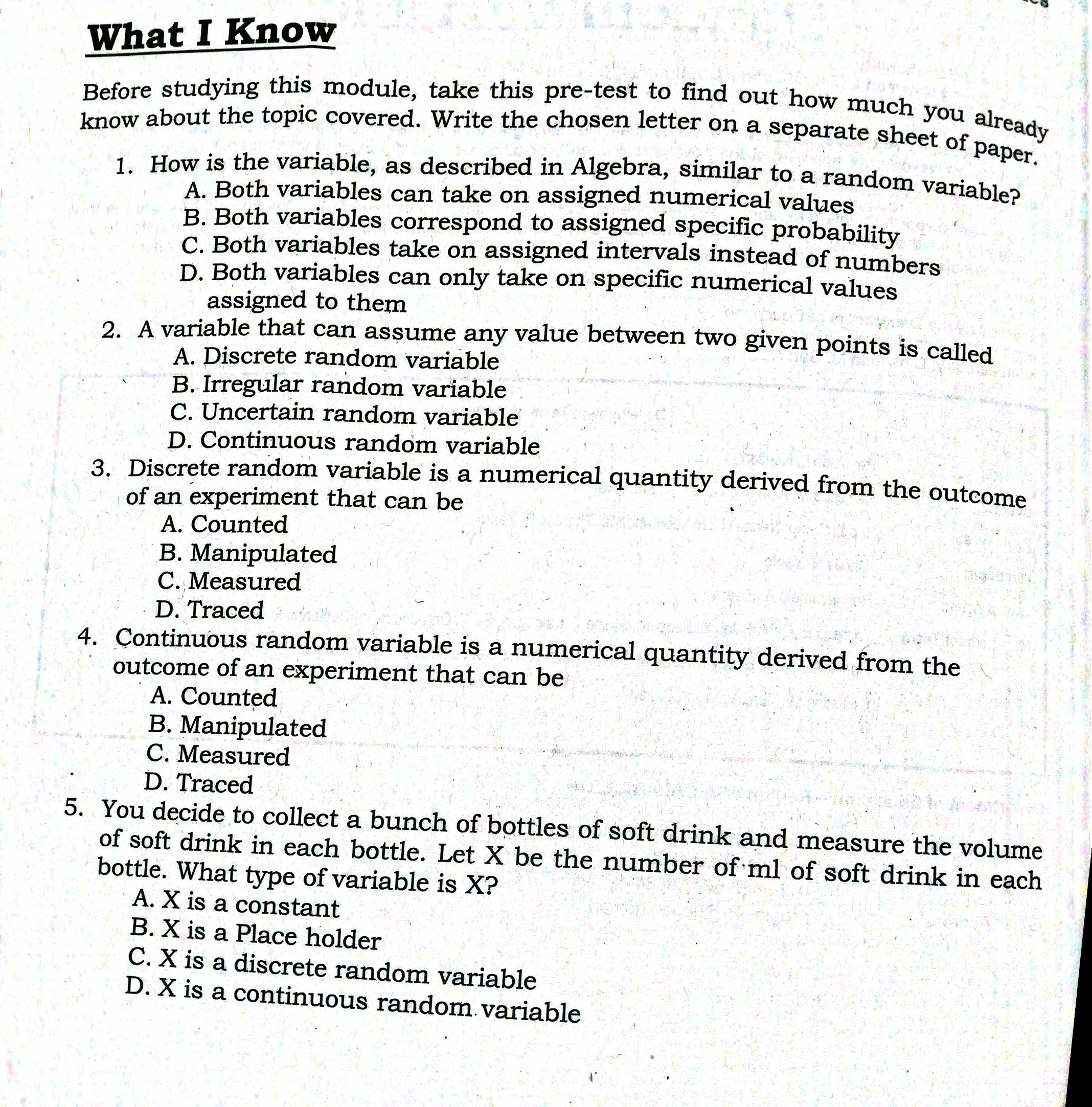
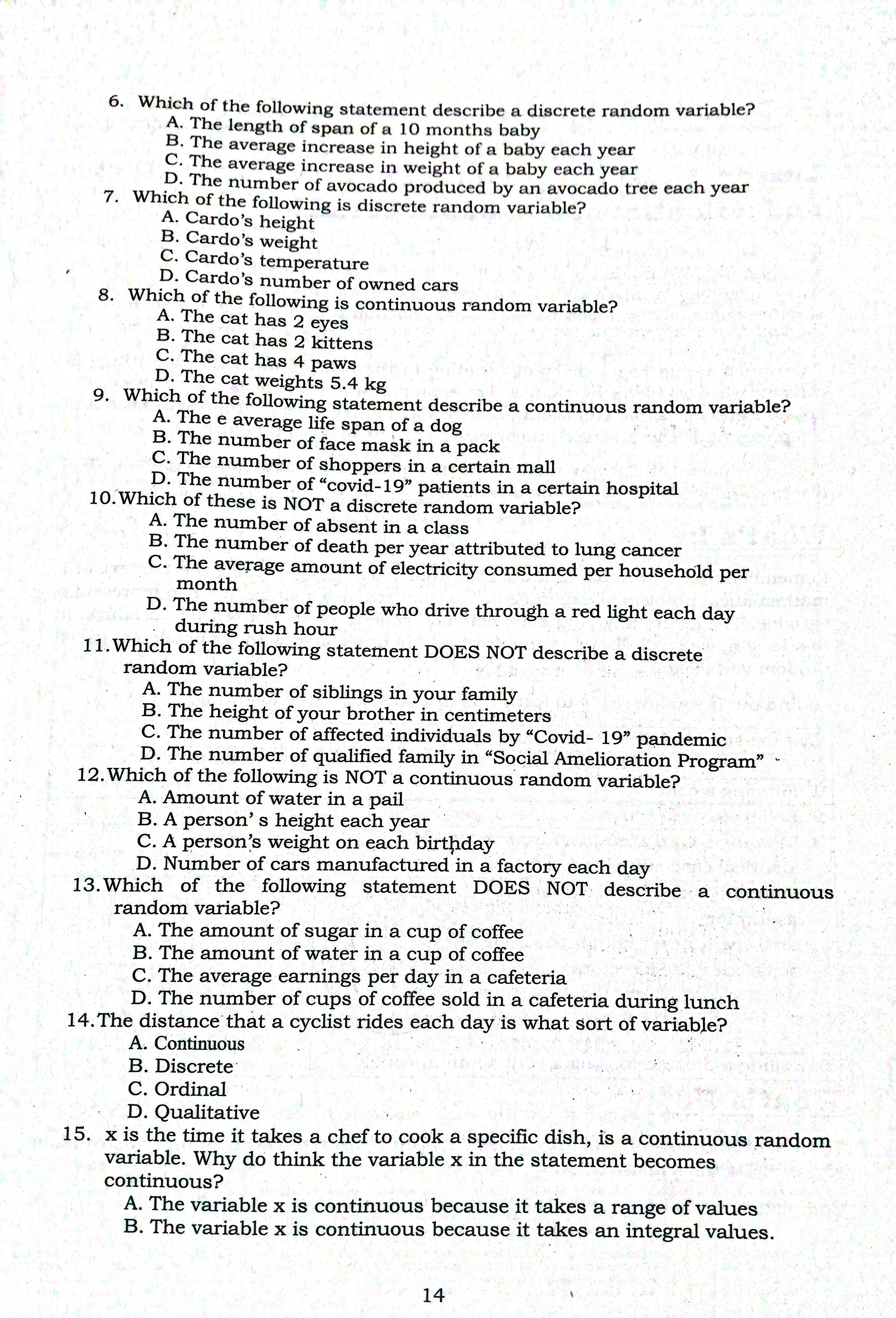
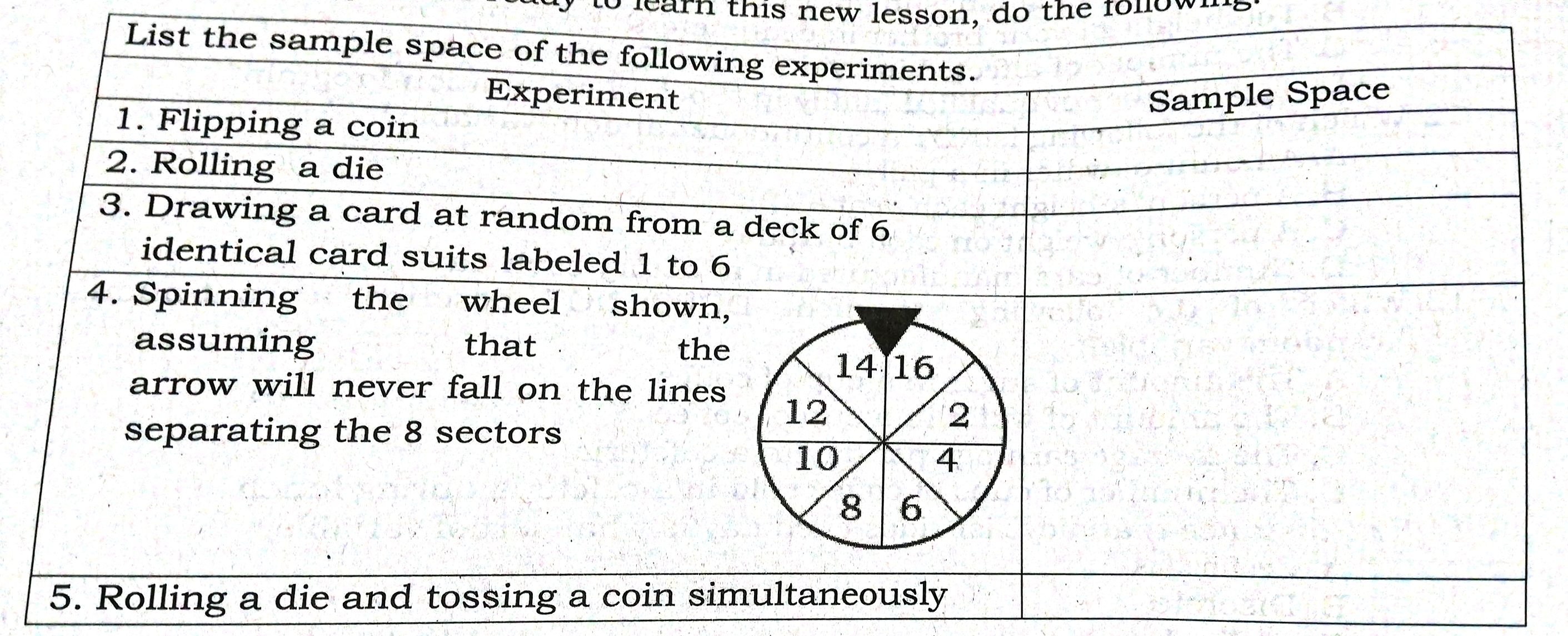
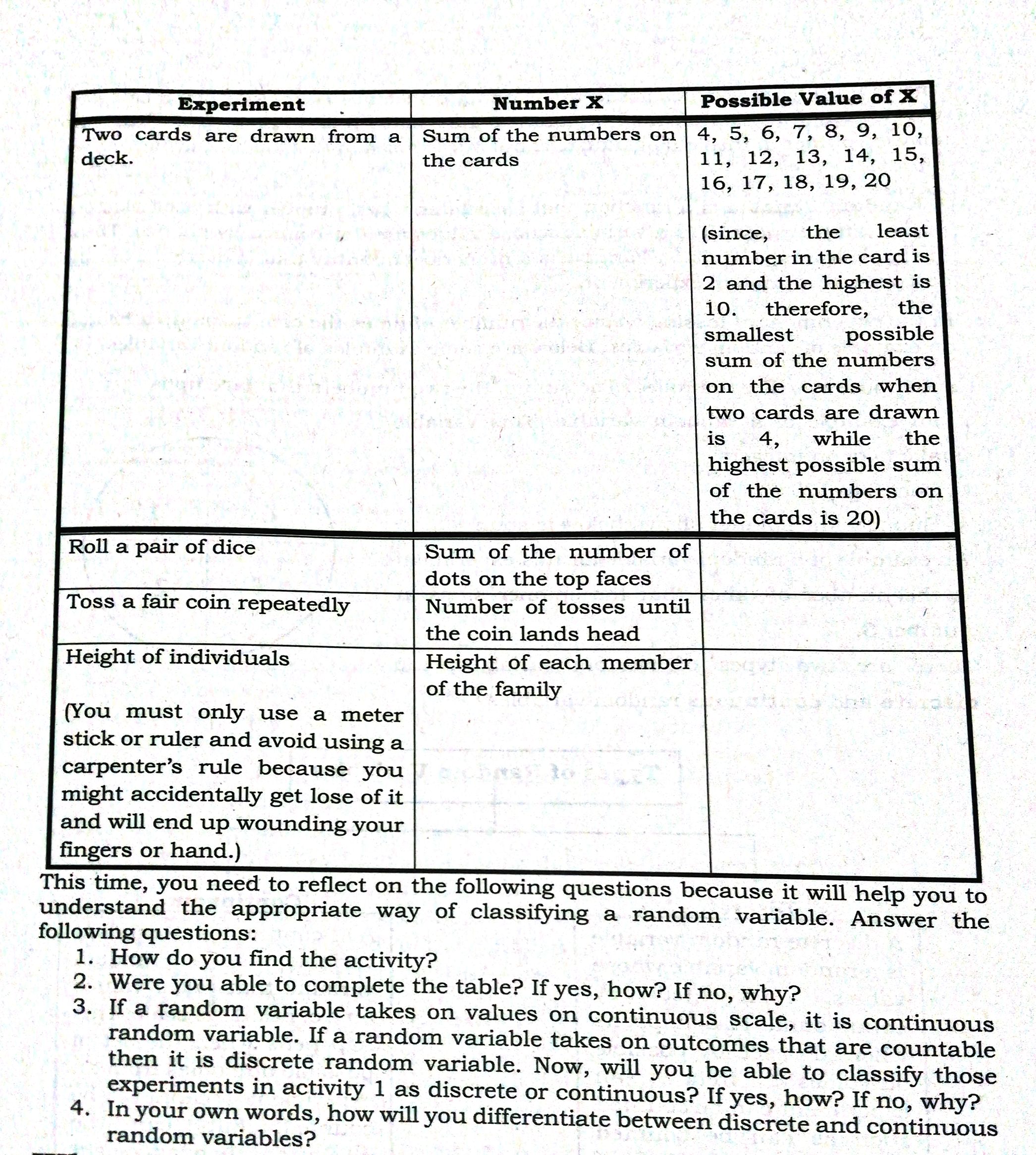
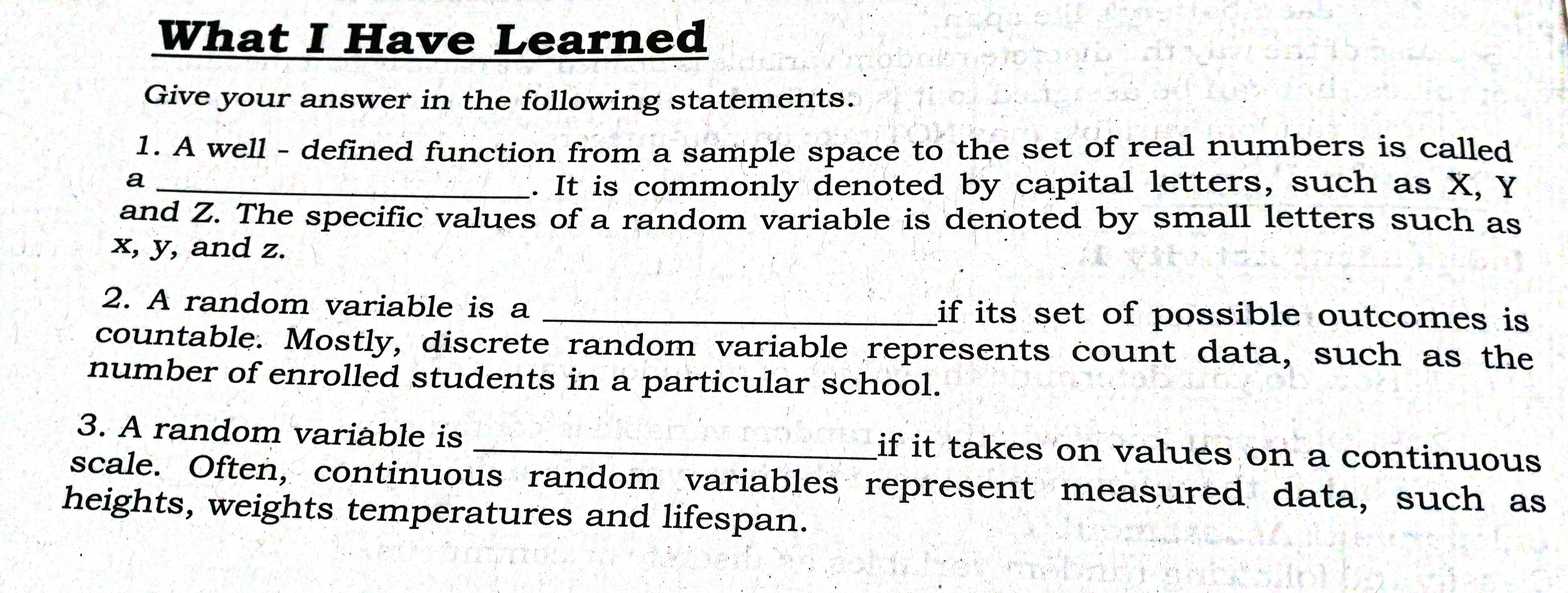
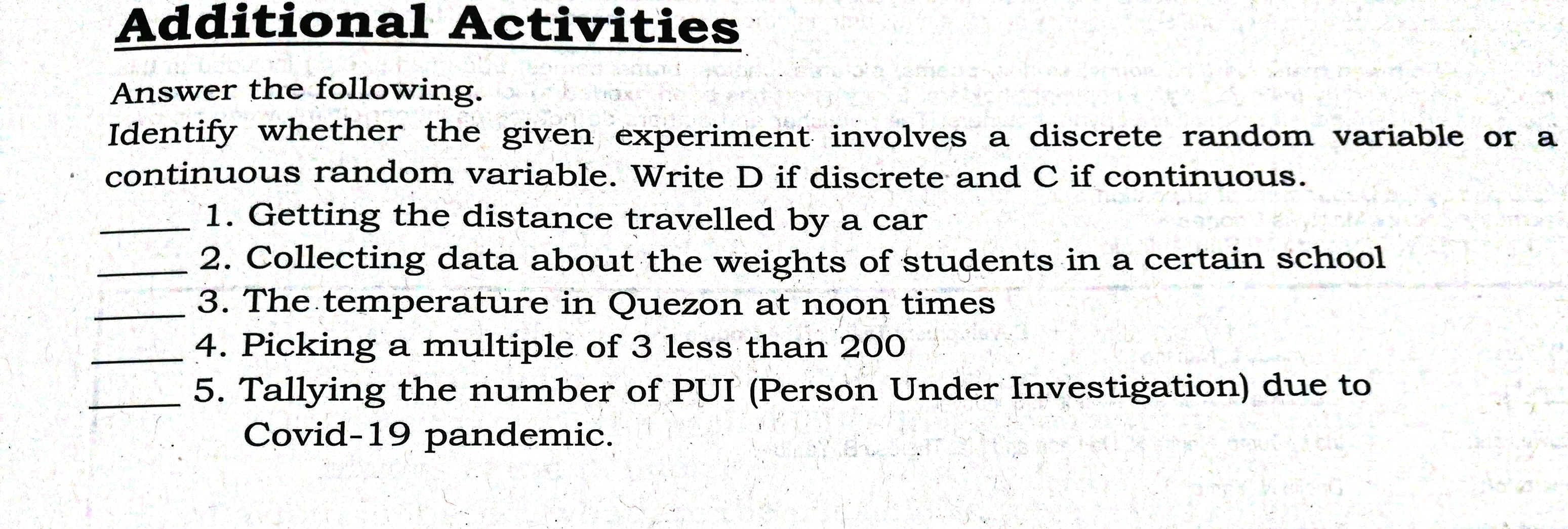
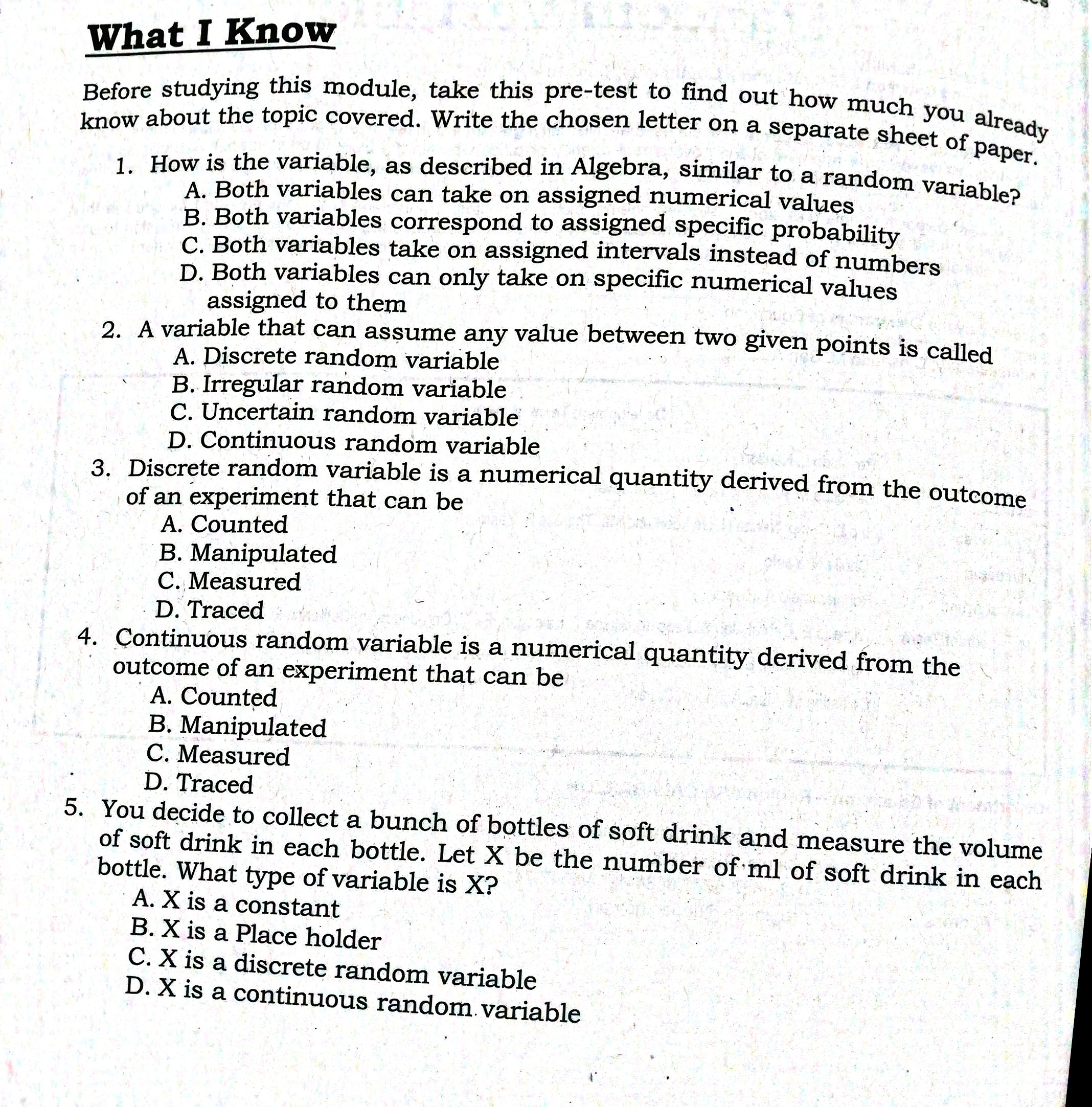
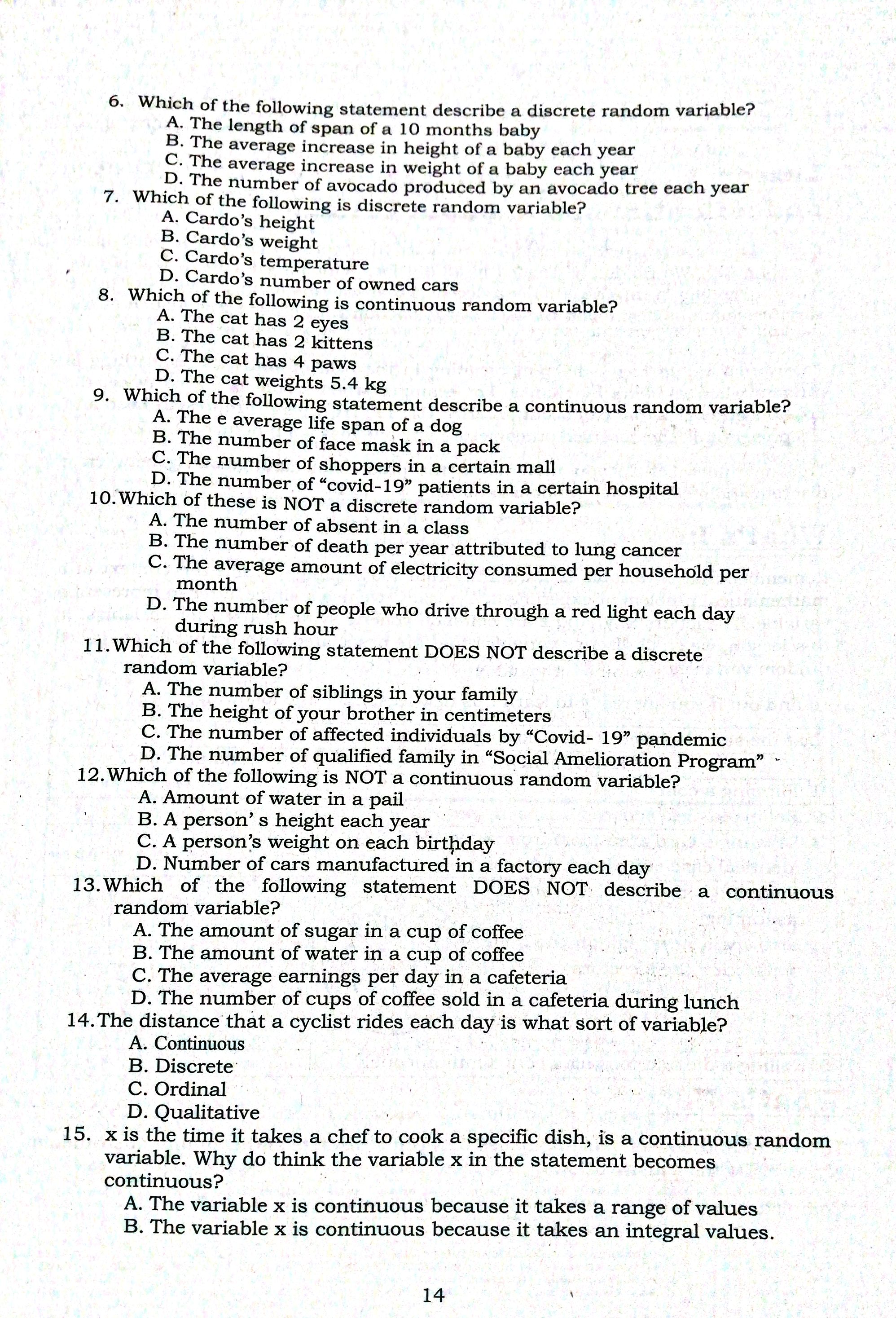
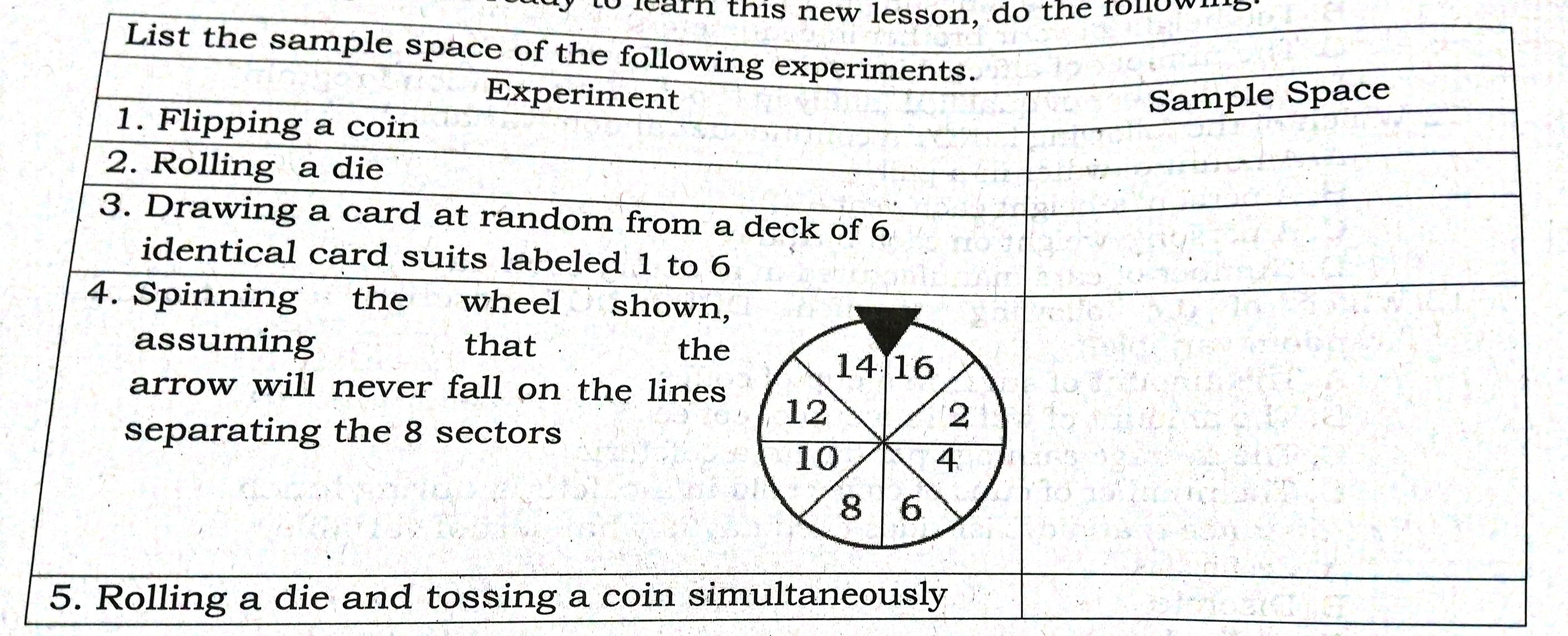
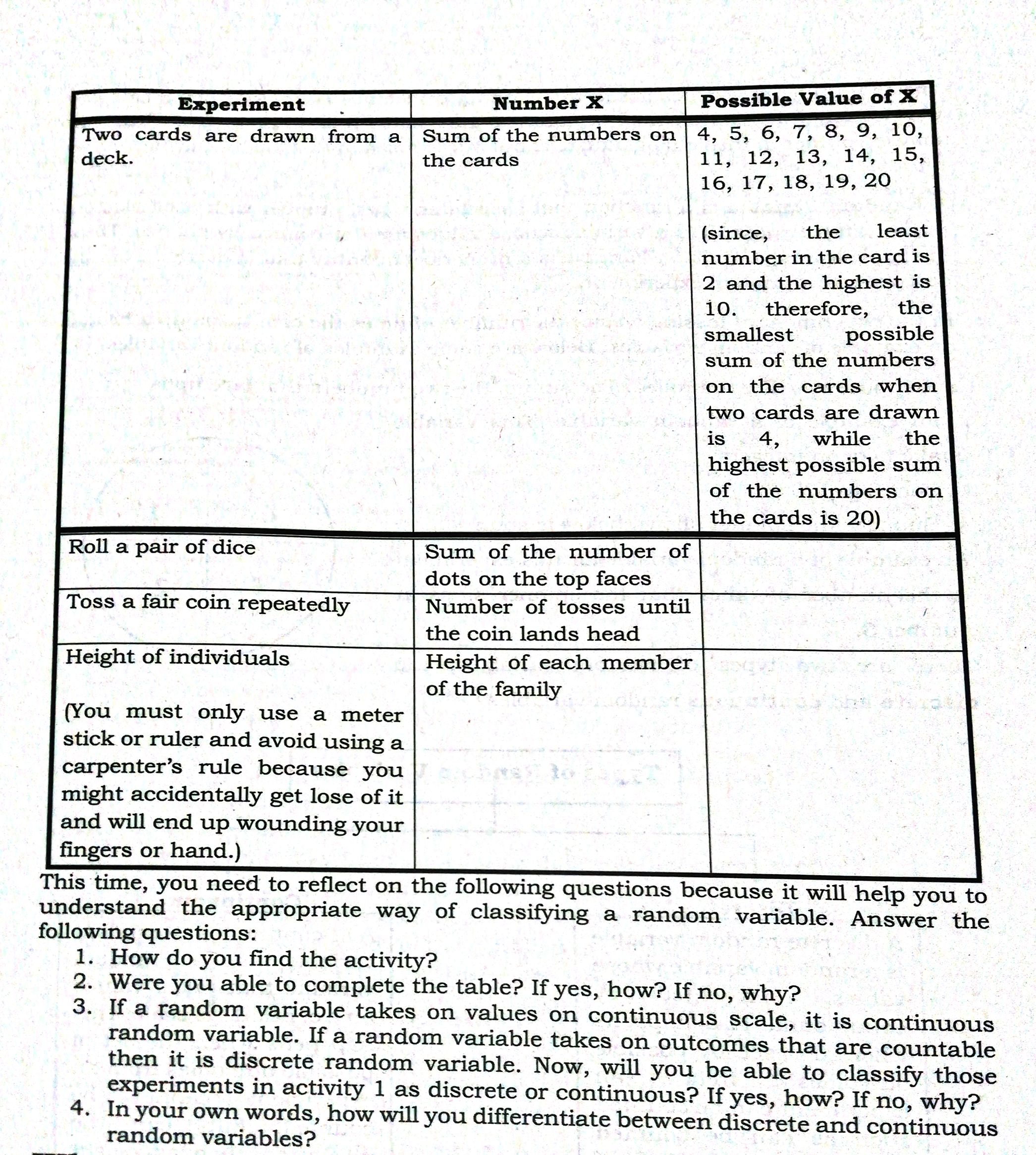
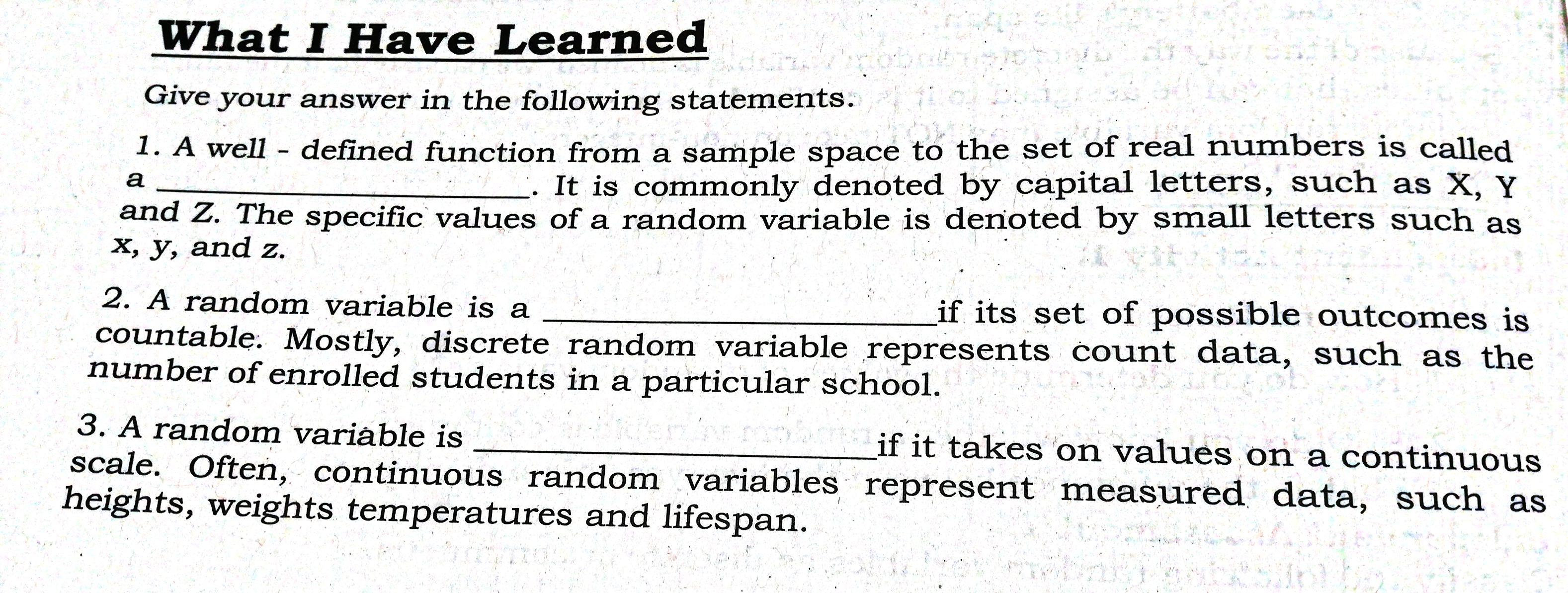
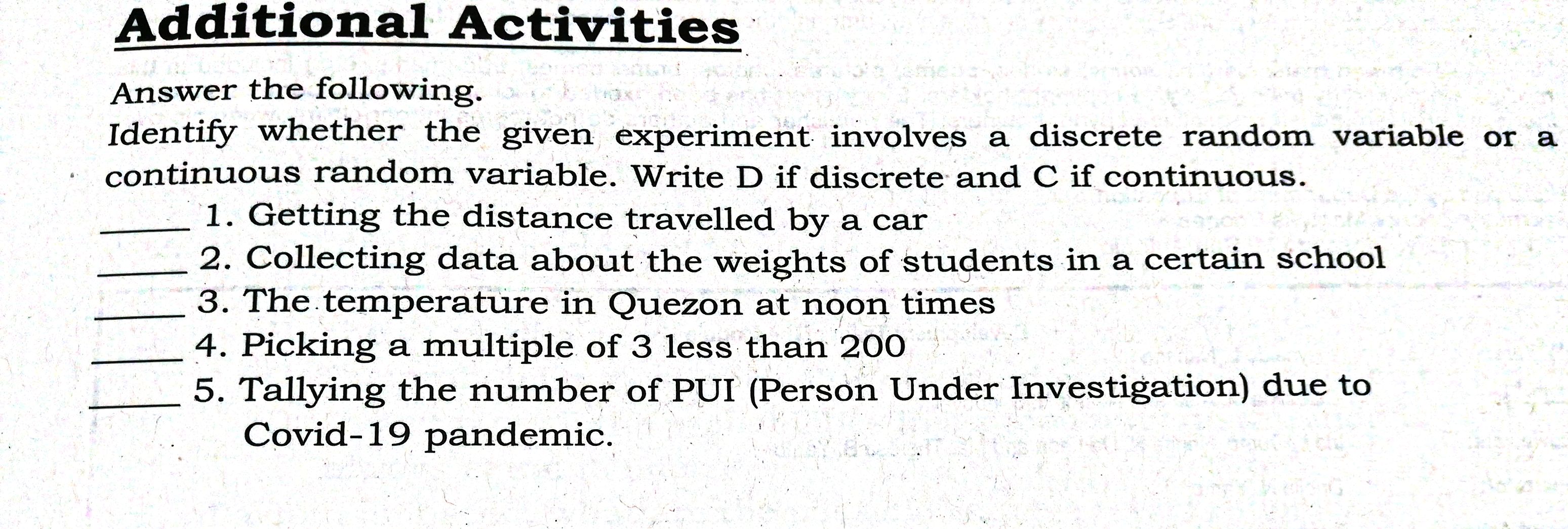
Additional Activities tondagua National High School-Senior High School would rise to conduct electing for the Accountancy Business and Management (ABM) officers. Complete the frion for the possible outcomes from a sample of four voters and luckily also the value le random variable of the number of "yes" votes. Value of Random Event Voter # 1 Voter #2 Voter #3 Voter #4 Variables (Number of Yes votes) 10 11 12 13 14 15 16What I Know Before studying this module, take this pre-test to find out how much you already know about the topic covered. Write the chosen letter on a separate sheet of paper. 1. How is the variable, as described in Algebra, similar to a random variable? A. Both variables can take on assigned numerical values B. Both variables correspond to assigned specific probability C. Both variables take on assigned intervals instead of numbers D. Both variables can only take on specific numerical values assigned to them 2. A variable that can assume any value between two given points is called A. Discrete random variable B. Irregular random variable C. Uncertain random variable D. Continuous random variable 3. Discrete random variable is a numerical quantity derived from the outcome of an experiment that can be A. Counted B. Manipulated C. Measured D. Traced 4. Continuous random variable is a numerical quantity derived from the outcome of an experiment that can be A. Counted B. Manipulated C. Measured D. Traced 5. You decide to collect a bunch of bottles of soft drink and measure the volume of soft drink in each bottle. Let X be the number of ml of soft drink in each bottle. What type of variable is X? A. X is a constant B. X is a Place holder C. X is a discrete random variable D. X is a continuous random variable6. Which of the following statement describe a discrete random variable? A. The length of span of a 10 months baby B. The average increase in height of a baby each year C. The average increase in weight of a baby each year D. The number of avocado produced by an avocado tree each year 7. Which of the following is discrete random variable? A. Cardo's height B. Cardo's weight C. Cardo's temperature D. Cardo's number of owned cars 8. Which of the following is continuous random variable? A. The cat has 2 eyes B. The cat has 2 kittens C. The cat has 4 paws D. The cat weights 5.4 kg 9. Which of the following statement describe a continuous random variable? A. The e average life span of a dog B. The number of face mask in a pack C. The number of shoppers in a certain mall D. The number of "covid-19" patients in a certain hospital 10. Which of these is NOT a discrete random variable? A. The number of absent in a class B. The number of death per year attributed to lung cancer C. The average amount of electricity consumed per household per month D. The number of people who drive through a red light each day during rush hour 11. Which of the following statement DOES NOT describe a discrete random variable? A. The number of siblings in your family B. The height of your brother in centimeters C. The number of affected individuals by "Covid- 19" pandemic D. The number of qualified family in "Social Amelioration Program" 12. Which of the following is NOT a continuous random variable? A. Amount of water in a pail B. A person's height each year C. A person's weight on each birthday D. Number of cars manufactured in a factory each day 13. Which of the following statement DOES NOT describe a continuous random variable? A. The amount of sugar in a cup of coffee B. The amount of water in a cup of coffee C. The average earnings per day in a cafeteria D. The number of cups of coffee sold in a cafeteria during lunch 14. The distance that a cyclist rides each day is what sort of variable? A. Continuous B. Discrete C. Ordinal D. Qualitative 15. x is the time it takes a chef to cook a specific dish, is a continuous random variable. Why do think the variable x in the statement becomes continuous? A. The variable x is continuous because it takes a range of values B. The variable x is continuous because it takes an integral values. 14carn this new lesson, do the followi List the sample space of the following experiments. Experiment Sample Space 1. Flipping a coin 2. Rolling a die 3. Drawing a card at random from a deck of 6 identical card suits labeled 1 to 6 4. Spinning the wheel shown, assuming that the 14 16 arrow will never fall on the lines 12 2 separating the 8 sectors 10 4 8 6 5. Rolling a die and tossing a coin simultaneouslyExperiment Number X Possible Value of X Two cards are drawn from a Sum of the numbers on 4, 5, 6, 7, 8, 9, 10, deck. the cards 11, 12, 13, 14, 15, 16, 17, 18, 19, 20 (since, the least number in the card is 2 and the highest is 10. therefore, the smallest possible sum of the numbers on the cards when two cards are drawn is 4, while the highest possible sum of the numbers on the cards is 20) Roll a pair of dice Sum of the number of dots on the top faces Toss a fair coin repeatedly Number of tosses until the coin lands head Height of individuals Height of each member of the family You must only use a meter stick or ruler and avoid using a carpenter's rule because you might accidentally get lose of it and will end up wounding your fingers or hand.) This time, you need to reflect on the following questions because it will help you to understand the appropriate way of classifying a random variable. Answer the following questions: 1. How do you find the activity? 2. Were you able to complete the table? If yes, how? If no, why? 3. If a random variable takes on values on continuous scale, it is continuous random variable. If a random variable takes on outcomes that are countable then it is discrete random variable. Now, will you be able to classify those experiments in activity 1 as discrete or continuous? If yes, how? If no, why? 4. In your own words, how will you differentiate between discrete and continuous random variables?What I Have Learned Give your answer in the following statements. 1. A well - defined function from a sample space to the set of real numbers is called a . It is commonly denoted by capital letters, such as X, Y and Z. The specific values of a random variable is denoted by small letters such as x, y, and z. 2. A random variable is a if its set of possible outcomes is countable. Mostly, discrete random variable represents count data, such as the number of enrolled students in a particular school. 3. A random variable is if it takes on values on a continuous scale. Often, continuous random variables represent measured data, such as heights, weights temperatures and lifespan.Additional Activities Answer the following.x Identify whether the given experiment involves a discrete random variable or a continuous random variable. Write D if discrete and C if continuous. 1. Getting the distance travelled by a car 2. Collecting data about the weights of students in a certain school 3. The temperature in Quezon at noon times 4. Picking a multiple of 3 less than 200 5. Tallying the number of PUI (Person Under Investigation) due to Covid-19 pandemic
Step by Step Solution
There are 3 Steps involved in it

Get step-by-step solutions from verified subject matter experts