



Question: Indicators: Let A be an event, and let IA be the associated indicator random variable: IA (w) = 1 if w belongs A , and
Indicators:
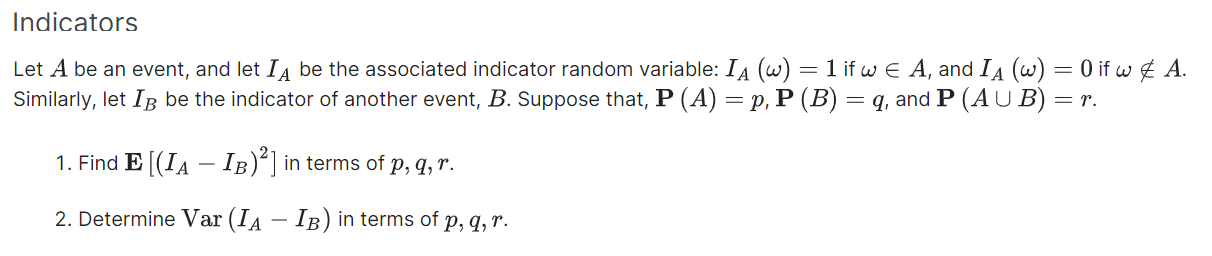
Let A be an event, and let IA be the associated indicator random variable: IA (w) = 1 if w belongs A, and IA (w) = 0 if w doesn't belong to A.
Similarly, let IB be the indicator of another event, B. Suppose that, P (A) = p, P (B) = q, and P (A union B) = r.
1. Find E [(IA - IB)2] in terms of p, q, r.
2. Determine Var (IA-IB) in terms of p, q, r.
Attachment:
Indicators Let A be an event, and let IA be the associated indicator random variable: IA (w) = 1 if we A, and IA (w) = 0ifwe A. Similarly, let Is be the indicator of another event, B. Suppose that, P (A) = p, P (B) = q, and P (A U B) = r. 1. Find E [(IA - IB )"] in terms of p, q, r. 2. Determine Var (IA - IB ) in terms of p, q, r
Step by Step Solution
There are 3 Steps involved in it

Get step-by-step solutions from verified subject matter experts