



Question: Industry structure under perfect competition Suppose that a perfectly competitive (or price taking) rm has the following (short-run) total cost function: TC(q) = q2 +
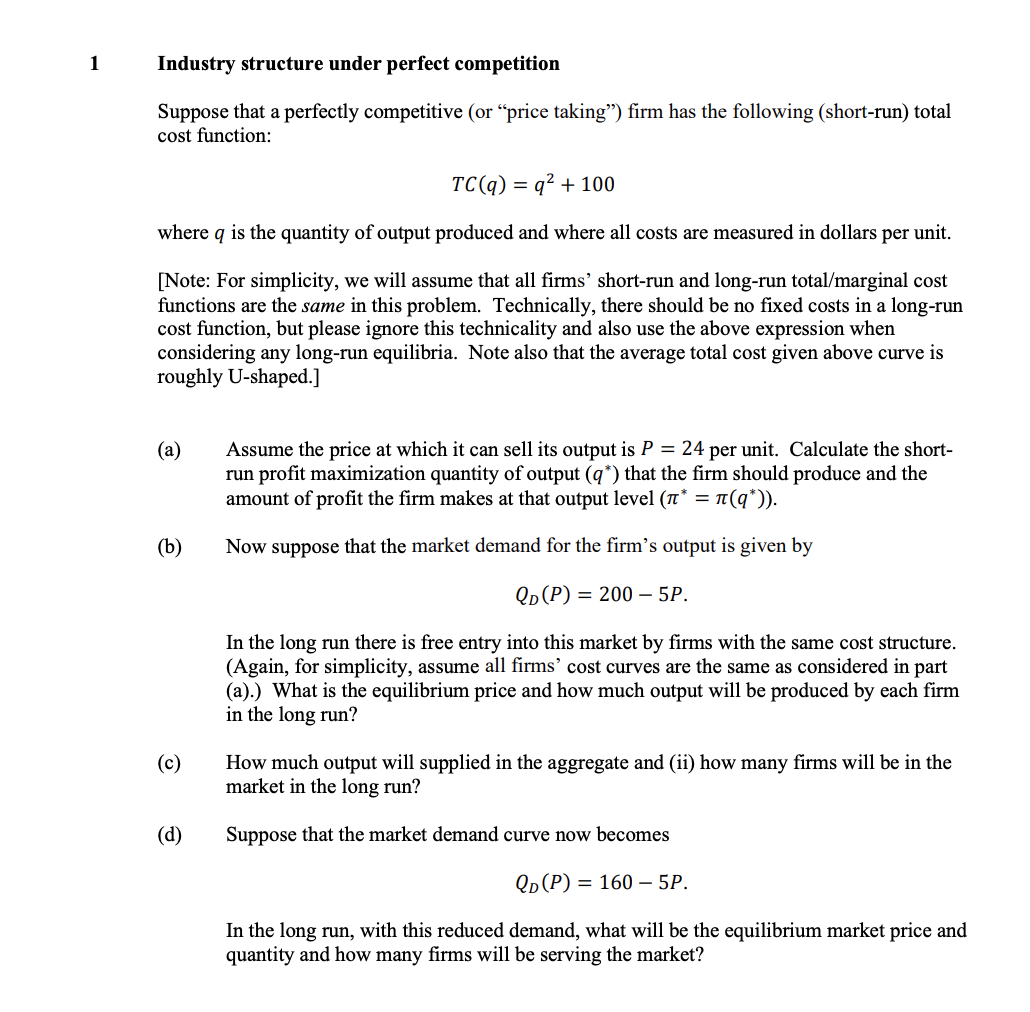

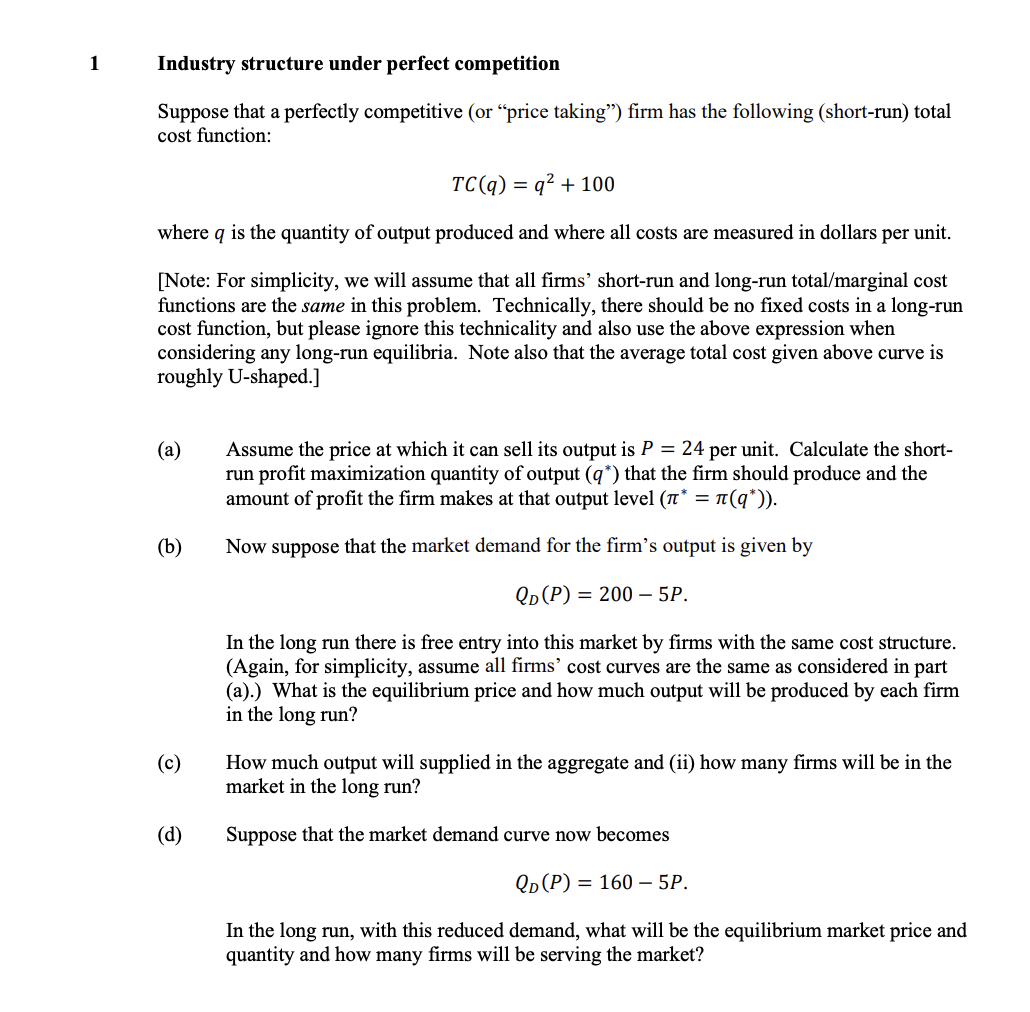

Industry structure under perfect competition Suppose that a perfectly competitive (or \"price taking\") rm has the following (short-run) total cost function: TC(q) = q2 + 100 where q is the quantity of output produced and where all costs are measured in dollars per unit. [Note: For simplicity, we will assume that all rms\" short-run and long-run totalfmarginal cost functions are the same in this problem. Technically, there should be no xed costs in a long-run cost function, but please ignore this technicality and also use the above expression when considering any long-run equilibria. Note also that the average total cost given above curve is roughly Ushaped.] (a) (b) (d) Assume the price at which it can sell its output is P = 24- per unit. Calculate the short- run prot maximization quantity of output (cf) that the firm should produce and the amount of prot the rm makes at that output level (11" = rr(q\")). Now suppose that the market demand for the rm's output is given by QDUJ} = 200 5P. In the long run there is free entry into this market by rms with the same cost structure. (Again, for simplicity, assume all rms" cost curves are the same as considered in part (a).) What is the equilibrium price and how much output will be produced by each rm in the long run? How much output will supplied in the aggregate and (ii) how many firms will be in the market in the long run? Suppose that the market demand curve now becomes QDUJ} = 160 5P. In the long run, with this reduced demand, what will be the equilibrium market price and quantity and how many firms will be serving the market? (e) Based on your answers from pan (d), graph the long-run market adjustment process and describe the path that prices will take
Step by Step Solution
There are 3 Steps involved in it

Get step-by-step solutions from verified subject matter experts