







Question: HW#2 : . Q1) (2 points) What BOD stands for? Draw typical BOD curve with time. Describe this curve (in your answer you should
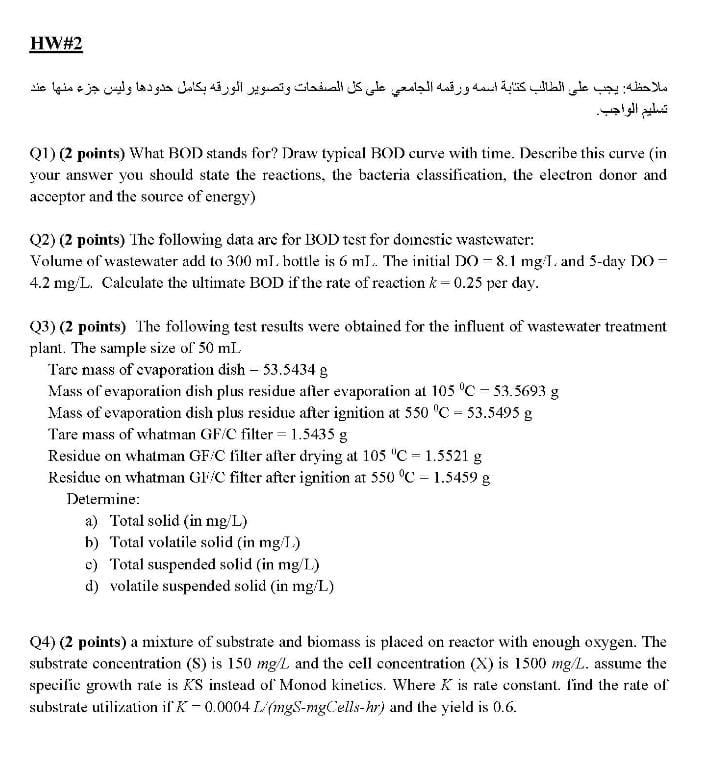
HW#2 : . Q1) (2 points) What BOD stands for? Draw typical BOD curve with time. Describe this curve (in your answer you should state the reactions, the bacteria classification, the electron donor and acceptor and the source of energy) Q2) (2 points) The following data are for BOD test for domestic wastewater: Volume of wastewater add to 300 ml. bottle is 6 ml. The initial DO-8.1 mg 1. and 5-day DO- 4.2 mg/L. Calculate the ultimate BOD if the rate of reaction k = 0.25 per day. Q3) (2 points) The following test results were obtained for the influent of wastewater treatment plant. The sample size of 50 ml. Tare mass of evaporation dish - 53.5434 g Mass of evaporation dish plus residue after evaporation at 105 C -53.5693 g Mass of evaporation dish plus residue after ignition at 550 C-53.5495 g Tare mass of whatman GF/C filter = 1.5435 g Residue on whatman GF/C filter after drying at 105 "C= 1.5521 g Residue on whatman Gl/C filter after ignition at 550 C -1.5459 g Determine: a) Total solid (in mg/L) b) Total volatile solid (in mg/L.) c) Total suspended solid (in mg/L) d) volatile suspended solid (in mg/L) Q4) (2 points) a mixture of substrate and biomass is placed on reactor with enough oxygen. The substrate concentration (S) is 150 mg/L and the cell concentration (X) is 1500 mg/L. assume the specific growth rate is KS instead of Monod kinetics. Where K is rate constant. find the rate of substrate utilization if K-0.0004 L/(mgS-mgCells-hr) and the yield is 0.6.
Step by Step Solution
3.46 Rating (159 Votes )
There are 3 Steps involved in it
Question 1 Question 2 Question 3 Question 4 Ans BOD stands for Biochemical ... View full answer

Get step-by-step solutions from verified subject matter experts
 Study Help