







Question: INFERENCE STATISTICS fQUESTION 2 [301 Refer to QUESTION 1. l (31) Find the maximum likelihood estimator of ~. (3) o (b) Show that the estimator
INFERENCE STATISTICS
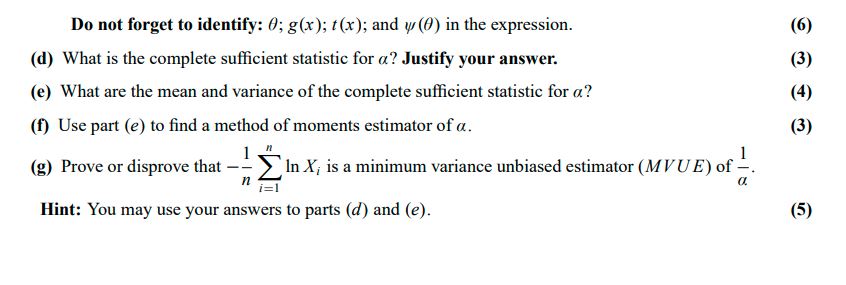
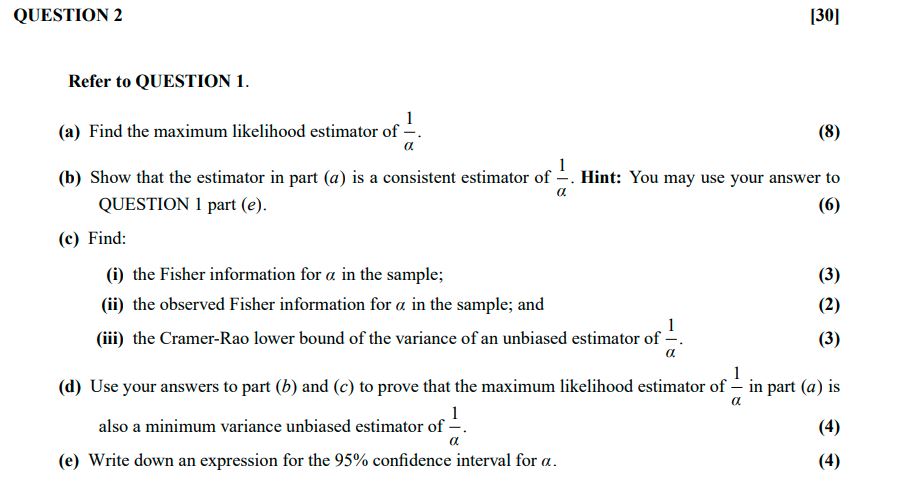
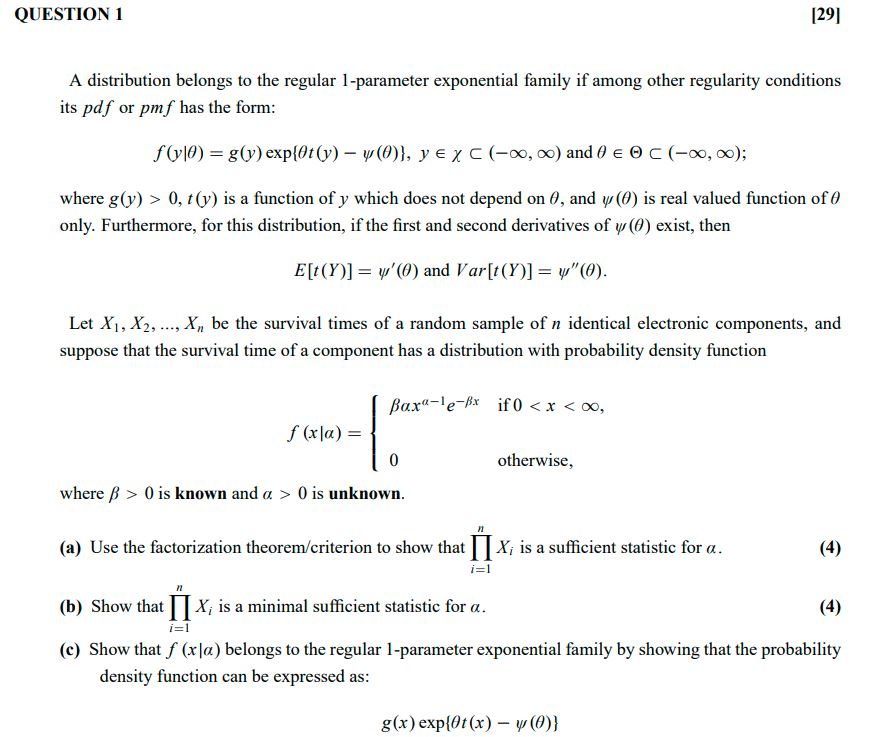
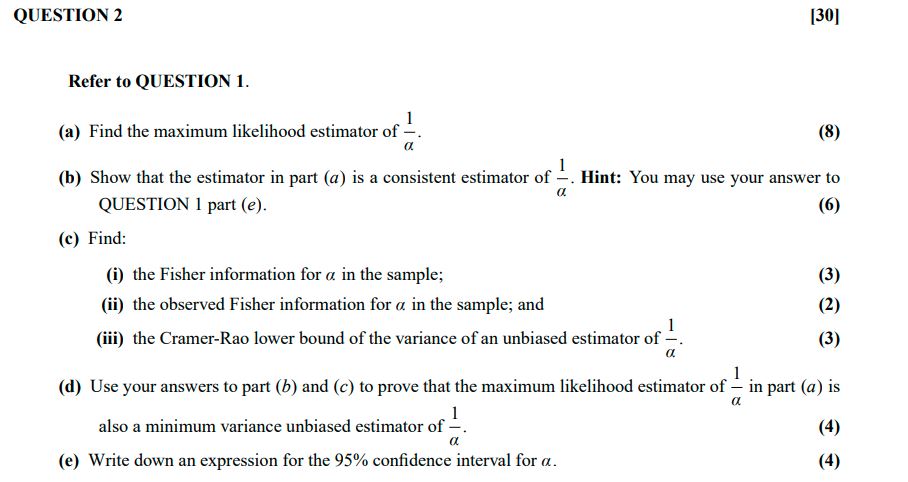
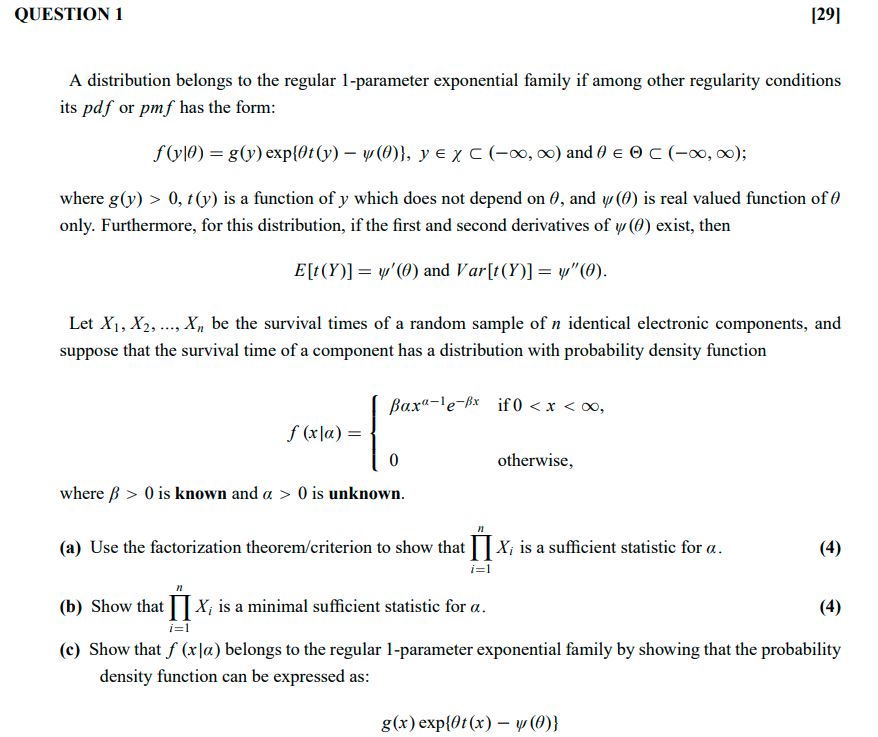
\fQUESTION 2 [301 Refer to QUESTION 1. l (31) Find the maximum likelihood estimator of ~. (3) o (b) Show that the estimator in part (a) is a consistent estimator of 1. Hint: You may use your answer to QUESTION 1 part (2). a (a) (c) Find: (i) the Fisher information for a in the sample; (3) (ii) the observed Fisher information for a in the sample; and (2) 1 (iii) the CramerRao louver bound of the variance ofan unbiased estilnator of . (3) {I l (d) Use your EIISWE-'I'S to part {b} and {C} to prove that the maximum likelihood estimator of in part (a) is o: 1 also a minimum variance unbiased estimator of m_ (4) a (e) Write doWn an expression for the 95% condence interval for or. (4) QUESTION 1 [29] A distribution belongs to the regular l-pararneter exponential familyr if among other regularity conditions its pd f or pmf has the form: fU'l) = swam-910') - mm}, y E x C (-00, 00) and 9 E 8 C (-00, 00); where g(y) 2: t}, :0) is a inction of y which does not depend on a, and add) is real valued function of 6 only. Furthermore, for this distribution, if the rst and second derivatives of w?) exist, then arm] = we) and warm] = we). Let X;, X2, ..., X,1 be the survival times of a random sample of :1 identical electronic components, and suppose that the surViVal time of a component has a distribution with probability density function ax\"_le_x if is known and a > 0 is unknown. (3) Use the factorization leoremfcriterion to show that H X;- is a suicient statistic for r1. (4) i=1 ('1) Show that n X; is a minimal su fcient statistic for a. (4) i=l (c) Show that f (x la) belongs to the regular 1-paiame1aer exponential family by showing that the probability density function can be expressed as: s(x)EXP{6t(x) - we}
Step by Step Solution
There are 3 Steps involved in it

Get step-by-step solutions from verified subject matter experts
 Study Help