







Question: Inferences about the difference between two population means- matched samples 7. Inferences about the difference between two population means - Matched samples Are store-brand grocery
Inferences about the difference between two population means- matched samples
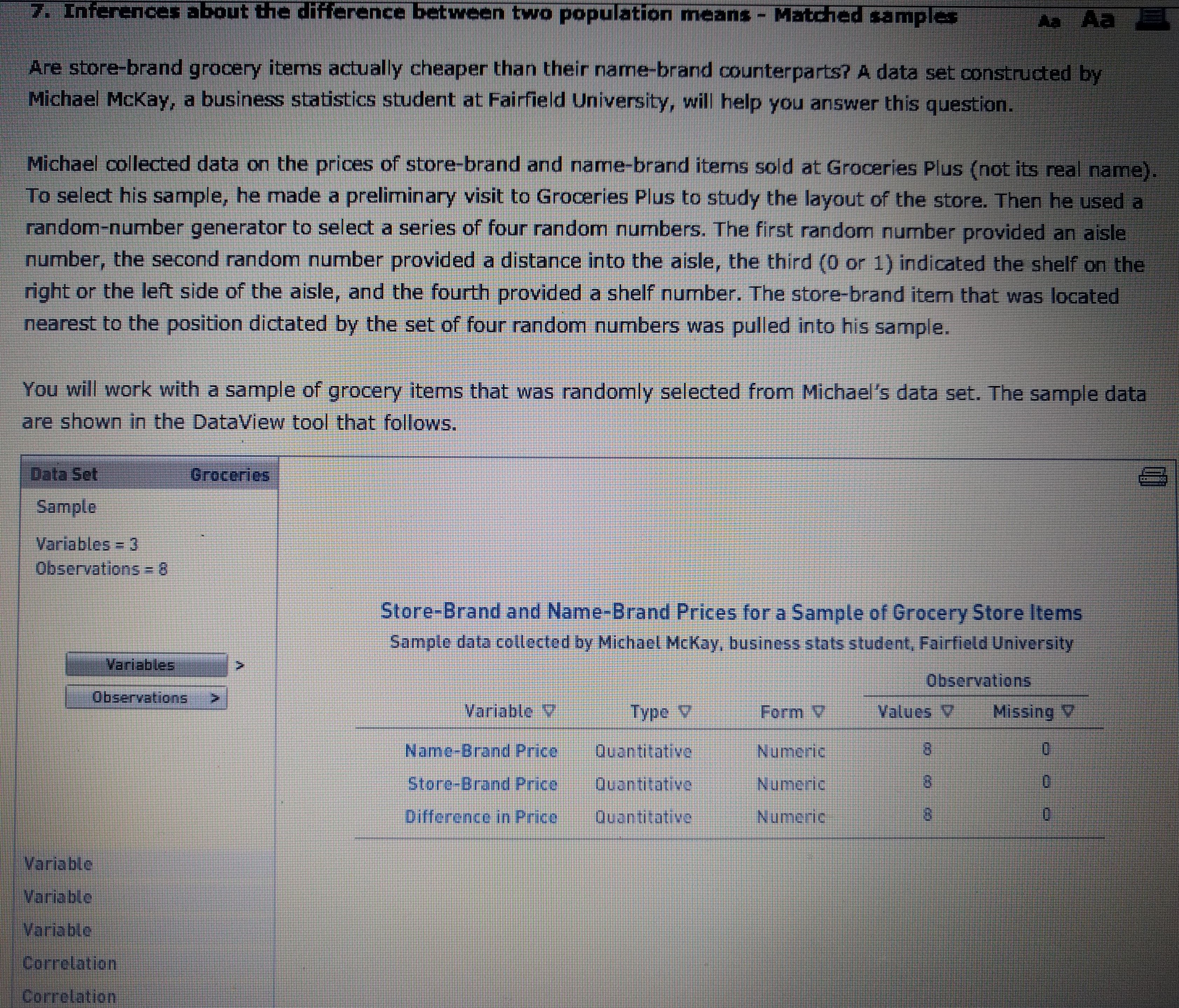
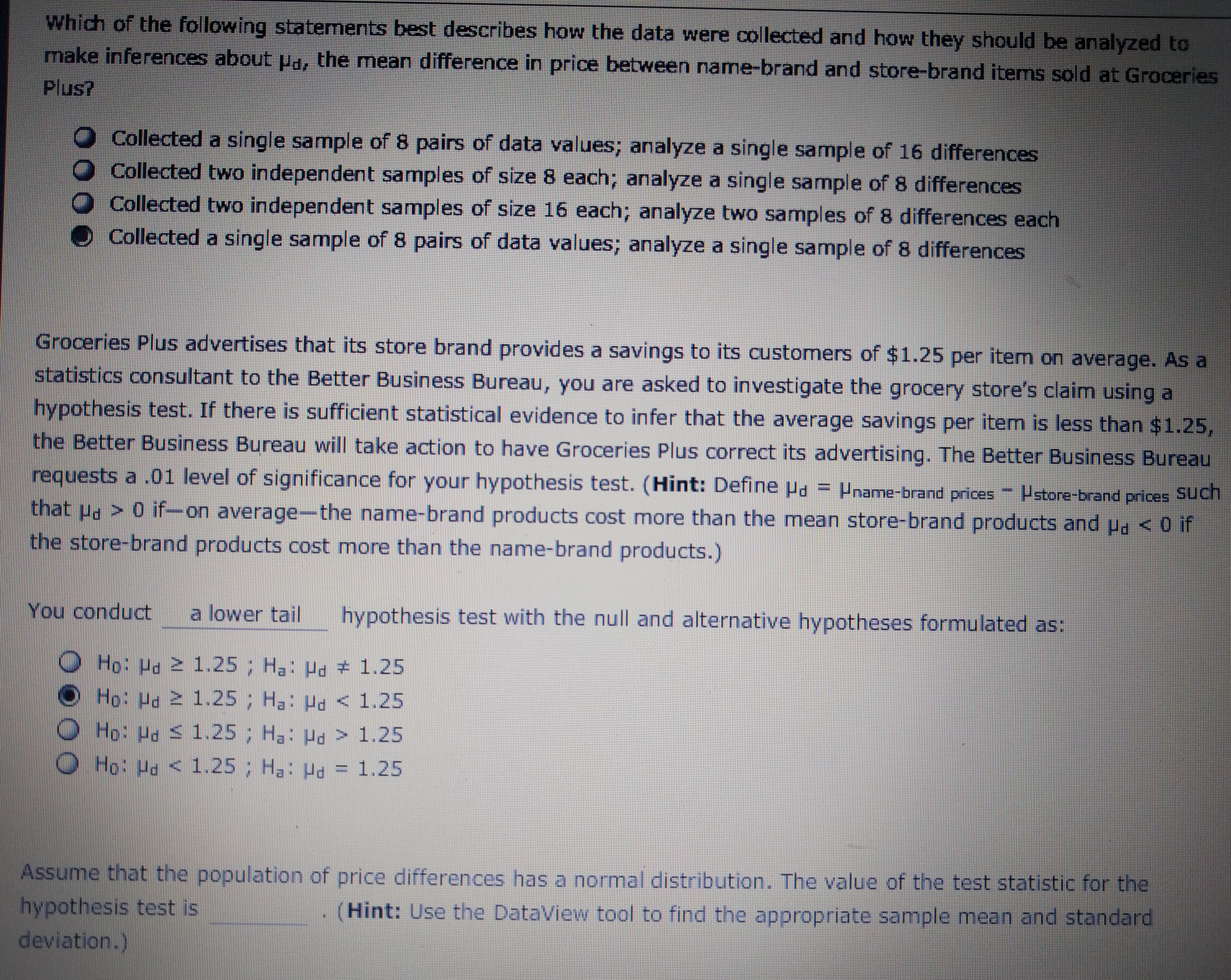
7. Inferences about the difference between two population means - Matched samples Are store-brand grocery items actually cheaper than their name-brand counterparts? A data set constructed by Michael Mckay, a business statistics student at Fairfield University, will help you answer this question. Michael collected data on the prices of store-brand and name-brand items sold at Groceries Plus (not its real name) To select his sample, he made a preliminary visit to Groceries Plus to study the layout of the store. Then he used random-number generator to select a series of four random numbers. The first random number provided an aisle number, the second random number provided a distance into the aisle, the third (0 or 1) indicated the shelf on the right or the left side of the aisle, and the fourth provided a shelf number. The store-brand item that was located nearest to the position dictated by the set of four random numbers was pulled into his sample. You will work with a sample of grocery items that was randomly selected from Michael's data set. The sample data are shown in the DataView tool that follows. Set Groceries Sample Variables = 3 Observations = 8 Store-Brand and Name-Brand Prices for a Sample of Grocery Store Items Sample data collected by Michael Mckay, business stats student, Fairfield University Variables Observations Observations Variable Type v Form V Values Missing Name-Brand Price Quantitative Numeric Store-Brand Price Quantitative Numeric Difference in Price Quantitative NumericWhich of the following statements best describes how the data were collected and how they should be analyzed to make inferences about pa, the mean difference in price between name-brand and store-brand items sold at Groceries Plus? Collected a single sample of 8 pairs of data values; analyze a single sample of 16 differences Collected two independent samples of size 8 each; analyze a single sample of 8 differences Collected two independent samples of size 16 each; analyze two samples of 8 differences each Collected a single sample of 8 pairs of data values; analyze a single sample of 8 differences Groceries Plus advertises that its store brand provides a savings to its customers of $1.25 per item on average. As a statistics consultant to the Better Business Bureau, you are asked to investigate the grocery store's claim using a hypothesis test. If there is sufficient statistical evidence to infer that the average savings per item is less than $1.25, the Better Business Bureau will take action to have Groceries Plus correct its advertising. The Better Business Bureau requests a .01 level of significance for your hypothesis test. ( Hint: Define He = Hname-brand prices " store-brand prices Such that Uq > 0 if-on average-the name-brand products cost more than the mean store-brand products and Ha 1.25 O Ho: He
Step by Step Solution
There are 3 Steps involved in it

Get step-by-step solutions from verified subject matter experts
 Study Help