







Question: Inis activity is important because great executives not only adapt to changing conditions but also apply-fanatically, rigorously. consistently, and with discipline - the fundamental management
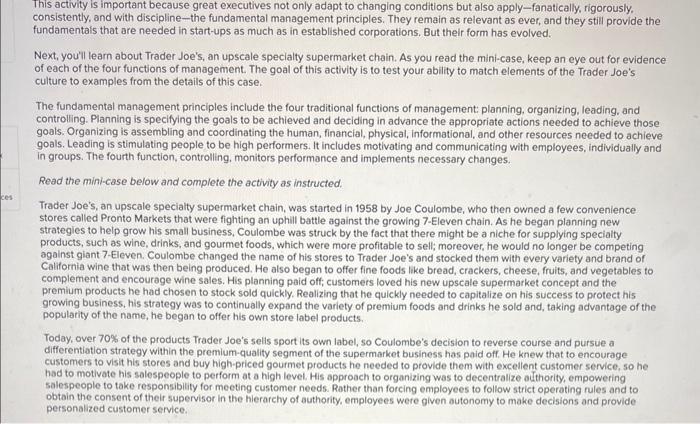
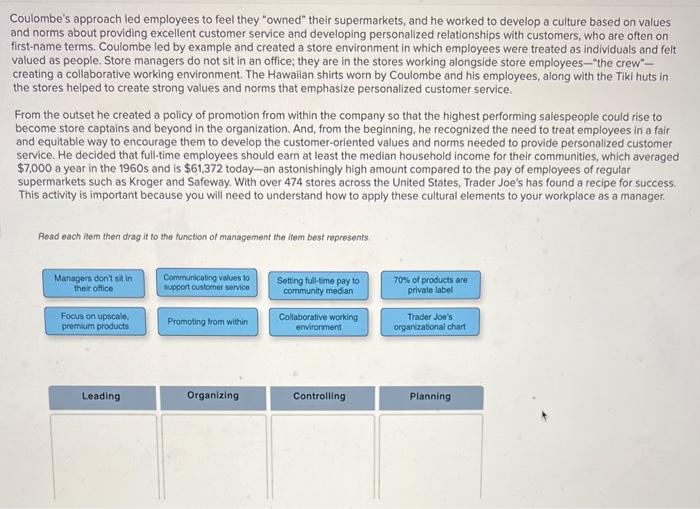
Inis activity is important because great executives not only adapt to changing conditions but also apply-fanatically, rigorously. consistently, and with discipline - the fundamental management principles. They remain as relevant as ever, and they still provide the fundamentais that are needed in start-ups as much as in established corporations. But their form has evolved. Next, you'll learn about Trader Joe's, an upscale specialty supermarket chain. As you read the mini-case, keep an eye out for evidence of each of the four functions of management. The goal of this activity is to test your ability to match elements of the Trader Joe's culture to examples from the details of this case. The fundamental management principles include the four traditional functions of management: planning, organizing, leading, and controlling. Planning is specifying the goals to be achieved and deciding in advance the appropriate actions needed to achieve those goals. Organizing is assembling and coordinating the human, financial, physical, informational, and other resources needed to achieve goals. Leading is stimulating people to be high performers. It includes motivating and communicating with employees, individually and in groups. The fourth function, controlling, monitors performance and implements necessary changes. Read the mini-case below and complete the activity as instructed. Trader Joe's, an upscale specialty supermarket chain, was started in 1958 by Joe Coulombe, who then owned a few convenience stores called Pronto Markets that were fighting an uphill battle against the growing 7-Eleven chain. As he began planning new strategies to help grow his small business, Coulombe was struck by the fact that there might be a niche for supplying specialty products, such as wine, drinks, and gourmet foods, which were more profitable to sell; moreover, he would no longer be competing against giant 7-Eleven. Coulombe changed the name of his stores to Trader Joe's and stocked them with every variety and brand of California wine that was then being produced. He also began to offer fine foods like bread, crackers, cheese, fruits, and vegetables to complement and encourage wine sales. His planning paid off; customers loved his new upscale supermarket concept and the premium products he had chosen to stock sold quickly. Realizing that he quickly needed to capitalize on his success to protect his growing business, his strategy was to continually expand the variety of premium foods and drinks he sold and, taking advantage of the popularity of the name, he began to offer his own store label products. Today, over 70% of the products Trader Joe's sells sport its own label, so Coulombe's decision to reverse course and pursue a differentiation strategy within the premium-quality segment of the supermarket business has paid off. He knew that to encourage customers to visit his stores and buy high-priced gourmet products he needed to provide them with excellent customer service, so he had to motivate his solespeople to perform at a high level. His approach to organizing was to decentralize athority, empowering 5alespeople to take responsiblity for meeting customer needs. Rather than forcing employees to follow strict operating rules and to obtain the consent of their supervisor in the hierarchy of authority, employees were given autonomy to make decisions and provide personalized customer service. Coulombe's approach led employees to feel they "owned" their supermarkets, and he worked to develop a culture based on values and norms about providing excellent customer service and developing personalized relationships with customers, who are often on first-name terms. Coulombe led by example and created a store environment in which employees were treated as individuals and felt valued as people. Store managers do not sit in an office; they are in the stores working alongside store employees- "the crew"creating a collaborative working environment. The Hawailan shirts worn by Coulombe and his employees, along with the Tiki huts in the stores helped to create strong values and norms that emphasize personalized customer service. From the outset he created a policy of promotion from within the company so that the highest performing salespeople could rise to become store captains and beyond in the organization. And, from the beginning, he recognized the need to treat employees in a fair and equitable way to encourage them to develop the customer-oriented values and norms needed to provide personalized customer service. He decided that full-time employees should earn at least the median household income for their communities, which averaged $7,000 a year in the 1960 s and is $61,372 today-an astonishingly high amount compared to the pay of employees of regular supermarkets such as Kroger and Safeway. With over 474 stores across the United States, Trader Joe's has found a recipe for success. This activity is important because you will need to understand how to apply these cultural elements to your workplace as a manager
Step by Step Solution
There are 3 Steps involved in it

Get step-by-step solutions from verified subject matter experts
 Study Help