







Question: Insects are virtually airborne oscillators. Many use the dynamic properties of their thorax ( a centralized exoskeleton structure that contains the flight muscles ) to
Insects are virtually airborne oscillators. Many use the dynamic properties of their thorax a centralized exoskeleton structure that contains the flight muscles to lower the energy requirements of flight. It has long been hypothesized that insects flap at the resonant frequency of their thorax to make flight more efficient. To assess this hypothesis, Dr Jankauski conducted frequency response testing of a honey bee thorax
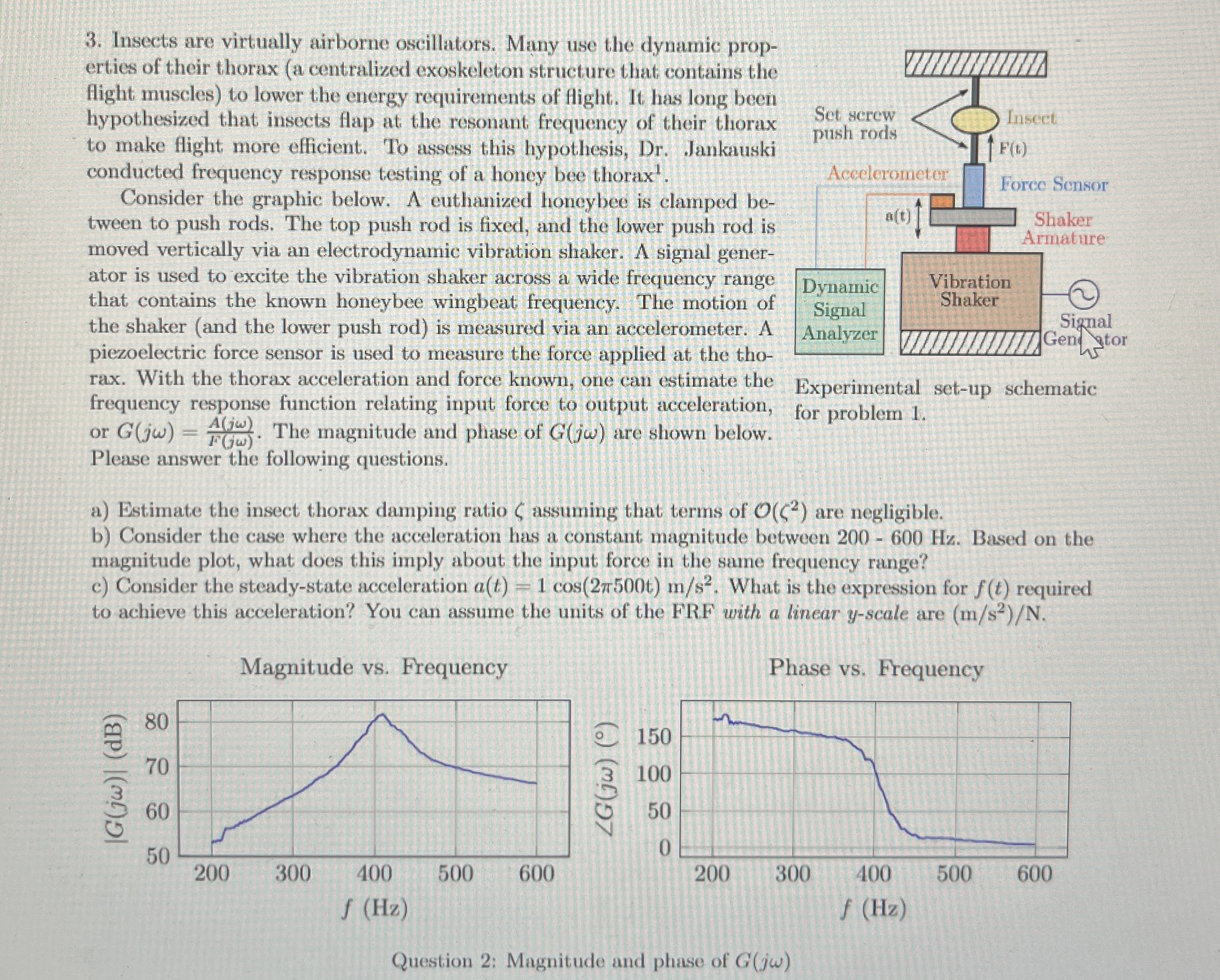
Consider the graphic below. A euthanized honeybee is clamped between to push rods. The top push rod is fixed, and the lower push rod is moved vertically via an electrodynamic vibration shaker. A signal generator is used to excite the vibration shaker across a wide frequency range that contains the known honeybee wingbeat frequency. The motion of the shaker and the lower push rod is measured via an accelerometer. A piezoelectric force sensor is used to measure the force applied at the thorax. With the thorax acceleration and force known, one can estimate the frequency response function relating input force to output acceleration, or The magnitude and phase of are shown below. for problem Please answer the following questions.
a Estimate the insect thorax damping ratio assuming that terms of are negligible.
b Consider the case where the acceleration has a constant magnitude between Based on the magnitude plot, what does this imply about the input force in the same frequency range?
c Consider the steadystate acceleration What is the expression for required to achieve this acceleration? You can assume the units of the FRF with a linear scale are
Magnitude vs Frequency
Question : Magnitude and phase of
Step by Step Solution
There are 3 Steps involved in it
1 Expert Approved Answer
Step: 1 Unlock

Question Has Been Solved by an Expert!
Get step-by-step solutions from verified subject matter experts
Step: 2 Unlock
Step: 3 Unlock
 Study Help