







Question: Instruction: Download the program submission template and answer pre-programming questions. Create new project, Lab10. Create new package, lab10. Create new class, Main. Study the example
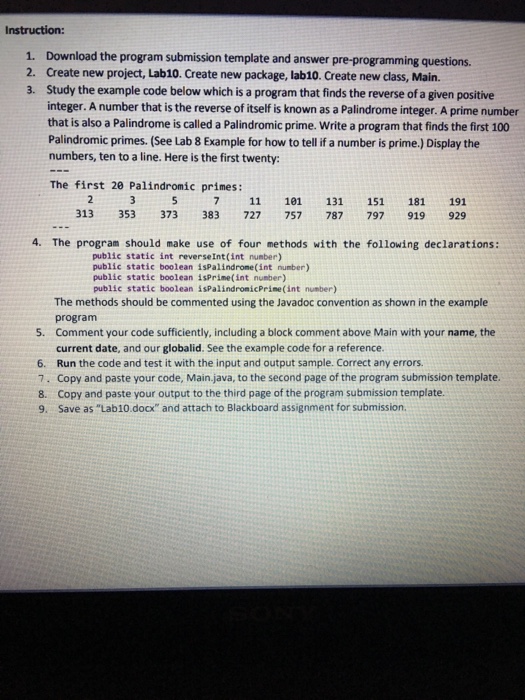
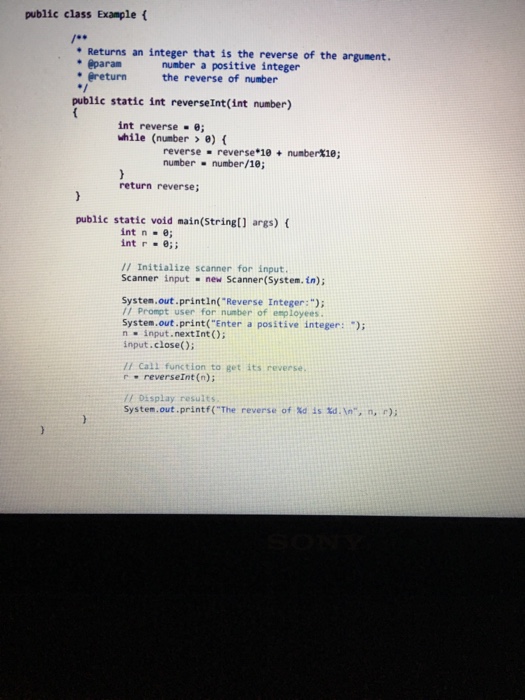
Instruction: Download the program submission template and answer pre-programming questions. Create new project, Lab10. Create new package, lab10. Create new class, Main. Study the example code below which is a program that finds the reverse of a given positive integer. A number that is the reverse of itself is known as a Palindrome integer. A prime number that is also a Palindrome is called a Palindromic prime. Write a program that finds the first 100 Palindromic primes. (See Lab 8 Example for how to tell if a number is prime.) Display the numbers, ten to a line. Here is the first twenty: 1. 2. 3. The first 20 Palindromic primes: 711 101 131151181 191 313 353 373 383 727 757 787 797 919 929 4. The program should make use of four methods with the following declarations public static int reverseInt (int number) public static boolean isPalindrome(int number) public static boolean isPrime(int number) public static boolean isPalindronicPrime(int number) The methods should be commented using the Javadoc convention as shown in the example program 5. Comment your code sufficiently, including a block comment above Main with your name, the current date, and our globalid. See the example code for a reference. 6. Run the code and test it with the input and output sample. Correct any errors. 7. Copy and paste your code, Main.java, to the second page of the program submission template. 8. Copy and paste your output to the third page of the program submission template. 9. Save as "Lab10.doc" and attach to Blackboard assignment for submission
Step by Step Solution
There are 3 Steps involved in it

Get step-by-step solutions from verified subject matter experts
 Study Help