







Question: Instruction: Read the case on Dell's supply chain management. Write your insights, understanding and analysis of the case with the guide questions provided below. Submit
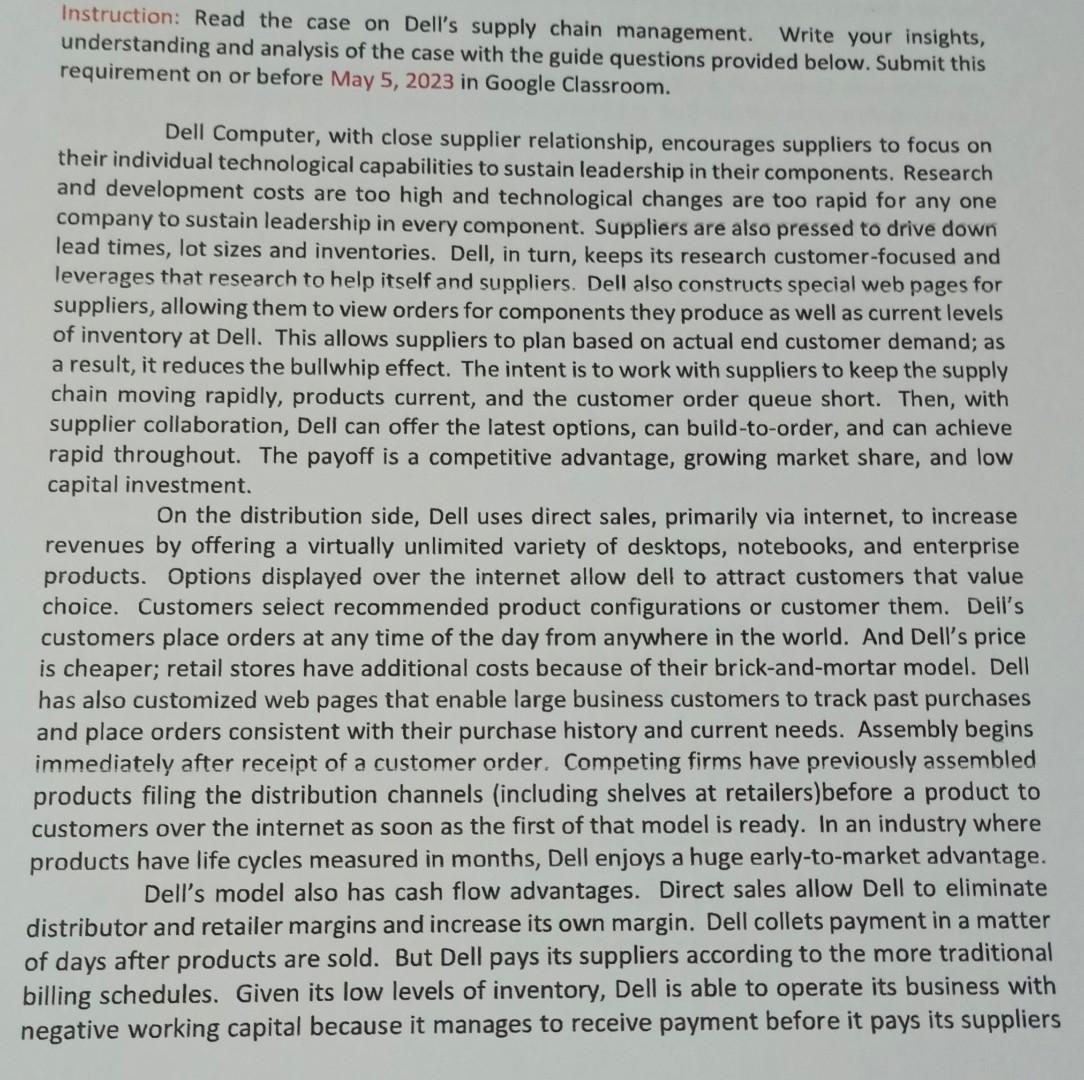
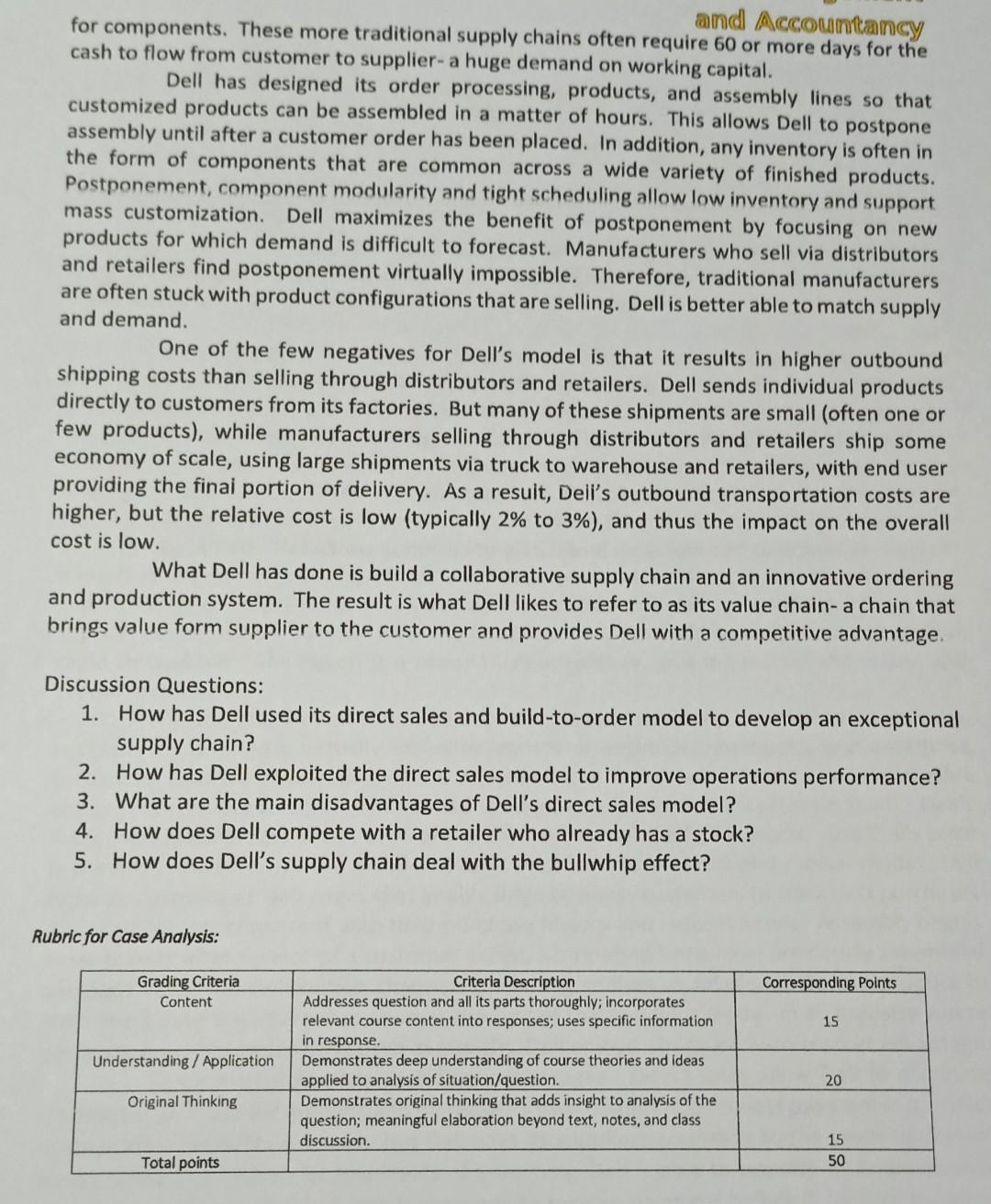
Instruction: Read the case on Dell's supply chain management. Write your insights, understanding and analysis of the case with the guide questions provided below. Submit this requirement on or before May 5, 2023 in Google Classroom. Dell Computer, with close supplier relationship, encourages suppliers to focus on their individual technological capabilities to sustain leadership in their components. Research and development costs are too high and technological changes are too rapid for any one company to sustain leadership in every component. Suppliers are also pressed to drive down lead times, lot sizes and inventories. Dell, in turn, keeps its research customer-focused and leverages that research to help itself and suppliers. Dell also constructs special web pages for suppliers, allowing them to view orders for components they produce as well as current levels of inventory at Dell. This allows suppliers to plan based on actual end customer demand; as a result, it reduces the bullwhip effect. The intent is to work with suppliers to keep the supply chain moving rapidly, products current, and the customer order queue short. Then, with supplier collaboration, Dell can offer the latest options, can build-to-order, and can achieve rapid throughout. The payoff is a competitive advantage, growing market share, and low capital investment. On the distribution side, Dell uses direct sales, primarily via internet, to increase revenues by offering a virtually unlimited variety of desktops, notebooks, and enterprise products. Options displayed over the internet allow dell to attract customers that value choice. Customers select recommended product configurations or customer them. Dell's customers place orders at any time of the day from anywhere in the world. And Dell's price is cheaper; retail stores have additional costs because of their brick-and-mortar model. Dell has also customized web pages that enable large business customers to track past purchases and place orders consistent with their purchase history and current needs. Assembly begins immediately after receipt of a customer order. Competing firms have previously assembled products filing the distribution channels (including shelves at retailers)before a product to customers over the internet as soon as the first of that model is ready. In an industry where products have life cycles measured in months, Dell enjoys a huge early-to-market advantage Dell's model also has cash flow advantages. Direct sales allow Dell to eliminate distributor and retailer margins and increase its own margin. Dell collets payment in a matte of days after products are sold. But Dell pays its suppliers according to the more traditiona billing schedules. Given its low levels of inventory, Dell is able to operate its business wit negative working capital because it manages to receive payment before it pays its supplie for components. These more traditional supply chains often require 60 or more days for the cash to flow from customer to supplier- a huge demand on working capital. Dell has designed its order processing, products, and assembly lines so that customized products can be assembled in a matter of hours. This allows Dell to postpone assembly until after a customer order has been placed. In addition, any inventory is often in the form of components that are common across a wide variety of finished products. Postponement, component modularity and tight scheduling allow low inventory and support mass customization. Dell maximizes the benefit of postponement by focusing on new products for which demand is difficult to forecast. Manufacturers who sell via distributors and retailers find postponement virtually impossible. Therefore, traditional manufacturers are often stuck with product configurations that are selling. Dell is better able to match supply and demand. One of the few negatives for Dell's model is that it results in higher outbound shipping costs than selling through distributors and retailers. Dell sends individual products directly to customers from its factories. But many of these shipments are small (often one or few products), while manufacturers selling through distributors and retailers ship some economy of scale, using large shipments via truck to warehouse and retailers, with end user providing the finai portion of delivery. As a resuit, Deli's outbound transportation costs are higher, but the relative cost is low (typically 2% to 3% ), and thus the impact on the overall cost is low. What Dell has done is build a collaborative supply chain and an innovative ordering and production system. The result is what Dell likes to refer to as its value chain- a chain that brings value form supplier to the customer and provides Dell with a competitive advantage. Discussion Questions: 1. How has Dell used its direct sales and build-to-order model to develop an exceptional supply chain? 2. How has Dell exploited the direct sales model to improve operations performance? 3. What are the main disadvantages of Dell's direct sales model? 4. How does Dell compete with a retailer who already has a stock? 5. How does Dell's supply chain deal with the bullwhip effect? Rubric for Case Analysis
Step by Step Solution
There are 3 Steps involved in it

Get step-by-step solutions from verified subject matter experts
 Study Help