





Question: INSTRUCTIONS: 1. The Assignment should be strictly done in groups of 5 2. Answer ALL questions 3. Give References for your work QUESTION ONE Carefully
INSTRUCTIONS: 1. The Assignment should beINSTRUCTIONS: 1. The Assignment should be

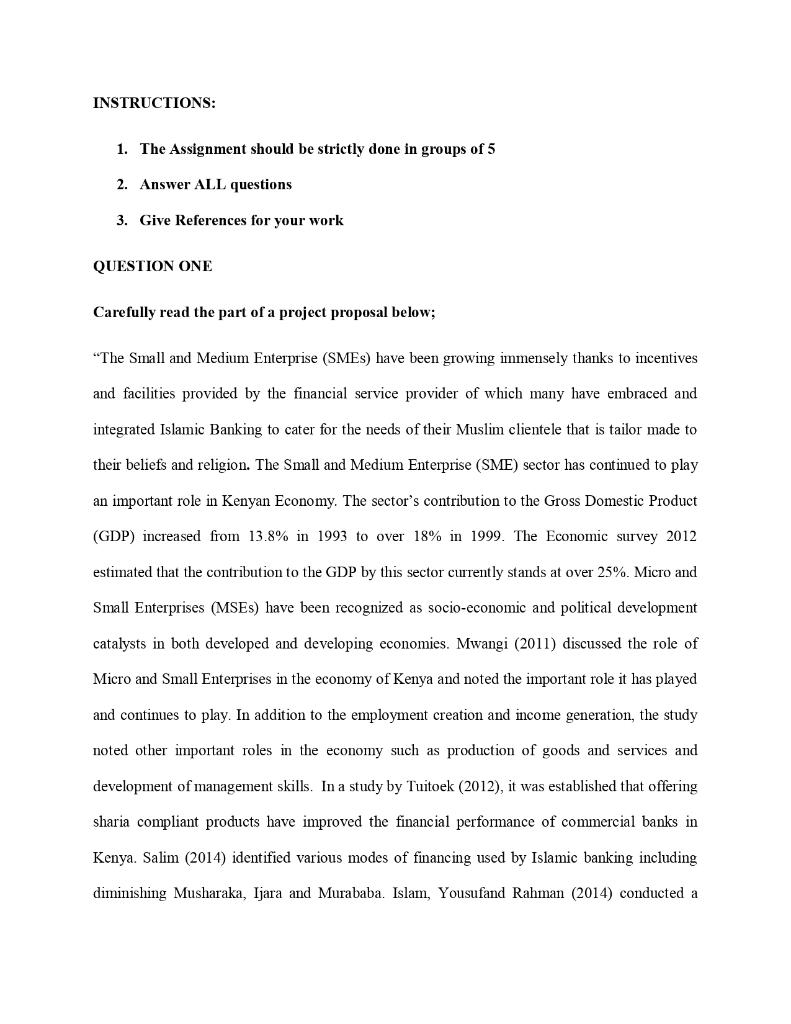
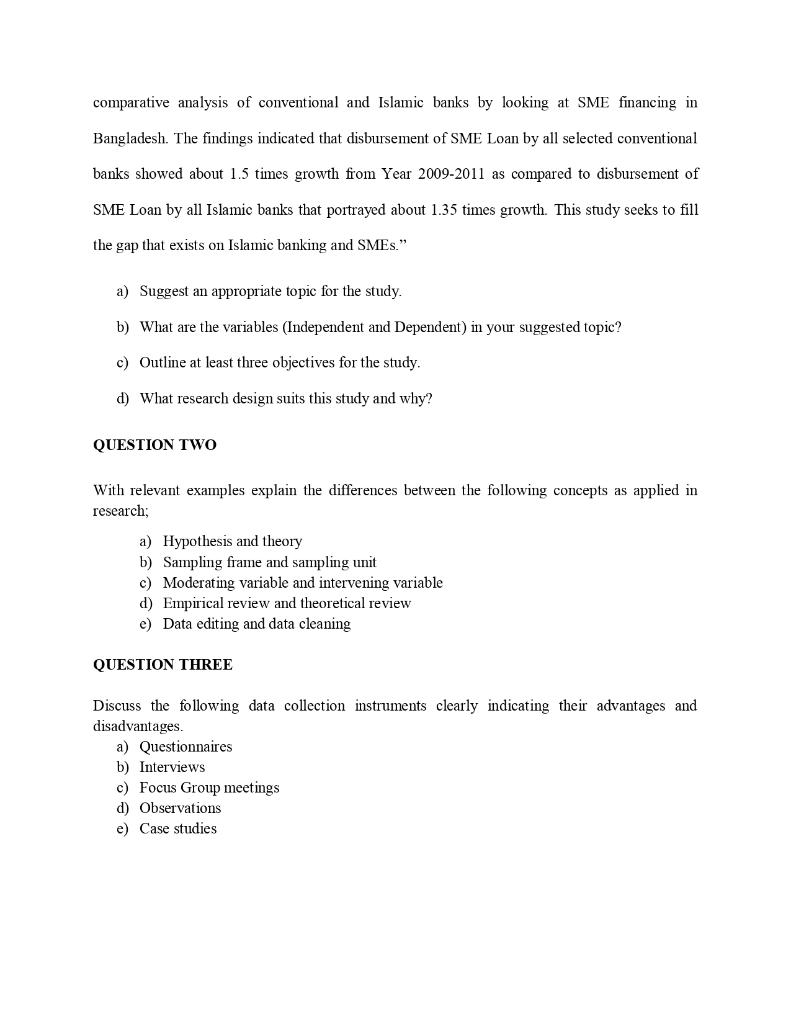
INSTRUCTIONS: 1. The Assignment should be strictly done in groups of 5 2. Answer ALL questions 3. Give References for your work QUESTION ONE Carefully read the part of a project proposal below; "The Small and Medium Enterprise (SMEs) have been growing inmensely thanks to incentives and facilities provided by the financial service provider of which many have embraced and integrated Islamic Banking to cater for the needs of their Muslim clientele that is tailor made to their beliefs and religion. The Small and Medium Enterprise (SME) sector has continued to play an important role in Kenyan Economy. The sector's contribution to the Gross Domestic Product (GDP) increased from 13.8% in 1993 to over 18% in 1999. The Economic survey 2012 estimated that the contribution to the GDP by this sector currently stands at over 25%. Micro and Small Enterprises (MSES) have been recognized as socio-economic and political development catalysts in both developed and developing economies. Mwangi (2011) discussed the role of Micro and Small Enterprises in the economy of Kenya and noted the important role it has played and continues to play. In addition to the employment creation and income generation, the study noted other important roles in the economy such as production of goods and services and development of management skills. In a study by Tuitoek (2012), it was established that offering sharia compliant products have improved the financial performance of commercial banks in Kenya. Salim (2014) identified various modes of financing used by Islamic banking including diminishing Musharaka, Ijara and Murababa. Islam, Yousufand Rahman (2014) conducted a comparative analysis of conventional and Islamic banks by looking at SME financing in Bangladesh. The findings indicated that disbursement of SME Loan by all selected conventional banks showed about 1.5 times growth from Year 2009-2011 as compared to disbursement of SME Loan by all Islamic banks that portrayed about 1.35 times growth. This study seeks to fill the gap that exists on Islamic banking and SMEs." a) Suggest an appropriate topic for the study. b) What are the variables (Independent and Dependent) in your suggested topic? c) Outline at least three objectives for the study. d) What research design suits this study and why? QUESTION TWO With relevant examples explain the differences between the following concepts as applied in research; a) Hypothesis and theory b) Sampling frame and sampling unit c) Moderating variable and intervening variable d) Empirical review and theoretical review e) Data editing and data cleaning QUESTION THREE Discuss the following data collection instruments clearly indicating their advantages and disadvantages. a) Questionnaires b) Interviews c) Focus Group meetings d) Observations e) Case studies INSTRUCTIONS: 1. The Assignment should be strictly done in groups of 5 2. Answer ALL questions 3. Give References for your work QUESTION ONE Carefully read the part of a project proposal below; "The Small and Medium Enterprise (SMEs) have been growing inmensely thanks to incentives and facilities provided by the financial service provider of which many have embraced and integrated Islamic Banking to cater for the needs of their Muslim clientele that is tailor made to their beliefs and religion. The Small and Medium Enterprise (SME) sector has continued to play an important role in Kenyan Economy. The sector's contribution to the Gross Domestic Product (GDP) increased from 13.8% in 1993 to over 18% in 1999. The Economic survey 2012 estimated that the contribution to the GDP by this sector currently stands at over 25%. Micro and Small Enterprises (MSES) have been recognized as socio-economic and political development catalysts in both developed and developing economies. Mwangi (2011) discussed the role of Micro and Small Enterprises in the economy of Kenya and noted the important role it has played and continues to play. In addition to the employment creation and income generation, the study noted other important roles in the economy such as production of goods and services and development of management skills. In a study by Tuitoek (2012), it was established that offering sharia compliant products have improved the financial performance of commercial banks in Kenya. Salim (2014) identified various modes of financing used by Islamic banking including diminishing Musharaka, Ijara and Murababa. Islam, Yousufand Rahman (2014) conducted a comparative analysis of conventional and Islamic banks by looking at SME financing in Bangladesh. The findings indicated that disbursement of SME Loan by all selected conventional banks showed about 1.5 times growth from Year 2009-2011 as compared to disbursement of SME Loan by all Islamic banks that portrayed about 1.35 times growth. This study seeks to fill the gap that exists on Islamic banking and SMEs." a) Suggest an appropriate topic for the study. b) What are the variables (Independent and Dependent) in your suggested topic? c) Outline at least three objectives for the study. d) What research design suits this study and why? QUESTION TWO With relevant examples explain the differences between the following concepts as applied in research; a) Hypothesis and theory b) Sampling frame and sampling unit c) Moderating variable and intervening variable d) Empirical review and theoretical review e) Data editing and data cleaning QUESTION THREE Discuss the following data collection instruments clearly indicating their advantages and disadvantages. a) Questionnaires b) Interviews c) Focus Group meetings d) Observations e) Case studies

Step by Step Solution

There are 3 Steps involved in it

1 Expert Approved Answer
Step: 1 Unlock blur-text-image

Question Has Been Solved by an Expert!

Get step-by-step solutions from verified subject matter experts

Step: 2 Unlock
Step: 3 Unlock

Students Have Also Explored These Related General Management Questions!