







Question: Instructions: Analyze the information from Case 4 and make a recommendation to Heidi regarding whether UHSC should acquire Sooner Clinics. Case Study - Sooner Clinics
Instructions:
Analyze the information from Case 4 and make a recommendation to Heidi regarding whether UHSC should acquire Sooner Clinics.
Case Study - Sooner Clinics
UHSC is one of the largest integrated healthcare providers in Oklahoma, serving northern and central areas. To gain market share in response to healthcare reform, UHSC has acquired primary care practices. The basic competitive strategy is to select practices that are geographically well located and will be able to attract and retain patients. As we move toward population health management, UHSC believes that this strategy is crucial.
Due to the overvaluation of downstream revenue, the initial acquisitions were not fully successful. UHSC overpaid for practices because it expected higher referrals and revenue after acquiring them. Most of these practices had only one physician. UHSC quickly learned that typically, these practices had insufficient patient volume to cover the substantial fixed costs of running a practice, had a payer mix of more than half from less profitable Medicare and Medicaid sources, included a physician who was not seeing an adequate number of patients per day, and paid insufficient attention to the efficient operation of the practice. The positive side of their business was that they had loyal patients and were generally viewed as an important part of their communities.
UHSC then acquired a much larger practice- Anderson Clinic- perhaps because of its less-than-satisfactory experience with small primary care practices. Anderson Clinic is a financial success for UHSC because of its large patient volume, lucrative payer mix, and busy physicians. The acquisition has also been fraught with issues. The biggest challenge has been changing the culture of such a large practice. Anderson Clinic physicians have been with the practice for a long time and have resisted many of the clinical procedures and customer service initiatives introduced by UHSC. Many implementation problems have occurred, and physician complaints have consumed a great deal of UHSC management time. A UHSC manager said, "Anderson gives us most of our profit, but it also gives us most of our headaches."
This less-than-successful experience with small primary care practices and a large practice prompted UHSC to review its practice acquisition strategy. After several months of study, UHSC decided that, although it can help to reduce practice costs and increase efficiency, the revenue side of the practice is most important. Thus, UHSC has established five criteria for evaluating the acquisition of a practice:
- Adequate patient volume for the number of providers
- Viable payer mix
- Physician productivity
- Effective operations, including revenue cycle management, pricing of services, coding and documentation, and service mix
- Qualitative factors, including patient referrals from customer service, organizational culture, quality improvement, and community relations
These criteria have resulted in UHSC adopting a strategy of acquiring "not-too-big and not-too-small" primary care practices. These multi-physician practices are not as financially lucrative as larger practices such as the Anderson Clinic, but the incorporation of the practices into the organization has been much easier. Thus, management has decided that this type of practice works best for UHSC and has been looking to acquire more practices of this type.
In the Sooner region of central Oklahoma, UHSC has acquired several practices in the southern end but does not yet have a practice in the northern end. UHSC practices provide general primary care services only, but UHSC is exploring the provision of some specialty services, such as pain clinics. UHSC plans to try some specialty services in a few practices to determine whether there is a business case to support an extensive rollout.
Sooner Clinics
One of the primary care practices that UHSC wants to acquire is Sooner Clinics, which is located in the northern end of the Sooner region. Several years ago, UHSC had targeted Sooner Clinics for acquisition but attempts to interest the two founding partners had failed. At the time, the founders had no interest in being purchased by a larger organization.
Nevertheless, Sooner Clinics was too inviting a takeover target to be overlooked for long. UHSC believes that acquisition of the practice would attract and retain new patients to the network; increase referrals to other UHSC services; and better prepare UHSC for new value-based payment models. Sooner would benefit from access to a larger network and greater net revenue from the UHSC expertise in boosting physician productivity. In addition, some UHSC senior managers know the two Sooner Clinics' founders, having served on various community committees together. "The Sooner docs see things the way we see them," a UHSC senior manager recently said. For these reasons, UHSC has continued to follow the physicians and business activities of Sooner Clinics.
Today, Sooner Clinics operates two walk-in facilities and consists of five physicians- three are board-certified in family practice and two in internal medicine. Three work full-time and two work part-time, resulting in four full-time equivalents (FTE) physicians. Sooner Clinics is organized as a for-profit corporation, but for tax purposes, the business is classified as an S corporation. (In an S corporation, the business pays no taxes. Rather, the corporation's taxable income is constructively distributed to the owners, who pay personal taxes on the income).
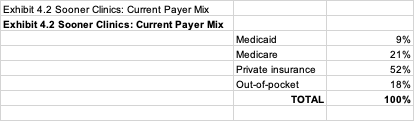
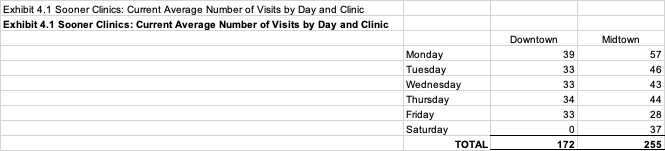
Sooner Clinics was founded ten years ago by two physicians (the part-timers) who wanted to have more free time than their solo practices allowed. Initially, Sooner Clinics had only one location, but a second was recently added. The downtown clinic, whose patients predominantly come directly from work sites, is open Monday through Friday from 8am to 2pm The midtown clinic, whose patients mostly come from home, is open Monday through Saturday from 8am to 8pm, and also provides a few specialty services, including a diabetes care service. Both downtown and midtown clinics are open 52 weeks per year. Exhibit 4.1 provides the average number of visits by day for the two clinics, and exhibit 4.2 shows the current payer mix. With the current medical and clerical staffs, as well as clinic space, Sooner Clinic's patient volume can grow as much as 50 percent without the need for additional personnel or facilities.
Step by Step Solution
There are 3 Steps involved in it

Get step-by-step solutions from verified subject matter experts
 Study Help