







Question: instructions Case Study Managing a Merger at Lightning Networks After receiving regulatory approval from the European Union, Lightning Networks, a major wireless carrier, and SarTV,
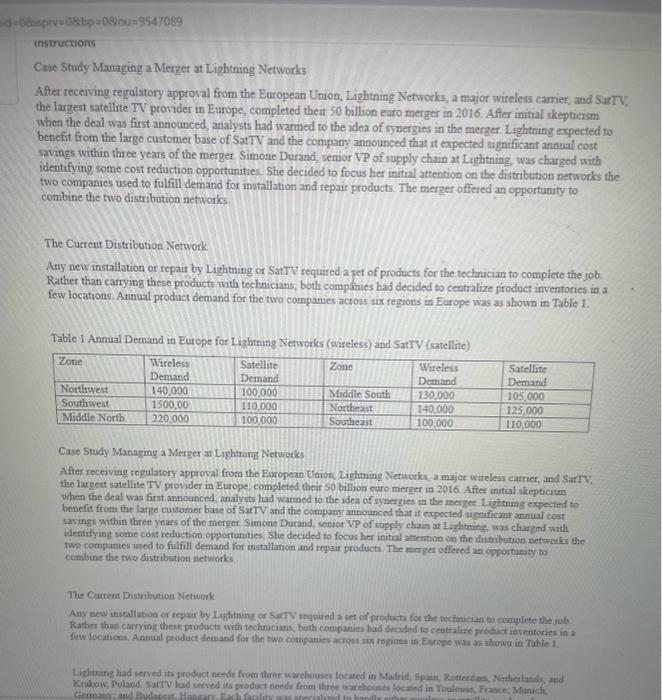
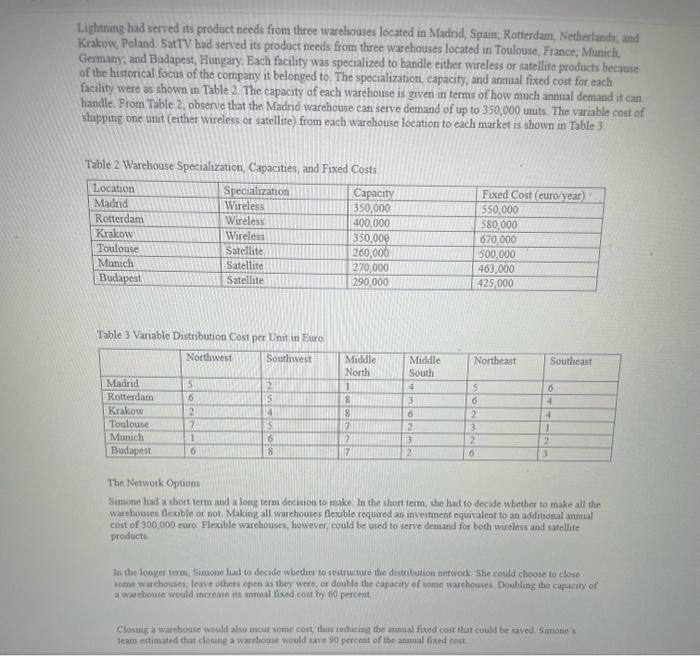
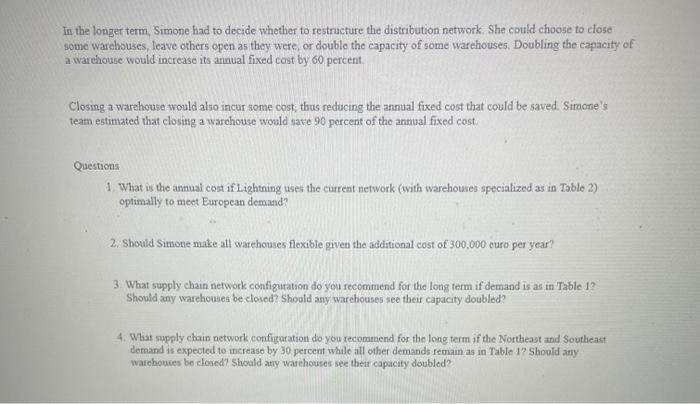
instructions Case Study Managing a Merger at Lightning Networks After receiving regulatory approval from the European Union, Lightning Networks, a major wireless carrier, and SarTV, the largest satellite TV provider in Europe, completed their 50 billion euro merger in 2016. Affer initial skepticism when the deal was first announced, analysts had wamed to the sder of synergies in the merger. Lightning expected to benefit from the largo customer base of SatTV and the company announced that it expected significant annual cost savings within three years of the merger. Simone Durand, senior VP of supply chain at Lightning, was charged with identifying some cost reduction opportunities. She decided to focus her initial attention on the distribution networks the two companies used to fulfill demand for installation and repair products. The merger offered an opportunity to combine the two distribution networks. The Current Distribution Network Any new installation or repair by Lightning or SatTV required a pet of products for the technician to complete the job. Rather than carrying these products with teclnicians, both companies had decided to centralize product inventonies in a fow locations: Annual product demand for the two compames actoss six regions in Europe was as shown in Table 1. Table 1 Annual Demand in Europe for Lightning Networks (wireless) and SarTV (catellite) Case Study Managing a Merger at Lightning Networks After roceiving regulatory approval from the European Uaion, Lightning Networks, a major wireless carner, and SarTV, the largent satellite TV provider in Europe, completed their 50 billion curo merger in 2016 After untial akepticium when the deal was first announced analysts had warmed to the idea of synergies m the merger Lightniag expected to benefit from the large customer base of SarTV and the cormpany atnounced that it expected significant annial cont savings within three years of the merger. Simone Durand, senior VP of supply chain at Lightning, was chaiged with identifying some cost reduction opportunities. She decided to focus her initial attention on the distriburion netweth the two companies used to fulfill demand for installition and repair products. The merger offered an opportunity to combine the two distribution networks Liphtning had served its product needs from three warehouses located in Madtid, Spain, Rotterdam, Netherlands, and Krakow, Poland SatTV had served its product needs from three warehouses located in Toulouse, France: Munieh Germany; and Budapest, Hungary. Bach facility was specialized to handle either wireless or satellite products beciuse of the hiftorical focus of the company it belonged to. The spectalization, capacity, and anrial fixed cost for each facility were as shown in Table 2 . The capacity of each warchouse is given in terms of how much annual demand it can handle. From Table 2, observe that the Madrid warehouse can serve demand of up to 350,000 units. The variable cost of shipping one unit (either wireless of satellite) from each warchouse location to each market is hown in Tabie 5 Table 2 Warehouse Specialization, Capacities, and Fixed Costs Table 3 Varable Distribution Cost per Unit in Euro Tho Network Options Simone liad a short term ind a long term decision to make. lo the short term, whe lad to decide whether to muake all ther warebouse fexible or not, Malung all warchouses flexible required an inveutanent equivaleat to an additsomal annual cost of 300,000 curo. Fexible warebouses, however, could be used to serve demand for both wireless and satellite prodocts. In the lonyer ierm, Simone had to decide whether to teatrueture the diatribution netwoik. 5 he could choose to close texm estimated that closing a warchouse woold iave 90 percent of the anawal fixed cost In the longer term, Simone had to decide whether to restructure the distribution network. She could choose to close some warehouses, leave others open as they were, or double the capacity of some warehouses, Doubling the capacity of a warchouse would increase its annual fixed cost by 60 percent. Closing a warchouse would also incur some cost, thus reducing the annual fixed cost that could be saved. Simone's team estimated that closing a warchouse would save 90 percent of the anmual fixed cost. Questions 1. What is the annual cont if Lightning uses the current network (with warehouses specializod as in Table 2) optimally to meet European demand? 2. Should Simone make all warehouses flexible given the additional cost of 300,000 curo per year? 3. What supply chain network configutation do you recommend for the long term if demand is as in Table 1 ? Should any warehouses be closed? Should any warchouses see their capacity doubled? 4. What supply chain network configuration do you recommend for the long term if the Northeast and Southeast demand is expected to inerease by 30 percent while all other demands remain as in Table 1 ? Should any warchouses be elosed? Should any watehouses see thert eapacity doubled
Step by Step Solution
There are 3 Steps involved in it

Get step-by-step solutions from verified subject matter experts
 Study Help