







Question: Instructions for Obtaining Random Numbers For each problem (1&2) or its part where random numbers are needed, obtain them from the consecutive random digits from
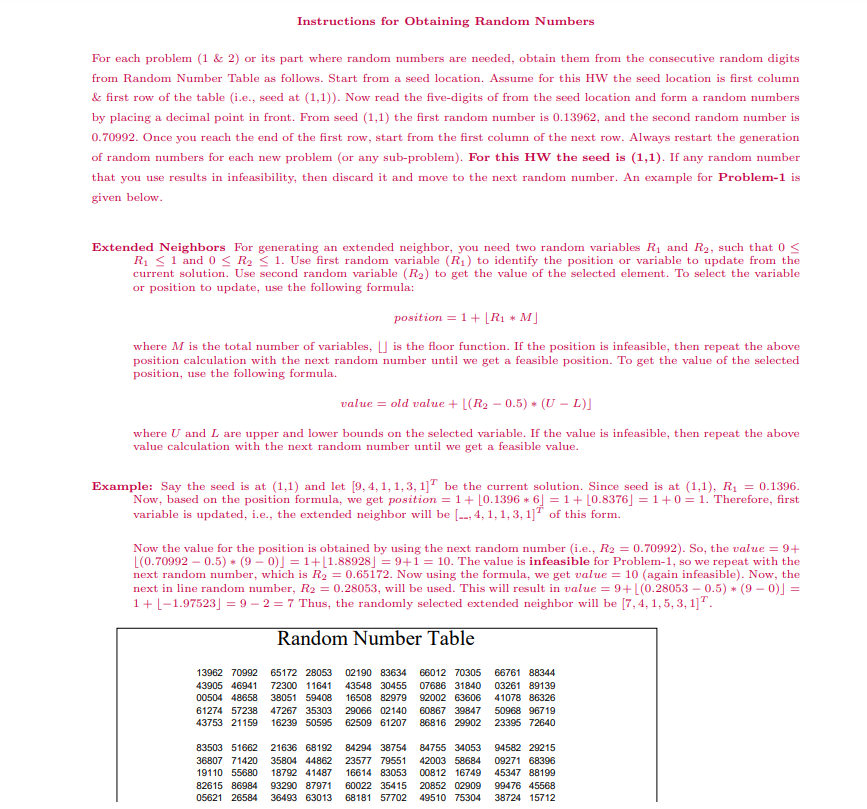
Instructions for Obtaining Random Numbers For each problem (1&2) or its part where random numbers are needed, obtain them from the consecutive random digits from Random Number Table as follows. Start from a seed location. Assume for this HW the seed location is first column \& first row of the table (i.e., seed at (1,1) ). Now read the five-digits of from the seed location and form a random numbers by placing a decimal point in front. From seed (1,1) the first random number is 0.13962 , and the second random number is 0.70992. Once you reach the end of the first row, start from the first column of the next row. Always restart the generation of random numbers for each new problem (or any sub-problem). For this HW the seed is (1,1). If any random number that you use results in infeasibility, then discard it and move to the next random number. An example for Problem-1 is given below. Extended Neighbors For generating an extended neighbor, you need two random variables R1 and R2, such that 0 R11 and 0R21. Use first random variable (R1) to identify the position or variable to update from the current solution. Use second random variable (R2) to get the value of the selected element. To select the variable or position to update, use the following formula: position=1+R1M where M is the total number of variables, U is the floor function. If the position is infeasible, then repeat the above position calculation with the next random number until we get a feasible position. To get the value of the selected position, use the following formula. value=oldvalue+(R20.5)(UL) where U and L are upper and lower bounds on the selected variable. If the value is infeasible, then repeat the above value calculation with the next random number until we get a feasible value. Example: Say the seed is at (1,1) and let [9,4,1,1,3,1]T be the current solution. Since seed is at (1,1),R1=0.1396. Now, based on the position formula, we get position =1+0.13966=1+0.8376=1+0=1. Therefore, first variable is updated, i.e., the extended neighbor will be [,4,1,1,3,1]T of this form. Now the value for the position is obtained by using the next random number (i.e., R2=0.70992 ). So, the value =9+ (0.709920.5)(90)=1+1.88928=9+1=10. The value is infeasible for Problem- 1 , so we repeat with the next random number, which is R2=0.65172. Now using the formula, we get value =10 (again infeasible). Now, the next in line random number, R2=0.28053, will be used. This will result in value =9+(0.280530.5)(90)= 1+1.97523=92=7 Thus, the randomly selected extended neighbor will be [7,4,1,5,3,1]T
Step by Step Solution
There are 3 Steps involved in it

Get step-by-step solutions from verified subject matter experts
 Study Help