Question: Instructions for PM Case 1: Sager Products (20 Points) 1. Develop a table showing the activities of the project, the duration of each activity, the
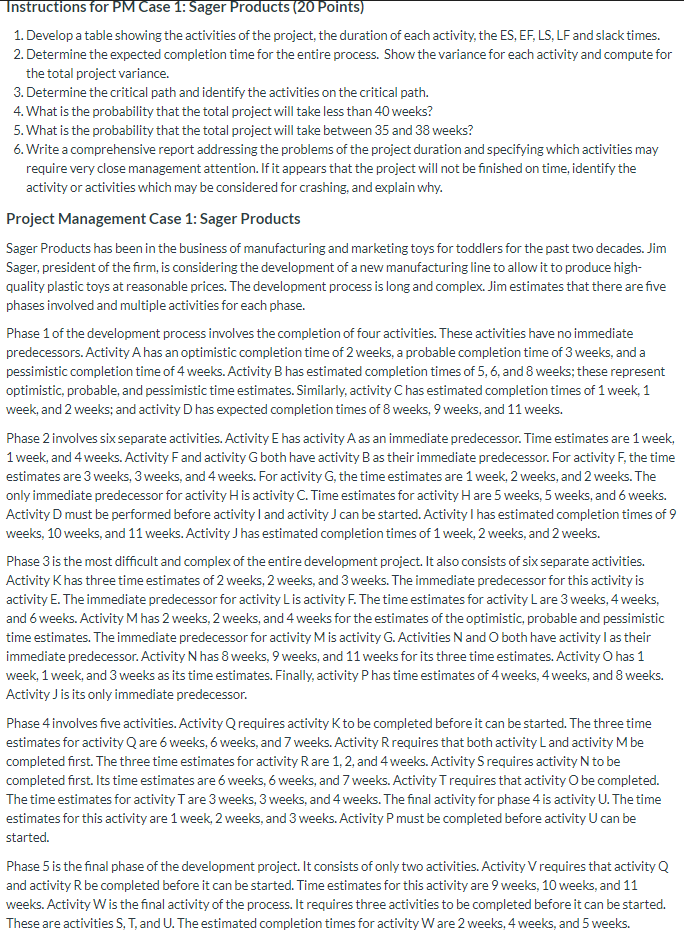
Instructions for PM Case 1: Sager Products (20 Points) 1. Develop a table showing the activities of the project, the duration of each activity, the ES, EF, LS, LF and slack times. 2. Determine the expected completion time for the entire process. Show the variance for each activity and compute for the total project variance. 3. Determine the critical path and identify the activities on the critical path. 4. What is the probability that the total project will take less than 40 weeks? 5. What is the probability that the total project will take between 35 and 38 weeks? 6. Write a comprehensive report addressing the problems of the project duration and specifying which activities may require very close management attention. If it appears that the project will not be finished on time, identify the activity or activities which may be considered for crashing, and explain why. Project Management Case 1: Sager Products Sager Products has been in the business of manufacturing and marketing toys for toddlers for the past two decades. Jim Sager, president of the firm, is considering the development of a new manufacturing line to allow it to produce high- quality plastic toys at reasonable prices. The development process is long and complex. Jim estimates that there are five phases involved and multiple activities for each phase. Phase 1 of the development process involves the completion of four activities. These activities have no immediate predecessors. Activity A has an optimistic completion time of 2 weeks, a probable completion time of 3 weeks, and a pessimistic completion time of 4 weeks. Activity B has estimated completion times of 5, 6, and 8 weeks; these represent optimistic, probable, and pessimistic time estimates. Similarly, activity C has estimated completion times of 1 week, 1 week, and 2 weeks; and activity Dhas expected completion times of 8 weeks, 9 weeks, and 11 weeks. Phase 2 involves six separate activities. Activity E has activity A as an immediate predecessor. Time estimates are 1 week, 1 week, and 4 weeks. Activity Fand activity G both have activity B as their immediate predecessor. For activity F, the time estimates are 3 weeks, 3 weeks, and 4 weeks. For activity G, the time estimates are 1 week, 2 weeks, and 2 weeks. The only immediate predecessor for activity His activity C. Time estimates for activity Hare 5 weeks, 5 weeks, and 6 weeks. Activity D must be performed before activity I and activity J can be started. Activity I has estimated completion times of 9 weeks, 10 weeks, and 11 weeks. Activity J has estimated completion times of 1 week, 2 weeks, and 2 weeks. Phase 3 is the most difficult and complex of the entire development project. It also consists of six separate activities. Activity Khas three time estimates of 2 weeks, 2 weeks, and 3 weeks. The immediate predecessor for this activity is activity E. The immediate predecessor for activity Lis activity F. The time estimates for activity Lare 3 weeks, 4 weeks. and 6 weeks. Activity Mhas 2 weeks, 2 weeks, and 4 weeks for the estimates of the optimistic, probable and pessimistic time estimates. The immediate predecessor for activity Mis activity G. Activities N and O both have activity I as their immediate predecessor. Activity N has 8 weeks, 9 weeks, and 11 weeks for its three time estimates. Activity O has 1 week, 1 week, and 3 weeks as its time estimates. Finally, activity Phas time estimates of 4 weeks, 4 weeks, and 8 weeks. Activity J is its only immediate predecessor. Phase 4 involves five activities. Activity Qrequires activity K to be completed before it can be started. The three time estimates for activity Q are 6 weeks, 6 weeks, and 7 weeks. Activity R requires that both activity Land activity Mbe completed first. The three time estimates for activity Rare 1, 2, and 4 weeks. Activity Srequires activity N to be completed first. Its time estimates are 6 weeks, 6 weeks, and 7 weeks. Activity Trequires that activity O be completed. The time estimates for activity T are 3 weeks, 3 weeks, and 4 weeks. The final activity for phase 4 is activity U. The time estimates for this activity are 1 week, 2 weeks, and 3 weeks. Activity P must be completed before activity U can be started. Phase 5 is the final phase of the development project. It consists of only two activities. Activity requires that activity Q and activity R be completed before it can be started. Time estimates for this activity are 9 weeks, 10 weeks, and 11 weeks. Activity Wis the final activity of the process. It requires three activities to be completed before it can be started. These are activities S, T, and U. The estimated completion times for activity Ware 2 weeks, 4 weeks, and 5 weeks. Instructions for PM Case 1: Sager Products (20 Points) 1. Develop a table showing the activities of the project, the duration of each activity, the ES, EF, LS, LF and slack times. 2. Determine the expected completion time for the entire process. Show the variance for each activity and compute for the total project variance. 3. Determine the critical path and identify the activities on the critical path. 4. What is the probability that the total project will take less than 40 weeks? 5. What is the probability that the total project will take between 35 and 38 weeks? 6. Write a comprehensive report addressing the problems of the project duration and specifying which activities may require very close management attention. If it appears that the project will not be finished on time, identify the activity or activities which may be considered for crashing, and explain why. Project Management Case 1: Sager Products Sager Products has been in the business of manufacturing and marketing toys for toddlers for the past two decades. Jim Sager, president of the firm, is considering the development of a new manufacturing line to allow it to produce high- quality plastic toys at reasonable prices. The development process is long and complex. Jim estimates that there are five phases involved and multiple activities for each phase. Phase 1 of the development process involves the completion of four activities. These activities have no immediate predecessors. Activity A has an optimistic completion time of 2 weeks, a probable completion time of 3 weeks, and a pessimistic completion time of 4 weeks. Activity B has estimated completion times of 5, 6, and 8 weeks; these represent optimistic, probable, and pessimistic time estimates. Similarly, activity C has estimated completion times of 1 week, 1 week, and 2 weeks; and activity Dhas expected completion times of 8 weeks, 9 weeks, and 11 weeks. Phase 2 involves six separate activities. Activity E has activity A as an immediate predecessor. Time estimates are 1 week, 1 week, and 4 weeks. Activity Fand activity G both have activity B as their immediate predecessor. For activity F, the time estimates are 3 weeks, 3 weeks, and 4 weeks. For activity G, the time estimates are 1 week, 2 weeks, and 2 weeks. The only immediate predecessor for activity His activity C. Time estimates for activity Hare 5 weeks, 5 weeks, and 6 weeks. Activity D must be performed before activity I and activity J can be started. Activity I has estimated completion times of 9 weeks, 10 weeks, and 11 weeks. Activity J has estimated completion times of 1 week, 2 weeks, and 2 weeks. Phase 3 is the most difficult and complex of the entire development project. It also consists of six separate activities. Activity Khas three time estimates of 2 weeks, 2 weeks, and 3 weeks. The immediate predecessor for this activity is activity E. The immediate predecessor for activity Lis activity F. The time estimates for activity Lare 3 weeks, 4 weeks. and 6 weeks. Activity Mhas 2 weeks, 2 weeks, and 4 weeks for the estimates of the optimistic, probable and pessimistic time estimates. The immediate predecessor for activity Mis activity G. Activities N and O both have activity I as their immediate predecessor. Activity N has 8 weeks, 9 weeks, and 11 weeks for its three time estimates. Activity O has 1 week, 1 week, and 3 weeks as its time estimates. Finally, activity Phas time estimates of 4 weeks, 4 weeks, and 8 weeks. Activity J is its only immediate predecessor. Phase 4 involves five activities. Activity Qrequires activity K to be completed before it can be started. The three time estimates for activity Q are 6 weeks, 6 weeks, and 7 weeks. Activity R requires that both activity Land activity Mbe completed first. The three time estimates for activity Rare 1, 2, and 4 weeks. Activity Srequires activity N to be completed first. Its time estimates are 6 weeks, 6 weeks, and 7 weeks. Activity Trequires that activity O be completed. The time estimates for activity T are 3 weeks, 3 weeks, and 4 weeks. The final activity for phase 4 is activity U. The time estimates for this activity are 1 week, 2 weeks, and 3 weeks. Activity P must be completed before activity U can be started. Phase 5 is the final phase of the development project. It consists of only two activities. Activity requires that activity Q and activity R be completed before it can be started. Time estimates for this activity are 9 weeks, 10 weeks, and 11 weeks. Activity Wis the final activity of the process. It requires three activities to be completed before it can be started. These are activities S, T, and U. The estimated completion times for activity Ware 2 weeks, 4 weeks, and 5 weeks









 Study Help