







Question: INSTRUCTIONS: In this assignment, you are given a scenario, and you will need to develop a mathematical model and then solve the model using either
INSTRUCTIONS:
In this assignment, you are given a scenario, and you will need to develop a mathematical model and then solve the model using either Excel Solver or Pyomo to find an optimal solution. Instructions: Read the case study and the instructions carefully. Answer each question one by one. When you develop a mathematical model, clearly define the decision variables, the objective function, and the constraints. Solve the model using either Excel Solver . If you choose to use Excel Solver, make sure to submit your excel file Since this is a group assignment, one submission from each group is sufficient. You will submit two files: o A Word file with the mathematical formulations and solutions of the problems. If the question asks you to provide insights about your result, clearly provide your insight on the word file. An Excel file file for solving the mathematical models. You are expected to type the mathematical formulations of each question using the Equation editor (under the Insert Menu). Also, solve each question in a separate spreadsheet in the excel file. Name the spreadsheets as Part b, Part d, etc. Name the files you are submitting with your name. For example, if I submit an excel file, I should name it "Eyyub_Kibis_Assignment.xlsx" and If I submit an MS word file, the file name should read " Eyyub_Kibis_Assignment.docx". Indicate the questions and your answers in the files properly so that I know which question your specific answer corresponds to.
CASE ASSIGNING STUDENTS TO SCHOOLS The Clifton school board has decided to shut down one of its middle schools that caters to students in sixth, seventh, and eighth grades, and relocate these students to the remaining three middle schools from the next academic year. The school district offers transportation facilities to all middle school students who need to travel more than a mile to reach their school. Therefore, the school board wants to create a plan for the reassignment of students that will minimize the overall transportation cost. The given table shows the annual cost per student of transportation from each of the six residential areas of the city to each of the schools. The table also includes other essential information for the next academic year. A cost of 0 indicates that transportation is not required, and a dash indicates an infeasible assignment.
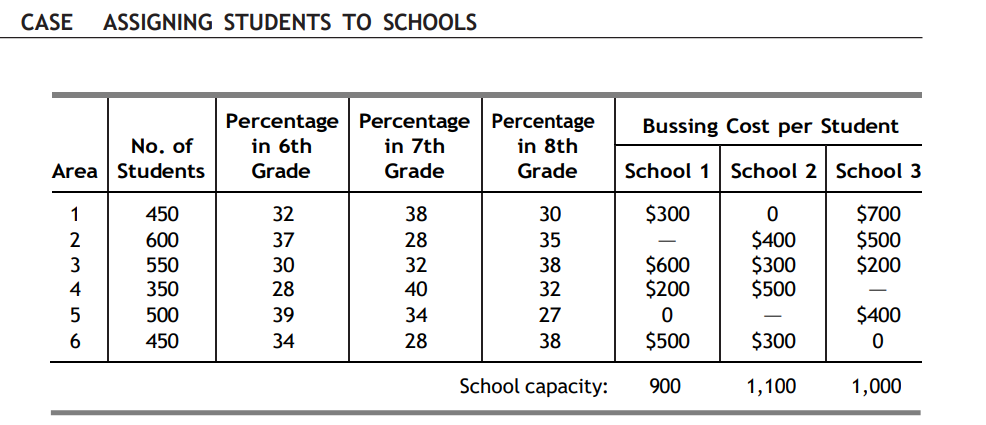
The school board also has imposed the restriction that each grade must constitute between 30 and 36 percent of each schools population. The above table shows the percentage of each areas middle school population for next year that falls into each of the three grades. The school attendance zone boundaries can be drawn so as to split any given area among more than one school, but assume that the percentages shown in the table will continue to hold for any partial assignment of an area to a school. You have been hired as an operations research consultant to assist the school board in determining how many students in each area should be assigned to each school. (a) Formulate a linear programming model for this problem. (b) Solve the model. (c) What is your resulting recommendation to the school board? After seeing your recommendation, the school board expresses concern about all the splitting of residential areas among multiple schools. They indicate that they would like to keep each neighborhood together. (d) Adjust your recommendation as well as you can to enable each area to be assigned to just one school. (Adding this restriction may force you to fudge on some other constraints.) How much does this increase the total bussing cost? The school board is considering eliminating some bussing to reduce costs. Option 1 is to eliminate bussing only for students traveling 1 to 1.5 miles, where the cost per student is given in the table as $200. Option 2 is to also eliminate bussing for students traveling 1.5 to 2 miles, where the estimated cost per student is $300. (e) Revise the model from part (a) to fit Option 1, and solve. Compare these results with those from part (c), including the reduction in total bussing cost. (f) Repeat part (e) for Option 2. The school board now needs to choose among the three alternative bussing plans (the current one or Option 1 or Option 2). One important factor is bussing costs. However, the school board also wants to place equal weight on a second factor: the inconvenience and safety problems caused by forcing students to travel by foot or bicycle a substantial distance (more than a mile, and especially more than 1.5 miles). Therefore, they want to choose a plan that provides the best trade-off between these two factors. (g) Use your results from parts (c), (e), and ( f ) to summarize the key information related to these two factors that the school board needs to make this decision. (h) Which decision do you think should be made? Why? (i) The Clifton School Board now has made the decision to prohibit the splitting of residential areas among multiple schools. Thus, each of the six areas must be assigned to a single school. i.1) Formulate a BIP model for this problem under the current policy of providing bussing for all middle school students who must travel more than approximately a mile. i.2) Solve the BIP model formulated in part i.1. i.3) Referring to part (c), determine how much the total bussing cost increases because of the decision to prohibit the splitting of residential areas among multiple schools
Note: Only solve the question : D,E,F,G. Properly do not provide any random or ChatGPT answers.
CASE ASSIGNING STUDENTS TO SCHOOLS
Step by Step Solution
There are 3 Steps involved in it

Get step-by-step solutions from verified subject matter experts
 Study Help