







Question: Instructions: Manipulate numbers in the Settings window as needed to answer the following questions. You may find it helpful to click combined above the
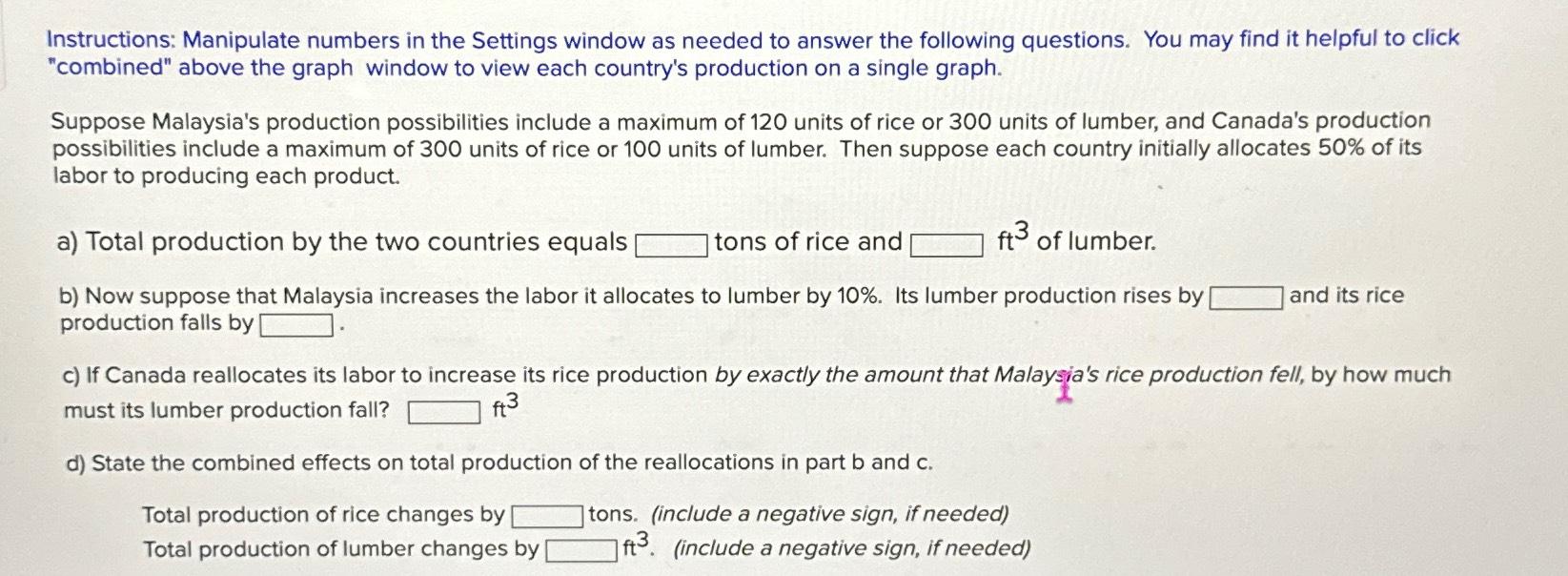
Instructions: Manipulate numbers in the Settings window as needed to answer the following questions. You may find it helpful to click "combined" above the graph window to view each country's production on a single graph. Suppose Malaysia's production possibilities include a maximum of 120 units of rice or 300 units of lumber, and Canada's production possibilities include a maximum of 300 units of rice or 100 units of lumber. Then suppose each country initially allocates 50% of its labor to producing each product. a) Total production by the two countries equals | tons of rice and ft of lumber. b) Now suppose that Malaysia increases the labor it allocates to lumber by 10%. Its lumber production rises by production falls by and its rice c) If Canada reallocates its labor to increase its rice production by exactly the amount that Malaysia's rice production fell, by how much must its lumber production fall? ft3 d) State the combined effects on total production of the reallocations in part b and c. Total production of rice changes by [ Total production of lumber changes by tons. (include a negative sign, if needed) ft3. (include a negative sign, if needed)
Step by Step Solution
There are 3 Steps involved in it

Get step-by-step solutions from verified subject matter experts
 Study Help