







Question: INSTRUCTIONS: - Please answer this AS FAST AS POSSIBLE. - I only have 60 minutes to answer this question. - Please do not plagiarize, write
INSTRUCTIONS:
- Please answer this AS FAST AS POSSIBLE.
- I only have 60 minutes to answer this question.
- Please do not plagiarize, write your own words.
- Your answer will definitely be rated, thanks in advance!
Reading:
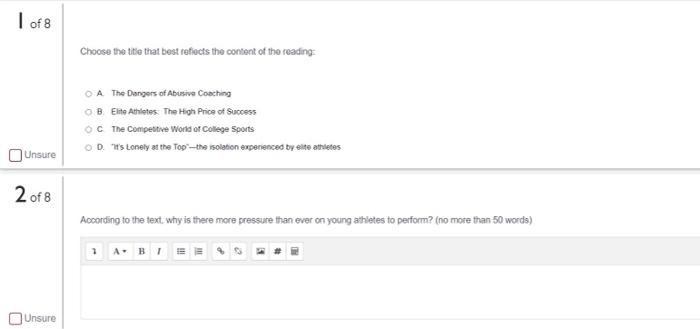
Read the text below. Then answer the comprehension questions on the next page. Do not include unnecessary ideas in your answers.
Number 1 In the pursuit of excellence, sport is demanding more and more from its elite performers. Universities and colleges are now looking at recruiting ever-younger players, and in order to obtain valuable university scholarships, parents and athletes want to maximize success at a younger age. Extreme performance demands are now being placed on elite child athletes (816 years of age), and in the constant struggle for success these athletes are training longer and harder (Donnelly, 1997). As a consequence, elite child athletes are spending significantly more time with their coaches. The relationship between them could be the most significant relationship that a child has with an adult. Indeed, athletes may even perceive the coach to be more important than their parents (MacAuley, 1996). As children work their way up the sporting ranks, the relationship with the coach becomes even more significant since the coach has the power to decide the path of their athletic careers. The coach also has a personal investment in the athlete, which may directly relate to his or her own career advancement (Gervis and Brierely, 1999).
Number 2 In order to appreciate the role of the coach in the production of world-class performances, there is a need to understand what it takes to achieve excellence in sport. Training is often long, boring and repetitive. It is physically and psychologically demanding, requiring athletes to push themselves to extreme limits. The sport dominates their lives and often socially isolates them. If an elite child athlete trains 6 days a week for several hours a day, there is very little time left for anything else except school, sleeping and eating. Athletes often travel abroad to compete and can spend even more time with their coaches than with their parents. The coach is, therefore, in a position of considerable influence, which makes the elite child athlete very vulnerable if this is misused, and the nature of this relationship needs to be carefully examined.
Number 3 In a study of twelve former elite child athletes in various disciplines, all reported some form of emotional abuse as a direct consequence of their coachs behaviour. Many of the athletes reported having lasting emotional and psychological problems.
Number 4 The elite child athlete has to cope with pressures of training, long hours, and competing at the highest level in a climate of sustained attacks on their self-esteem at a time when they are most vulnerable. Participants reported that coaches were abusing their position of power, and that they felt damaged by their coaches actions. However, this behaviour goes on without being challenged or questioned so long as the athlete is successful. Thus, abusive actions can actually become coaching tools, and this creates a culture of coaching which reinforces behaviours that are associated with success.
Number 5 Despite the fact that there is now a greater awareness of the incidence of sexual and physical abuse, sports coaching is still largely unregulated. Although national governing bodies of sport are responding through the introduction of child protection documents and courses, people continue to work closely with children without any, or with only limited, formal training. Sport has still not fully addressed the quality assurance of coaches, which leaves child athletes potentially exposed and vulnerable to abuse. Sport largely operates outside organizations controlled by laws, and therefore national frameworks, guidelines, and rules that guide other organizations working with children are largely ignored. Children who participate in sport would not in normal circumstances be considered at risk, so we need a shift in our view of child athletes and their relationship with their coaches. Also, parents need to learn how they can support their children in positive ways in managing this difficult relationship.
QUESTION:

Step by Step Solution
There are 3 Steps involved in it

Get step-by-step solutions from verified subject matter experts
 Study Help