



Question: Instructions: Please read the following business case, create a capital budgeting model (or use my provided model), and answer the five case questions. The first
Instructions: Please read the following business case, create a capital budgeting model (or use my provided model), and answer the five case questions. The first four can be shown within the model, just label these items. The final question is qualitative, just add a text box into your excel near your NPV/IRR calculations and type in your response. Finally, there are 5 extra credit questions. Depending on the accuracy and amount of effort put into these questions, I will award you extra points.
Executive Summary: The Hydro Company, HC, recently discovered a unique and very large aquifer in Florida that contains naturally pure water via a well it drilled in 2022. The aquifer is home to a natural alkaline water (pH 8.3) containing amounts of calcium, magnesium, potassium, silica, and sodium ideal for human consumption with no undesired qualities or contaminants. The water is sourced from over 5,000 feet below the surface and has never been impacted by human activity, as the source has been sealed deep underground for over 400 million years. Florida state hydrologists have performed multiple studies to assess the scale of the aquifer, labeling it as a new source of water and expecting the aquifer to produce billions of gallons. The geologists also determined this to be the deepest source of artesian water in the country, and possibly the world. HC has hired you as a financial consultant to evaluate the feasibility and profitability of this business opportunity.
Capital Expenditures: HC is evaluating whether to commercialize the aquifer by building a bottling facility near the well. This facility would allow the company to clean and bottle the water, label the bottles, prepare bottles into shippable cases, and ship bottles out of the facility. The company already owns 100 acres of land surrounding the well and believes the cost of building a bottling facility would require capital expenditures and net working capital totaling $56 million. The primary fixed assets, forecasted to cost $52 million, would be a 120,000 sq. ft facility and all the equipment necessary to get the plant operational. In addition to the equipment, HC estimates they would also require a $4 million infusion of net working capital.
Product Segments: HC would have two distinct business segments: private label manufacturing and branded bottled water under the companys brand, Hydro Homies. Private label manufacturing allows retailers, vendors, and other brands to sell a product under their own name. This way, large brands dont have to own manufacturing facilities, rather they can just purchase bottled water, juice, or even food from a private label manufacturer and slap their name on it. For example, Kroger, the American supermarket company sells bottled Kroger water in their stores. This water is actually sourced from a private label manufacturer, Niagara Water, who has bottling facilities all over the U.S. The companys second segment is their personal water bottle brand, Hydro Homies. These bottles would be marketed and sold to individuals all over the U.S. found in gas stations, convenience stores, supermarkets, and online retailers.
Market: The bottled water market is highly competitive, with many brands competing for market share. Consumers are becoming increasingly concerned about the quality and safety of the water they drink. Many bottled water brands are sourced from surface water, which contain contaminants such as tritium, PFOs/PFAs, and microplastics. These brands commonly treat and clean their water through a process called reverse osmosis, which removes beneficial minerals from the water and making it less healthy to drink. Reverse osmosis is popular with familiar brands like Essentia, Dasani, and Aquafina (which are all tap water!). Since HCs aquifer hasnt been exposed to the surface, the only treatment needed is an ultra-violet and ozonation process, deeming the water to be natural and healthy rather than overprocessed. This works well for HCs value proposition as consumers are looking for a natural, healthy, and pure source of water.
Pricing: Given the high quality and healthy attributes of the water, HC believes their customers will pay a premium for Hydro Homies and plans on pricing each bottle at $3.00 per unit. As for private label manufacturing, because bottles will be sold in bulk, each unit will be sold at $2.00. To keep up with inflation, the company plans on increasing the price per unit of each segment by 2% per year.
Production: HC believes once the bottling facility is up and running, they will be able to produce 5.25 million bottles per year at full capacity. 60% of these bottles will be allocated to private label manufacturing and the remaining 40% will be for Hydro Homies. Given it will take management some time to understand how to become fully efficient, HC believes it will take 2 years until they realize full capacity production. For the first year, HC projects 50% utilization, 75% for the second year, and 100% for the following 8 years. Fixed costs are projected to be 35% of total revenue and variable costs at 20% of total revenue for the first two years. After HC understands how to efficiently run the plant at 100% capacity, assume variable costs will be 15% of total revenue for years 3 through 10.
Other assumptions: HC will depreciate fixed assets based on a 10-year MACRS schedule and assume the project will last 10 years. At the end of the project, HC forecasts a market sale of all fixed assets at $20 million. In addition, the firm expects a 21% marginal tax rate.
Financing: Lastly, assume that HC will raise all of the capital to finance this project using a blend of debt and equity, and intends to use a capital structure based on the following existing outstanding sources. As a result, you base your cost of capital assumptions on the following:
The firm currently has 220,000 bonds outstanding with the following terms: o Remaining maturity = 15 years o Coupon rate = 5.40% (paid semiannually) o Price = $990 o Par = $1000
The firm currently has 8,000,000 common shares outstanding with the following price and market terms: o Price = $54 o Beta = 1.15 o Risk-free Rate = 1% o Expected return of the market = 8%
The firm currently has 500,000 preferred stock outstanding with the following price and terms: o Price = $72 o Par = $100 o Dividend yield = 4% (paid annually)
Case Questions
1. What is the initial cash outflow (CF0)?
2. What are the operating cash flows in years 1 through 10 - adjusted for taxes and depreciation?
3. What are the terminal-year cash flows added to the operating cash flow in year 10accommodating the return of NWC as well as Net Salvage Value?
4. What is the WACC?
5. Given your results for CF0 through CF10, would you have recommended that HC take on building the bottling facility with its specific projections? Compute and explain the significance of the NPV & IRR to support your answer.
Extra Credit Questions
1. What assumptions are you making within the capital budgeting model? If those assumptions would change, how would it affect the investment decision?
2. Based on the current capital structure, what is the debt-equity ratio of the firm? Find a public firm that is like HC and calculate their debt-equity ratio. Are their capital structures the same as HC? Why or why not?
3. If HC decided to issue only debt to raise the capital necessary for this project, how would that affect WACC? How would it affect the overall profitability, investment evaluation, and risk profile of the firm?
4. If the U.S. economy was in an environment where interest rates were increasing, how would this affect WACC and what recommendations would you provide the business?
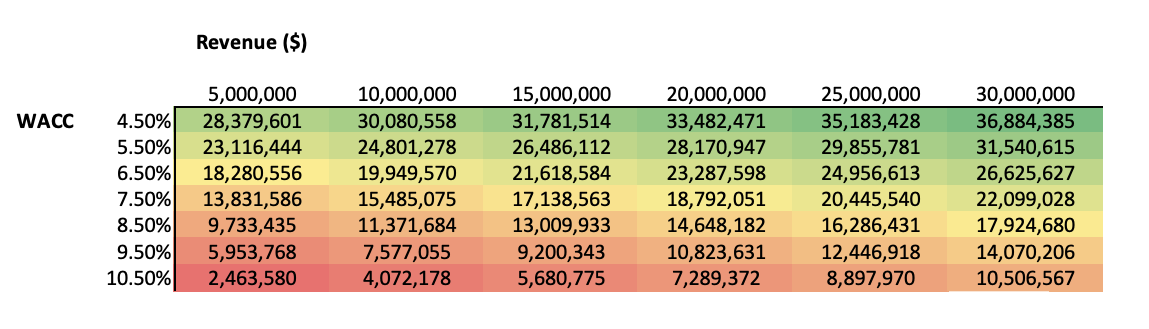
5. When creating cash flow models, it is common to supplement the analysis with a sensitivity table. Below is a sensitivity table that shows how NPV changes when changing the two variables: WACC and revenue. What insights can you draw from this table and how does it affect your investment decision?
Revenue (\$)
Step by Step Solution
There are 3 Steps involved in it

Get step-by-step solutions from verified subject matter experts